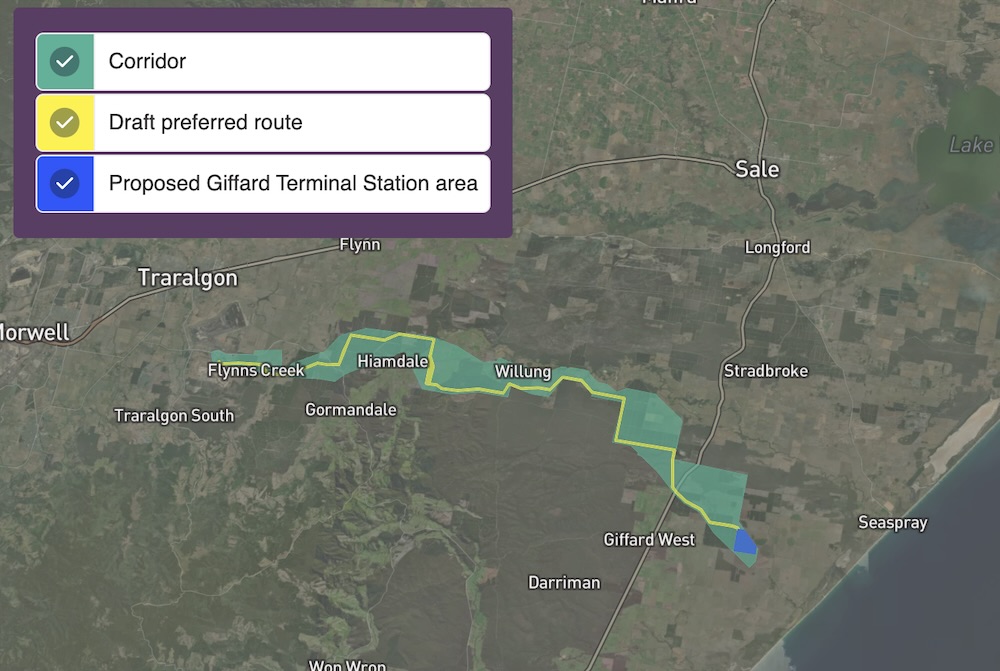
VicGrid has set out the preferred route for the transmission line and onshore grid connection hub that will deliver energy generated by Australia’s first offshore wind farms, off the coast of Victoria, to the state’s former coal centre in the Latrobe Valley.
VicGrid, which earlier this week officially assumed the role of planning Victoria’s electricity transmission network, says the draft preferred route runs from near Giffard, northwest past Stradbroke, west to Willung, across to Flynns Creek and into the Loy Yang Power Station.
The newly proposed corridor – narrowed down and refined from the broader study area released last year – reduces impacted privately owned land parcels from 56 to 24 and minimises impacts to important environmental areas, VicGrid said on Friday in a statement.
It has also sought to avoid homes and to co-locate near existing infrastructure where possible.
VicGrid CEO Alistair Parker says that while the corridor put forward on Friday is not final, it provides a focus for more detailed technical investigations and consultation.
“We’ve had really valuable input from locals about their properties, their farming practices and sensitive areas to avoid,” Parker said on Friday.
“On a project like this, local insights play a crucial role in narrowing down the areas that are more suitable to host infrastructure and helping us minimise the impacts on local properties, farming operations and the environment.”
The increasingly pressing need to upgrade Victoria’s transmission network to support the state’s transition to renewables has not been an easy sell to the communities expected to host huge new poles and wires, easements and substations.
VicGrid’s assumption of the role of managing the state’s transmission plans has in no small part been about re-building the bridge with communities that had well and truly crumbled under clumsy early-stage consulting on plans for major new links like VNI West.
But it’s a tough sell. As Vanessa Osborn, VicGrid’s director of land, planning and environment told the All Energy Australia conference on Thursday, there are not many landowners who will welcome massive transmission towers with open arms.
“It’s fair to say nobody wants transmission on their property,” Osborn told the conference. “When you live in agricultural areas, you don’t live there to have infrastructure on the property.
“I guess what we’re trying to do is really educate people … make sure that they understand why the project is needed and also make sure that they’re fairly compensated and also treated with the trust and respect.”
Parker says that over the coming months, VicGrid will keep refining the draft preferred route in consultation with landholders and technical experts with an intent to finalise it in early 2026.
“Our team will be reaching out to landholders in the corridor so we can better understand important values on their properties and help refine the route for this infrastructure,” he said.
“On a project like this, local insights play a crucial role in narrowing down the areas that are more suitable to host infrastructure and helping us minimise the impacts on local properties, farming operations and the environment.”
Interested parties can find more details about the corridor and draft preferred route as well as details of next steps on the Engage Victoria website.
If you would like to join more than 26,600 others and get the latest clean energy news delivered straight to your inbox, for free, please click here to subscribe to our free daily newsletter.
Electrification and Australia's boom in big batteries have helped to push out forecast gas shortfalls…
Nine batteries totalling nine gigawatts shortlisted to provide heartbeat of the grid in major turning…
The lesson from Hormuz is not that Australia needs a new panic plan for the…
Offshore wind developer kicks off four months of geophysical surveys for its 1.3 gigawatt project…
Senate inquiry wants more funding for climate research and digital literacy to address scare campaigns,…
Giant aluminium smelter will be among first in world to be powered by wind and…