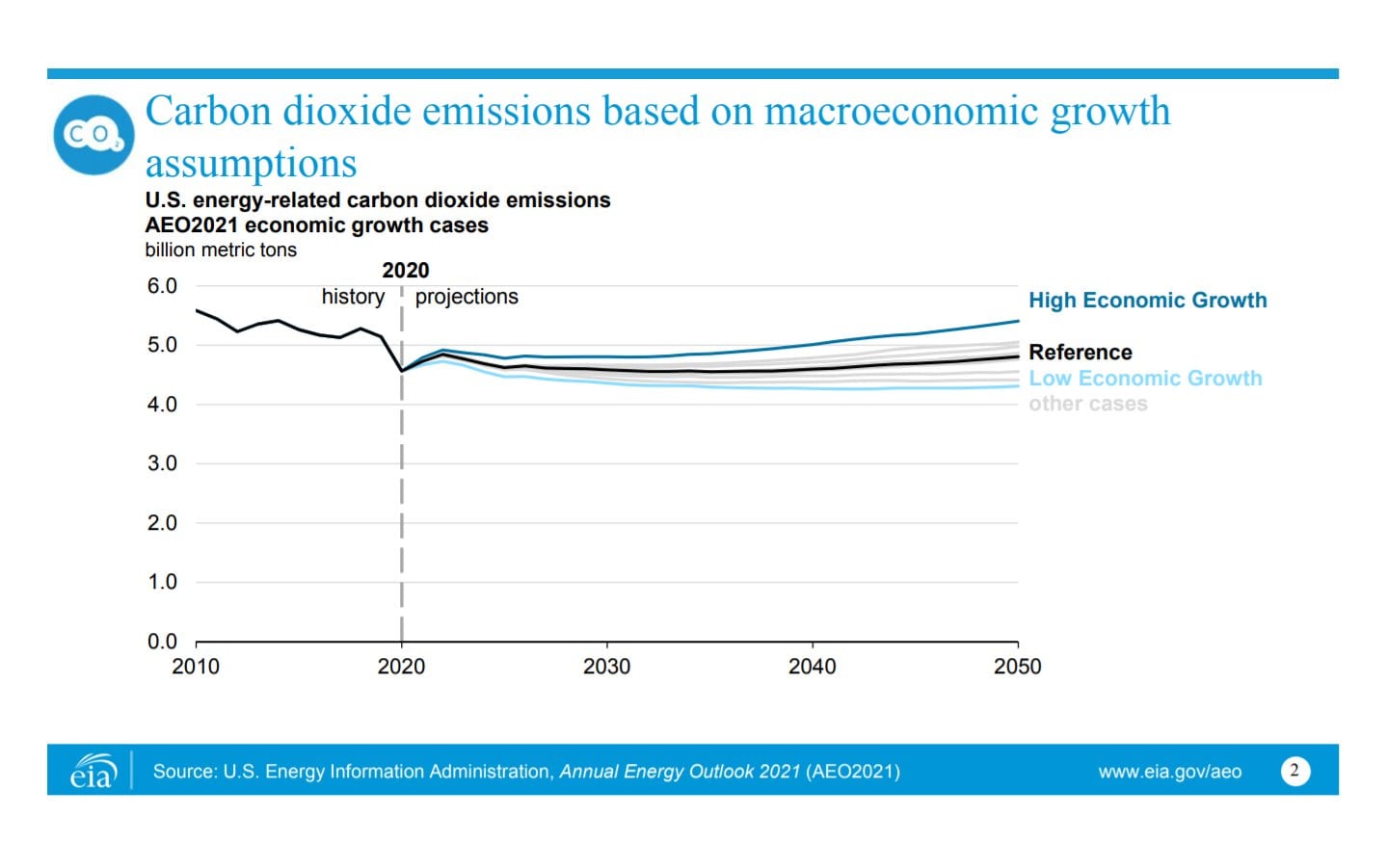
An update of the American Energy Information Agency (EIA)’s Annual Energy Outlook has found that the share of renewable energy in the country’s energy mix will more than double by 2050, while controversially predicting flat trends for both coal and gas despite the incoming Biden administration’s plan for widespread and rapid grid decarbonisation.
The report factors in the impacts of Covid-19, finding that a return to 2019 levels of consumption will take several years, but that those projections rely heavily on hard-to-predict variations in economic growth. However, it predicts a longer-term trend of renewable energy comprising nearly 60% of capacity additions from 2020 to 2050, resulting in a rising trend for renewable energy as fossil fuels remain static. The cost of fossil gas heavily influences the deployment of renewable energy in the EIA’s various scenarios:
The EIA’s optimistic forecasts for fossil fuels has already come under scrutiny; the agency has historically over-forecast the output of coal in particular and it seems likely that this trend will continue. In fact, a release only a week ago predicts that the proportion of new capacity will be mostly from renewable energy, at an amount far greater than predicted in this report.
The organisation has consistently under-forecast solar growth, too. US energy expert Ramez Naan wrote, in 2020:
“In 2010, the EIA believed that solar would have a learning rate of 15% for three doublings of scale, which would then decline to 8%. In 2015, EIA believed that solar’s learning rate was now 10%.
“In 2020, facing the the long history of price declines, EIA raised its assessment: Solar would drop 20% in price in the next doubling, and then the learning rate would drop to 10% forever more. Clearly, all of these numbers are well below the 30-40% learning rate observed over this decade.”
The model used by the EIA doesn’t incorporate proposed or even likely policy changes, and assumes that coal retirements cease entirely after 2025; something heavily criticised by energy industry experts.
The newly elected Biden administration intends to target a zero-emissions grid by 2035, which would entail the retirement of all coal-fired power stations and the vast majority of fossil gas power stations, save for those that can be retrofitted with carbon capture. The government also has a net-zero by 2050 target and is likely to submit an updated 2030 NDC in coming months.
This contrasts with the EIA’s economy-wide emissions forecasts, which predict the country will remain at current emissions levels.
Policy review will investigate settings for Australia's 2030 and 2035 emissions reduction targets.
Kane Thornton has moved from the peak renewables body to data centres, now the presumed…
Australia's government-run "carbon neutral" certification scheme is being wound up. It is good news for…
Victoria's newly appointed energy minister says the state will go ahead as planned with Australia's…
A promise of banning gas while waving through “gas firming” and “gas peaking” with unlimited offsets leaves…
Plans for a potentially massive new wind farm start federal environmental assessment, proposing up to…