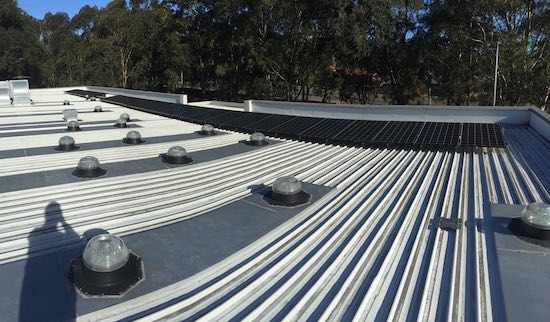
The new solar system, which is being installed over the course of 2018, is expected to generate around 2.8 million kWh a year, and cut the University’s greenhouse gas emissions by 2800 tonnes CO2-equivalent compared with conventional grid-sourced electricity.
It follows a 2016 feasibility report, which found that the Hunter Valley-based campus could reach 100 per cent renewables by 2020 by installing up to 12MW of rooftop and ground-mounted solar PV and 5MWh of battery storage.
The feasibility study – conducted by the Tom Farrell Institute (the UON’s environmental research and teaching hub, based at Callaghan) with CLEANaS – determined that this would be both technically feasible and financially beneficial for the UON.
“With a healthy return on investment of approximately 8 per cent, finance for this cost-neutral project has a payback time of around 10 years,” a report on the Tom Farrell Institute website says.
The solar and storage would supply up to 85 per cent of the university’s daytime electricity needs, with the possibility of feeding excess energy into the grid, or storing it for when the sun goes down. Remaining demand will be met through energy efficiency, or buying green power.
Whether these plans are realised remains to be seen, but in the meantime, the UON said it would use the new Callaghan solar system as a “living laboratory for sustainable futures” – offering added value to students and inspiration to come up with new ideas and innovations.
More broadly, the UON has overarching target to deliver a 20 per cent reduction on CO2 emissions per meter square of gross floor area by 2020, from a 2007 baseline.
In 2017, it installed a 75 kilowatt system on its library building at its Ourimbah campus – and it is also expanding that system this year. Elsewhere it has 80kW of PV installed at Port Macquarie, Tamworth and Taree. These systems are estimated to generate approximately 120,000 kWh of clean electricity per annum and avoid 100 tonnes of carbon emissions a year.
And it is not the only tertiary institution making the shift to renewables. In Victoria, the University of Melbourne has been rolling out 1.8MW solar at its Carlton campus; while Monash University last year set off on its path to 100 per cent renewables, via an innovative solar and battery storage-based renewable energy microgrid.
In New South Wales, the Charles Sturt University signed up to have 1.7MW of PV installed across 11 buildings at its Wagga Wagga campus; and in 2016, the University of New England announced plans to source up to half of its electricity from solar, through the installation of a PV farm on land adjacent to its Armidale campus.
Also in 2016, the University of Southern Queensland announced plans to add 1.9MW of rooftop solar and battery storage across its Toowoomba, Springfield and Ipswich campuses.
And not everyone is building their own renewable capacity. The University of New South Wales, though an unusual “tripartite” agreement, will buy up to 124,000MWh of renewable energy a year, for 15 years, from Maoneng’s 200MW Sunraysia Solar Farm located near Balranald in south western NSW, meeting the University’s annual energy requirement, starting in 2019.
This article was originally published on RenewEconomy’s sister site, One Step Off The Grid, which focuses on customer experience with distributed generation. To sign up to One Step’s free weekly newsletter, please click here.
The New South Wales Coalition Opposition's energy and climate change spokesperson, has announced his retirement…
NSW is looking at tariff reform to encourage big gas users to switch to heat…
Transgrid might be able to claw back some of the more than $1 billion in…
A groundbreaking compressed air energy storage project that promises to provide up to eight hours…
Nelson Zheng from Pylon on why the battery rebate has been kinder to some businesses…
Australia's carbon credit scheme is working, according to a review, but some of the nation's…