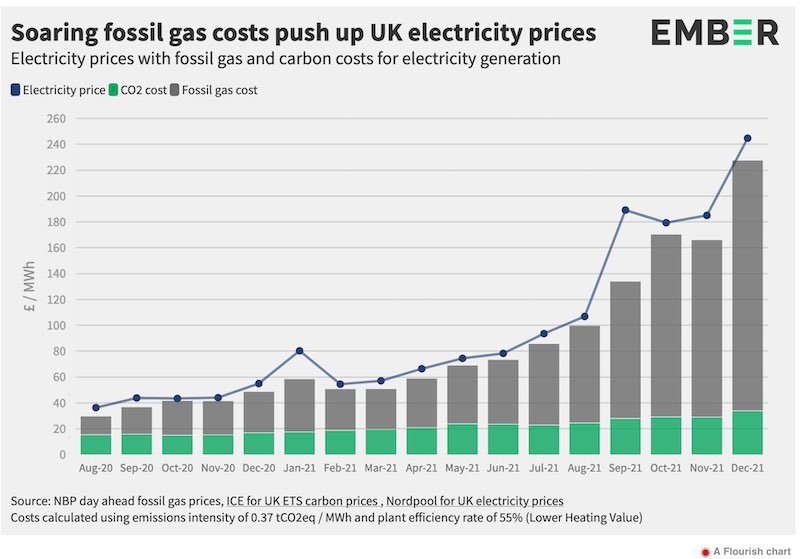
New analysis by energy think tank Ember reveals that the skyrocketing price of fossil gas was responsible for 85% of the increase in UK wholesale electricity prices in 2021. In just one year, wholesale electricity prices quadrupled and it became almost five times more expensive to generate electricity from gas plants.
“Gas is the villain. Not the green investments that can end the UK’s dependence on this costly and polluting fossil fuel,” said Ember COO Phil MacDonald.
Monthly average UK wholesale electricity prices jumped by almost £190/MWh in 2021 – from £55/MWh (December 2020) to £245/MWh (December 2021). The cost of fossil gas was responsible for £162/MWh (85%) of this spike.
The UK remains heavily reliant on fossil gas for its electricity. In 2021, the UK generated 40% of its electricity from fossil gas plants. From December 2020 to December 2021, the cost of generating electricity from a combined cycle gas power plant (CCGT) surged from £48/MWh to £227/MWh (+£179/MWh).[1] The carbon price only accounted for £17/MWh (10%) of the increased cost of generating electricity from CCGTs.
Skyrocketing wholesale electricity prices will soon hit consumers directly. The cap on UK energy bills is set for an unprecedented increase in April 2022, likely pushing millions more into energy poverty. Despite claims by a small group of Conservative MPs in the ‘Net Zero Scrutiny Group’, the energy crisis has almost nothing to do with green subsidies. The principal reason is the skyrocketing price of fossil gas. Previously Ember forecasted that the gas price spike will add £29 billion to UK electricity bills in 2022.
“The UK energy crisis is a fossil fuel crisis. The more wind turbines and solar panels the UK can build, the less the country will be hostage to the volatile global gas price,” said MacDonald.
“Every new wind and solar project in the UK will lower energy bills – now is the moment for the government to redouble its commitment to renewables.”
Energy prices are spiking around the world, partly as demand returns as we emerge from the coronavirus pandemic. Europe is especially exposed due to its dependence on Russian gas. As long as the UK continues to rely on fossil gas, the country will remain exposed to the volatility of global fossil fuel prices.
The government has committed to a zero-carbon power sector by 2035, following the successful phase-out of coal with a phase-out of gas. But to meet UK climate targets, National Grid shows we need to have driven gas use down to less than 1% by the end of this decade. Fossil gas provided 40% of UK electricity in 2021, a figure that is slowly falling (in 2010 gas provided 46%). Wind and solar produced 25%.
The cheapest electricity is now the greenest electricity. Offshore wind, onshore wind, and solar are now effectively subsidy free. According to the latest renewable generation costs from IRENA, generating electricity from existing UK fossil gas power plants is three times more expensive than from new onshore wind and almost twice that from new solar. Even the levelised cost of electricity (LCOE) from new offshore wind is currently cheaper than generating electricity from fossil gas.
The more clean power the UK can deploy, the less dependent it will be on gas, which will lower electricity costs – and cut emissions.
This article was republished under a Creative Commons licence. Read the original article here.
The Macorna wind project will have a simpler ride through state planning, and insists it…
One of the heaviest and longest road trips ever undertaken in Australia's energy transition has…
Australia has a choice between investing in the future we can already see – or subsidising…
The lengthy delays at what would have been the country's biggest wind farm have forced…
The public remains largely in the dark about the full cost of the giant Snowy…
Amandine Denis-Ryan from IEEFA on what can be done about Australia's unique and unhealthy dependence…