Image Credit: EnergyAustralia
Mainstream media loves a electricity blackout scare, but in the wake of this week’s report from the Victorian auditor-general on the state of the state’s transition to renewables, the headline hysteria hit new heights.
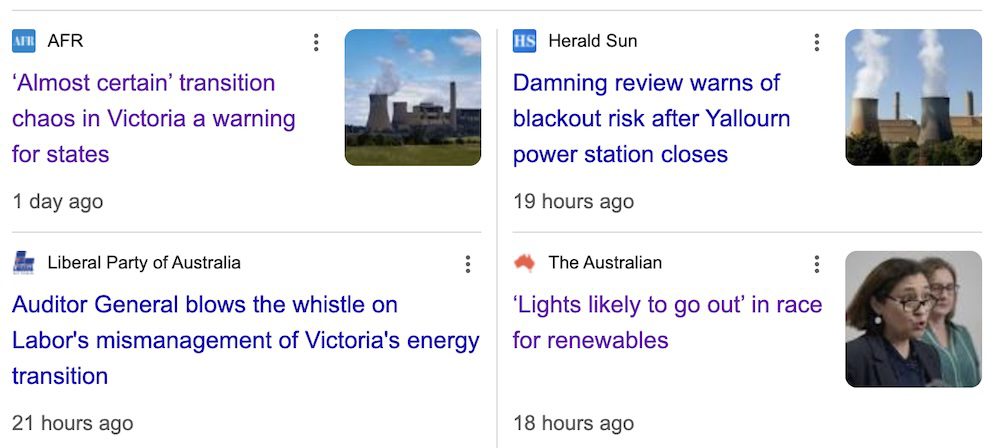
“‘Almost certain’ transition chaos,” said the Australian Financial Review. “Victoria power crisis: Damning review warns of blackout risk,” said the Herald Sun.“Lights likely to go out in race to renewables,” said The Australian.
Hair-raising stuff. If you’ve abandoned reading because you need to go directly to CostCo and stock up on canned goods and candles, fair enough!
But if you’re still reading, you might be curious to know what the report actually says – and what it definitely does not say – and what has been subject to interpretation and suggestion, including from the state Liberal opposition.
So, in the spirit of the recent Senate inquiry into the integrity of information around climate and energy in Australia, let’s walk through it, headline claim by headline claim.
“‘Almost certain’ transition chaos.”
This headline in the AFR appears derived from a table in the report that lists two state-significant and strategic risks related to energy reliability:
As the Australian reports it, quite accurately: “Using the government’s own risk management framework, the report rated as ‘significant (severe/almost certain)’ Victoria’s risk of a ‘disorderly energy transition’.”
The table says: “A disorderly transition to renewable energy could result in job losses, supply disruptions, price volatility for households and businesses and community resentment.”
So there we have it. “‘Almost certain’ transition chaos.” “Victoria faces ‘significant risk’ of blackouts from disorderly energy transition.” Let the outages begin!
Well, not quite. For starters, it’s worth noting that the words “disorderly transition” – or for that matter, “almost certain” – don’t appear anywhere else in the 61-page report, or in any of the associated report briefings or summaries, other than the above table.
The main focus of the 61 pages is the report’s three “key findings.” And by far the most “damning” of these is finding number 2, that says “Key projects have been delayed, risking electricity shortages.”
Here, the report points to the increasing likelihood that Victoria will miss its legislated offshore wind target of 2 gigawatts by 2032, and to delays to critical transmission projects – both fair concerns.
But on the plus-side, VAGO adds that “continued private and government investment in renewable energy projects is improving Victoria’s reliability outlook.
“Over 2024–25, an additional 807 MW of generation capacity and 2.3 GWh of utility storage capacity were committed or anticipated for development.”
In particular, the damning report – which makes a point to “look for what is working well, not only areas for improvement” – notes that Victoria is going great-guns on storage.
“There is enough new battery capacity planned that Victoria is on track to meet its 2.6 GW storage target by 2030,” the report says.
“AEMO data showed 1 GW of battery storage capacity in service before July 2025, with up to 4.7 GW in new capacity scheduled to come online by 2030.
“If completed on time, this means up to 5.8 GW of one-hour to 4-hour battery projects may be online by 2030 – more than double the 2.6 GW target.”
Key finding number one, meanwhile, is that Victoria is on track to meet and beat its 2025 target of a 40 per cent share of renewables, but it might have a tougher time meeting future targets.
“Victoria is on track to meet its 2025 renewable energy target,” the report says, adding that “under a range of plausible scenarios, Victoria’s renewable energy share for the 2025 calendar year exceeds the 40 per cent target.
“The pathway to 65 per cent renewable energy generation by 2030 is less certain.
“Achieving the target will depend on the CIS delivering all of Victoria’s renewable energy and storage allocation, plus additional Victorian government support. Reaching the 2030 target also requires on-time investment in transmission infrastructure so enough new projects can connect in time and supply electricity to the grid.”
Again, not quite damning. Particularly in the context of the report’s further comments on the CIS.
“The CIS is an Australian government revenue-underwriting scheme to reduce financial risk for investors and accelerate investment in renewable and clean energy,” it says.
“The Australian government–Victoria Renewable Energy Transformation Agreement sets out capacity allocations under the CIS …to keep Victoria’s electricity system reliable” and help meet state and federal renewable energy generation and storage targets.
“As the end of 2029 is the target commercial operating date for several CIS-supported projects, a share of these projects should also be online to help address potential electricity shortfalls by the start of 2030–31,” the report says.
Right. So not awful.
What about finding number three?
“Key finding 3: Victoria’s reliability outlook to 2030 has improved but more investment and risk management are needed as coal-fired power stations close.”
Here, the report notes that Victoria is “more likely to face electricity shortfalls after Yallourn coal-fired power station closes in mid-2028” – but that is if it doesn’t successfully manage risks like key projects being completed on time, demand higher than forecast, gas shortages, planned power plant maintenance and adverse weather conditions.
Aha! So the Herald Sun is correct to say that “Victoria faces a shortfall of electricity when Yallourn power station closes” in 2028 and will “have to schedule outages” during periods of peak demand?
Well not exactly.
“If Australian and Victorian government renewable energy developments proceed as planned, Victoria should have enough generation and storage for a smooth transition from coal,” the report says.
“Under the committed and anticipated developments assessment, AEMO forecasts that 1.7 GW of new generation capacity and 7 GWh of new battery projects will be delivered by mid-2028.
“Under the ‘committed and anticipated developments’ reliability assessment, AEMO no longer expects electricity shortfalls until 2030,” it says.
What about transmission delays and stalled projects? It’s like the AFR says “The Allan government has not adequately planned for Victoria’s renewable transition and cannot guarantee energy reliability.”
Actually, the report notes, with all that new generation and storage in the pipeline, it’s not looking too bad – and that’s without even counting the possible boost Victoria will get from the federal government’s Capacity Investment Scheme.
“[AEMO] expects [forecast new capacity] to outweigh the negative effects of forecast higher electricity demand and delays to transmission projects.
“These figures do not include new CIS-supported projects that have not yet met AEMO’s criteria.
“As the end of 2029 is the target commercial operating date for several CIS-supported projects, a share of these projects should also be online to help address potential electricity shortfalls by the start of 2030–31,” the report says.
“If Australian and Victorian government renewable energy developments proceed as planned, Victoria should have enough generation and storage for a smooth transition from coal.
“However, AEMO forecasts substantial electricity shortfalls beyond 2030 in the absence of continued private and government investment.”
And there it is, the headline that everyone missed. “Lights likely to got out if political ideology continues to dog investment in renewables.”
Meanwhile, as the AFR reports: “The report made four recommendations, including greater monitoring of potential future power shortfalls from coal plant closures and increased co-ordination of transmission planning. All have been accepted by the Allan government.”
The site of one of Australia's very first wind farms now shows little evidence of…
The "35 by 35" electrification goal has an Australian origin that the government seems to…
If we fail to ensure data centres pay for new renewables and storage to cover…
Home batteries look like resetting the behaviour of households when it comes to responding to…
South Australia energy minister hints that the 100 pct net renewables target may not be…
Australia's first major transmission loop is now operating, and will be at full capacity by…