(AAP Image/Darren England)
Six months-worth of energy storage capacity was registered through the federal Cheaper Home Batteries in just one month, new data has revealed, as households around the country – and particularly in the regions – embrace the chance to store and use more of their own solar.
The latest monthly data from SunWiz finds that 423 megawatt-hours (MWh) of behind-the-meter energy storage capacity was registered through the Small-scale Renewable Energy Scheme (SRES) in August 2025 – equivalent to half of 2024’s annual tally installed in one month.
This is partly because interest in the Cheaper Home Batteries scheme has been huge – beyond expectations, with an average of about 1,000 systems installed a day. But it is also largely because households and businesses opting in to the federal rebate are also choosing to go big.
SunWiz managing director Warwick Johnston says it was the 30-50 kWh market that grew by the greatest amount in August, driven by households wishing to make the most of the roughly $300/kWh discount and by emerging interest from small businesses.
Source: SunWiz
This trend towards super-sizing has boosted the average size of battery systems installed through the rebate to 21 kWh in August – an increase from 19 kWh in July.
“People are installing batteries that are now twice as large as the 10-12 kWh size they were for most of the first half of this decade,” Johnston says in the new battery market report.
The figures contrast to a downbeat rooftop solar market, as household focus on the battery rebates: See: Rooftop solar takes a beating as home batteries take centre stage
There have been some interesting patterns emerging across different parts of Australia, too, in August, with the states that had lagged behind in the first month of the rebate – we’re looking at you, Western Australia – playing catch-up.
According to SunWiz, WA doubled its home battery registration volumes from July to August, quite possibly due to participants giving up on meeting the extra conditions for the state government rebate and instead opting go with the federal rebate, alone.
Source: SunWiz
As Renew Economy sister site, One Step Off The Grid, reported here, WA’s Labor government has opted to “stack” a revised version of its Residential Battery Scheme with the federal rebate, adding up to what the state energy minister recently described as “the most generous battery subsidy in the nation.”
But it has not necessarily been received that way – largely because the addition of the state’s between $130-$380/ kWh discount comes with the requirement that recipients sign their battery up to one of the state’s virtual power plants, for a minimum of two years.
As Johnston notes, the uptick in growth in WA in August might be due to installers deciding it’s faster to install without being involved in the WA government program.
A state government update from around a fortnight ago said nearly 9,000 batteries had been ordered through the combined rebate since July, putting the state “well on track” to hit 20,000 applications by the year’s end.
According to SunWiz, the state’s “impressive growth” in volume was also accompanied by an impressive growth in attachment rate – the rate at which new batteries are installed alongside a new rooftop solar system – which is the second highest in the country.
Another pattern that has been noted, in this case by federal energy minister Chris Bowen, is that the biggest demand for batteries through the rebate has so far come from Australia’s regions and outer suburbs.
Speaking at the Farmers for Climate Action Farming Forever National Summit 25 on Tuesday, Bowen put the tally for the total number of batteries installed since the Cheaper Home Batteries Rebate launched on July 01 at 44,865.
“This is Australians across the board saying they’re getting on with it,” Bowen told the summit in Canberra. “And do you know where the biggest take up of these batteries is? … The electorates in New South Wales with the biggest take-up [are] Gilmore, Nowra and Ulladulla; Bateman’s Bay.
“The biggest take-up in Australia is [the electorate of] Mayo in regional South Australia. The biggest take up in Queensland is the seat of Wright, outer suburban regional Queensland.
“So this is not inner city, latte-sipping lefties, this is Australians in the outer suburbs and the regions getting on with it. Because they know what’s good for the planet is good for their pocket.
“And in many cases, they’re going – effectively – off-grid… making their own energy and saving their energy and feeding it in when they choose; becoming prosumers, producers and consumers all at the same time.
“This is the opportunity for our country. This is the opportunity for all of us. We can ignore the challenge, pretend it’s all too hard, or we can tackle that challenge with all its related difficulties, and we can make it a winner for our country, a winner for our farmers, a winner for our regions.
“That’s what I intend to do. That’s what I think you intend to do. That’s what our country intends to do. We don’t have long… We now have 52 months to 2030 – that goes real quick. We wasted a lot of time over the last decade. We don’t have the time to waste now.”
Back to the data on home battery uptake in August, SunWiz notes that the volume of batteries installed in the 12-14 kWh range was one of the few segments to contract, as people preferred 14-16 kWh batteries and 18-20 kWh rose to become the most popular sub-20 kWh option.
In the upper size ranges, there was a marked increase in the 20-30 kWh bracket and significant growth in the 30-50 kWh range, as noted above.
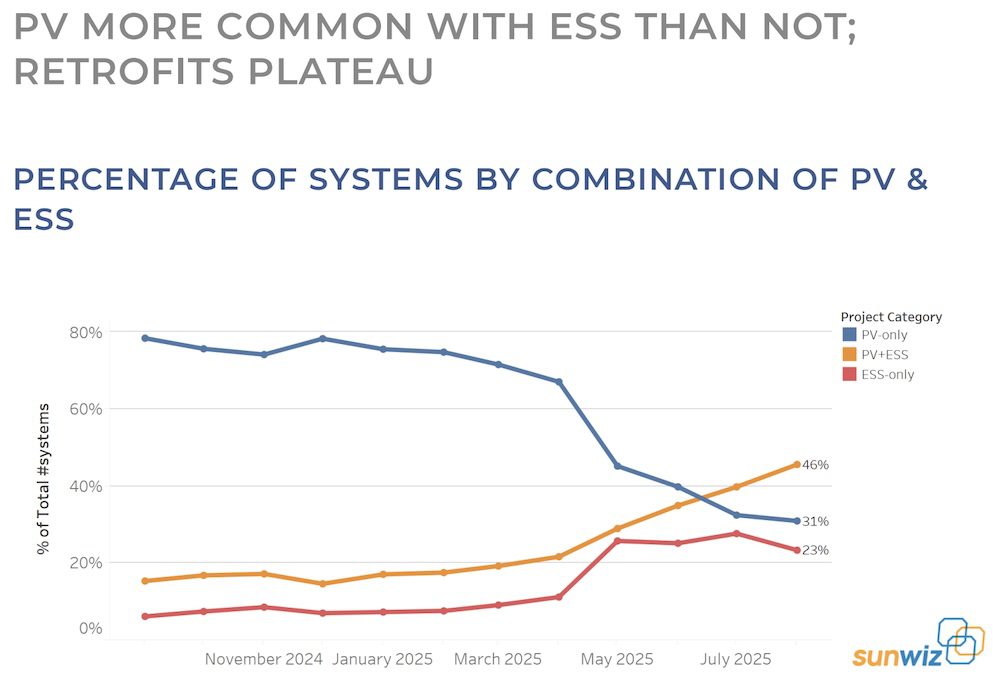
One down-side of the huge uptick in battery installations has been the concurrent decline in the share of rooftop solar-only projects around the country, which One Step Off The Grid details here.
Johnston notes that PV+ESS [energy storage system] is now the most common way of installing rooftop solar, but retrofit ESS (ESS-only) installations are where most of the action is at, for now, on the battery side of the equation.
“The battery market is in hot demand, though it appears to have plateaued as the initial surge of interest has been met, and bottlenecks in equipment supply and installation hold back the next levelling-up of the industry,” Johnston says.
Applying for grid connections is like a fishing expedition. You lower your hook into the…
Australians have spent decades fighting over how much multi-national investors should pay for our resources.…
Transgrid details causes of the "contract failure" that has blighted delivery of Project EnergyConnect, as…
Stand-alone solar and battery systems used to upgrade upgraded remote rail crossings from “passive” –…
Progress update on a wind farm being developed by Andrew Forrest's Squadron Energy says the…
Federal Labor slashes fuel excise in half for petrol and diesel cars, and will cut…