There is heated debate about a recent AEMC proposal for owners of rooftop solar systems to be charged extra for use of the electricity network at times when the network is stressed, to pay for the cost of necessary upgrades to cope.
Some community advocates have supported this, on the grounds that low income households that face barriers to installing PV should not subsidise the costs of upgrading the supply system to cope with PV.
In my view, we are having the wrong debate.
We need to step back and look at how rooftop solar electricity exports are treated under the existing outdated energy market arrangements.
I argue that rooftop solar exports are subsidising others, and that any extra costs to cope with increasing PV export could be sourced from part of that existing subsidy, without charging PV owners more.
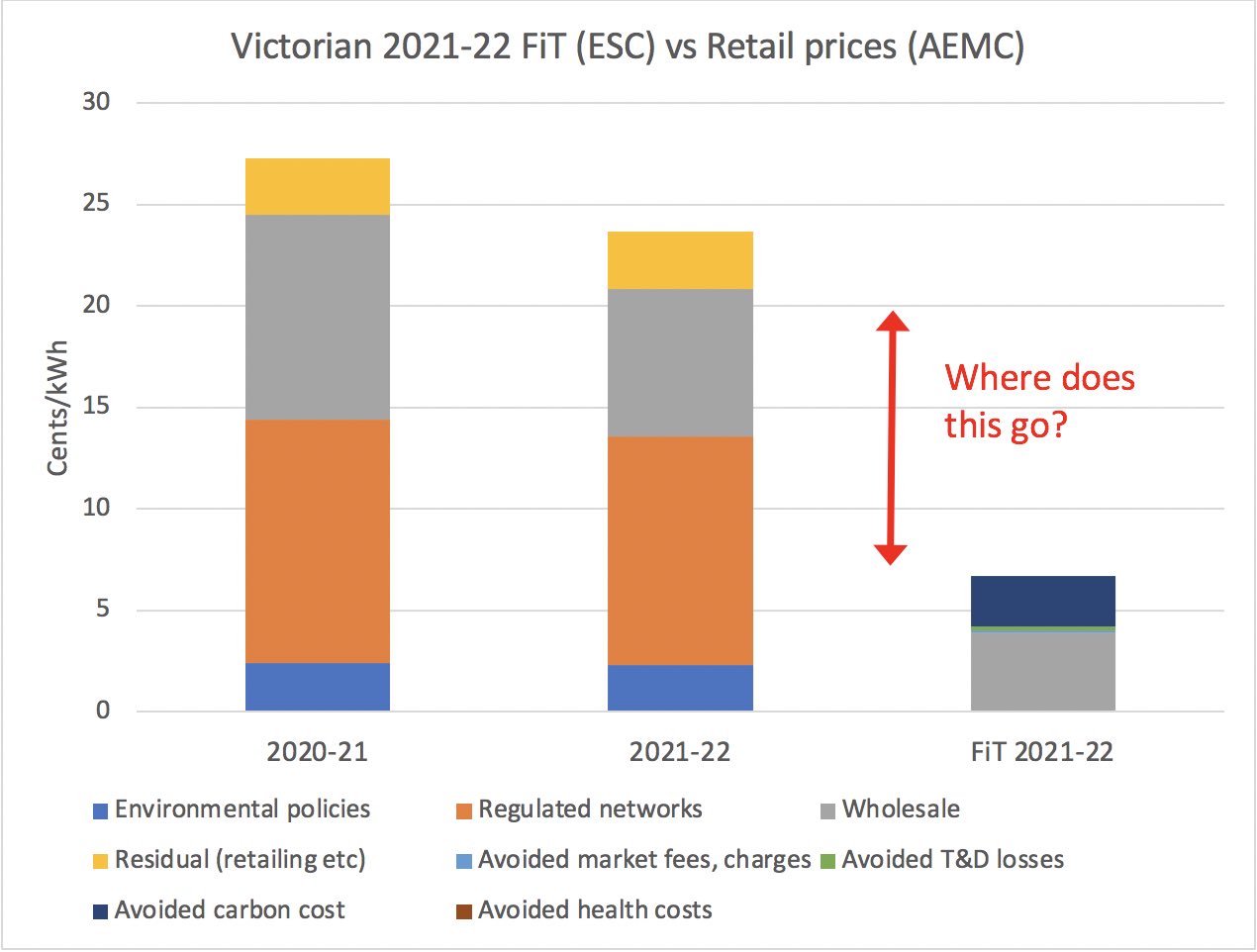
Present rooftop solar export prices are calculated based on treating rooftop solar as a wholesale electricity generator, just like a distant coal or gas generator, as shown in the breakdowns for Victoria and NSW below.
Under this outdated market design PV exports pay the same price per kilowatt-hour to transmission and network operators as a distant, large power station, as well as averaged retail charges. But for most or all of the time, PV exports are consumed by nearby neighbours, using a tiny part of the poles and wires.
Even in a future of high PV output, exports are likely to only flow into the broader network for limited times, and for limited distances. All PV owners also already pay a retailer to operate their account.
So there is a fundamental question: should PV exports pay over 10 cents per kilowatt-hour for every unit of export, the same as a large power station that relies on the transmission and distribution system for delivery of every unit of electricity they sell?
Should they pay ‘average’ retailing charges, given they already have an account?
It seems to me that an ‘economically efficient’ market would require rooftop solar to pay for only the proportion of the network it uses. Rooftop solar is fundamentally different from a large power station.
It competes with the retail price of electricity, not the wholesale price. So it should be rewarded by being paid the retail price minus the actual costs incurred by energy retailers and network operators in delivering it to its destination.
So how much does it cost an energy retailer to measure and bill for a kilowatt-hour of exported PV generation?
How much of the network and associated costs does a network operator incur, on average and when network congestion may occur, to deliver PV exports to the point where they are consumed?
I don’t think anyone knows. But I suspect this will be a lot less than the 14 cents/kilowatt-hour a Victorian PV exporter now pays to the retailer and network operator.
My point is that, yes, a PV exporter should pay the real extra costs incurred by the energy supply businesses. But, even under very high export scenarios, the average cost per kWh of delivering this electricity to another consumer and managing billing is likely to be far less than PV owners are now paying.
At present, energy retailers and network operators are making windfall profits from PV exporters. To the extent that regulated network profits may be factored into reducing regulated network charges, PV exporters are already subsidising all other retail customers, including low income households.
Any extra costs to adapt networks to cope with increasing PV report should be paid for out of the existing subsidy paid by PV.
It should also be noted that, as energy market rules change to allow network operators to profit from street level batteries and retailers establish profitable Virtual Power Plants, they may well increase profits as they adapt to higher PV generation.
Of course, if you believe that rooftop PV should be treated the same as a large fossil fuel power station, you can say I am wrong.
Note that the Victorian FiT includes an estimated wholesale electricity price and credits for avoided market fees and charges, transmission and distribution losses, carbon costs and health costs.
Too many Australian households are being locked into high energy use, high bills and uncomfortable…
Vestas has landed a contract to supply turbines to the biggest wind project to begin…
I spent all my working life in coal mines before retiring in 2020. Since then…
BoM chart shows giant El Niño climate pattern in the Pacific is nearing record weekly…
Report suggests focus has shifted from how we can leverage rapidly improving emissions measurement technologies,…
The Australian Greens has named its new leaders, in a move the party says will…