(Photo credit: HySTRA).
As I’ve written before many times here at RenewEconomy, hydrogen, as a substance and an industrial movement, means many things to many different people.
It’s a fuel that burns clean (ish), but that generally has to be produced using something else. If you make it using fossil fuels, you’ve contributed to climate change. Even if you capture some of those emissions, the remainder still cause climate change. If you produce it using a clean, zero emissions source, like electricity from wind or solar, you’ve mostly eradicated that specific problem.
The sheer intensity of the debate around hydrogen is, really, very well justified. It’s an issue that contains so many of the broader trends on climate solutions right now. As I wrote in a thread last week, the infamous Victorian ‘Hydrogen Energy Supply Chain’ (HESC) project serves as an incredible package of the worst, most alarming efforts to preserve the lifespan of fossil fuels and delay decarbonisation for as long as possible.
HESC produces hydrogen using the absolute worst-of-the-worst brown coal. For now, it’s “offset” through the purchase of carbon credit certificates, which do not really neutralise the climate impacts of the greenhouse gases. In the longer term, there’s a blatantly empty promise to capture the emissions and bury them underground.
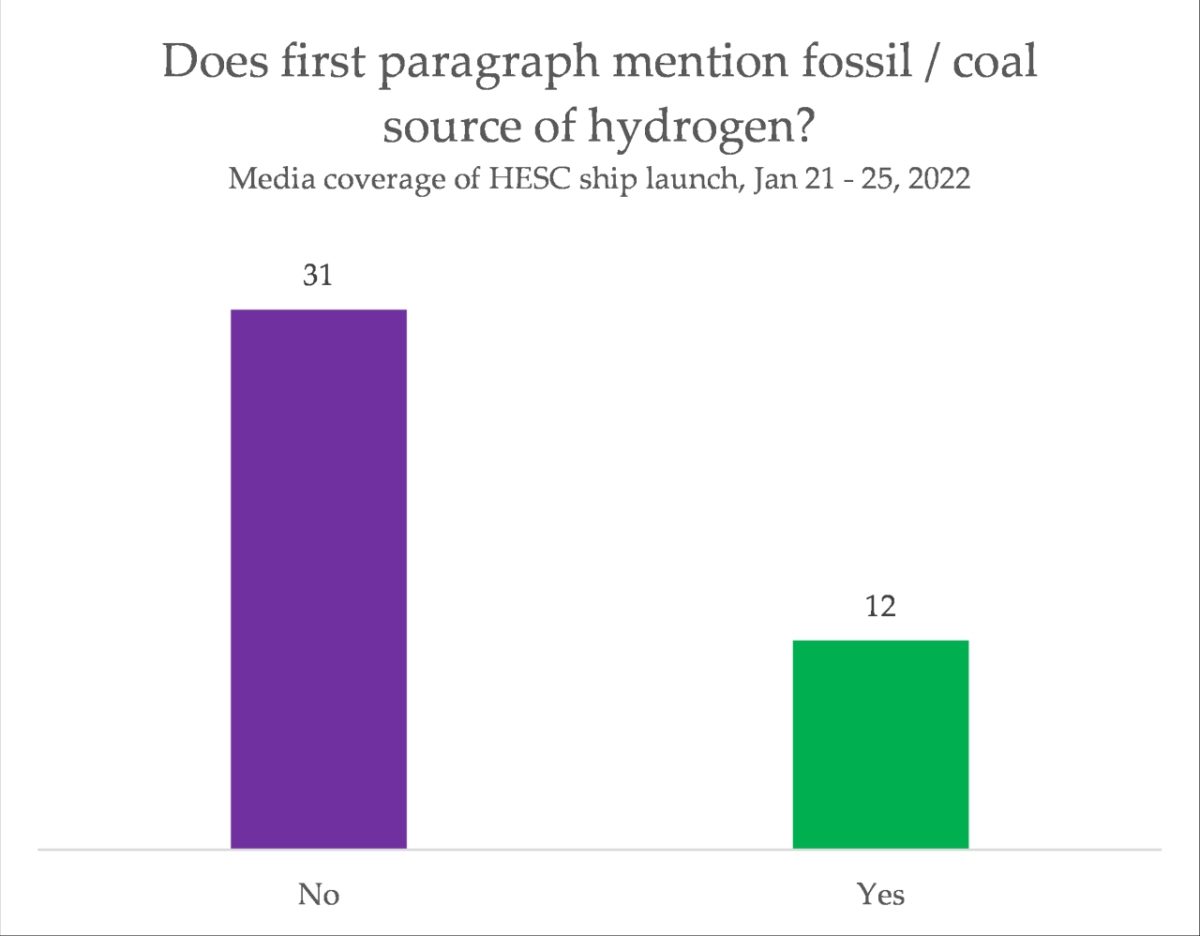
Last Friday, that project saw its first shipment of that dirty-as-hell hydrogen to Japan. As a follow-up to my Twitter thread, I was curious to see how that announcement would be covered by media outlets. So, I gathered up every single piece of coverage – including RenewEconomy’s – and checked each one to see if either the headline or the first paragraph mentions that the hydrogen being shipped out from Australia is fossil hydrogen. There were 43 articles, 15 of which were ‘syndicated’, that is, the same article either by Reuters or Associated Press, shared across different media sites.
Of those 43 articles, 4 mentioned fossil fuels in the headline (RenewEconomy was one) and 39 did not. 12 mentioned coal in the opening paragraph, and 31 did not. Most did eventually mention the source, but most buried it in the back-end of the article. The reason this matters is that the project was – infuriatingly – reported as a major milestone for clean energy by many outlets.
The Daily Mail described it as a “landmark move in the fight against climate change”. Australian Associated Press articles described it as “Aussie Hydrogen” on the “ship of the future”. Both the Australian Federal government and the Victorian government talked up the role of CCS and underground geologic storage of captured carbon, linking HESC to climate targets, ambition and innovation.
Generally, it was seen as the launch of a major new pathway to transporting clean energy. Squint hard, and you can see how this has some legitimacy. Look directly at it though and you see a major new pathway for expanding emissions from coal use.
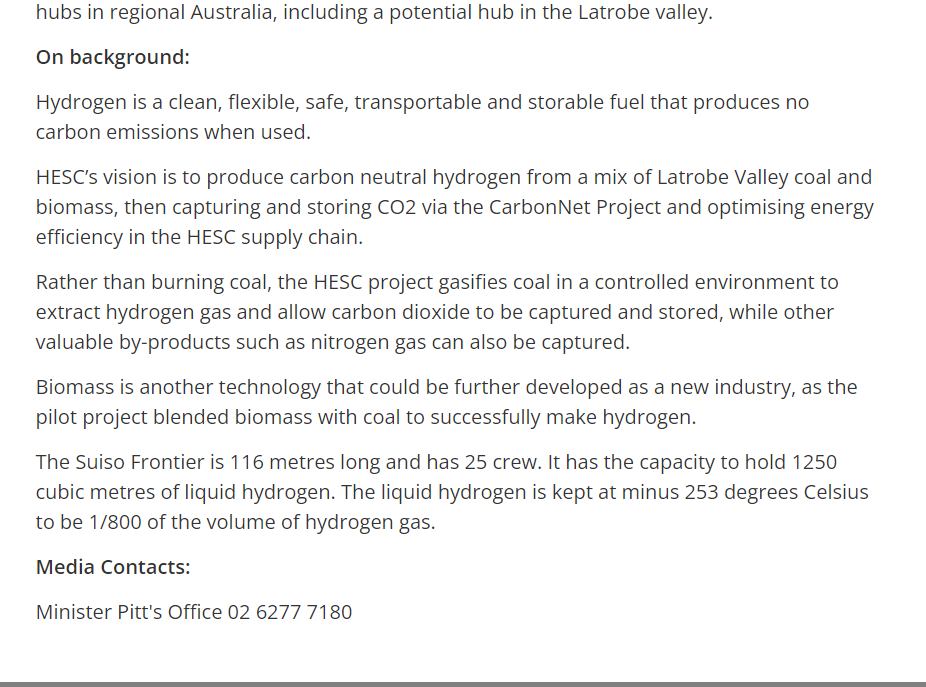
Amusingly, I noticed a little peek behind the curtain of this widespread media effect in the press releases for both the Minister for Resources and Water, Keith Pitt, and the Prime Minister. The identical joint release posted on the official website for both features a section some poor staffer has forgotten to delete from the upload:
“On background” generally means information provided to a journalist that they are free to use in their article, but cannot declare where they’ve received that information. In this case, it’s a collection of information about HESC that over-inflates and over-eggs the likelihood of the massive coal behemoth decarbonising using CCS and biomass. Morrison’s office noticed and deleted the ‘background’ bit over the weekend (archived here), but at the time of writing it’s still up on Pitt’s website, in all its glory (archive).
‘Backgrounding’ has come under increasing scrutiny and criticism within the world of journalism. Tech website The Verge updated their policy to increase transparency around the term. While in energy and climate ‘backgrounders’ don’t often contain anything too controversial, as above, they’re an invisible and troubling part of the broader problem. Hydrogen isn’t being scrutinised and criticised as it should be, given the in-built risks of it becoming a ‘new fossil fuel industry’.
Australia's first ever auction for offshore wind generation capacity is finally underway, but with little…
One Nation's Pauline Hanson has been picked to open one of Australia's biggest farm shows…
Soaring commodity prices have bolstered the profits of Australia's largest oil and gas producer, as…
State regulator suspends another company from participating in energy upgrades subsidy after it was allegedly…
The fight may not be over yet as woman leading the campaign against the Marinus-linked…
New guide launched guide to help farmers and regional businesses assess power and electric options…