Source: Freepik
In1936 King Edward VIII abdicated the British throne to marry Wallis Simpson, an American divorcée (photo). His decision caused a constitutional crisis as marrying a divorced person was unacceptable for the British monarch at the time and opposed by the Church of England, among others.
Fast forward to 2025 where we are witnessing another type of abdication that is not as sensational but certainly more consequential.
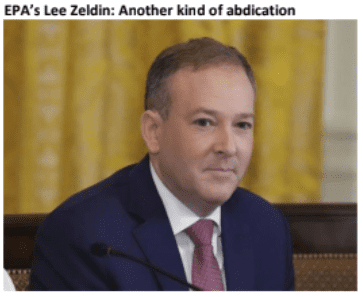
This one is the virtual abdication by the Environmental Protection Agency (EPA) of its authority and responsibility to regulate emissions of greenhouse gases. According to Lee Zeldin, President Trump’s overzealous EPA administrator, “Today is the greatest day of deregulation our nation has seen.”
In making the announcement Zeldin proudly declared that: “We are driving a dagger straight into the heart of the climate change religion to drive down cost of living for American families, unleash American energy, bring auto jobs back to the US and more.”
The EPA has embarked on a plan to end its ability to regulate greenhouse gas emissions (GHG), thereby its ability to fight climate change.
While most agencies strive to enlarge their mandate and mission, Mr. Zeldin would like to defang the EPA by making it essentially irrelevant. He has already said that the EPA will not be monitoring emissions or enforcing many regulations that it does not deem to be important – and that goes beyond GHGs.
In line with the Trump Administration policies, the EPA plans to repeal a fundamental scientific finding that gave it the authority to regulate GHG emissions and fight climate change by rescinding a 2009 “endangerment finding,” which identified that GHGs like CO2 and methane endanger human lives, thereby authorizing the EPA to limit their emissions from cars and power plants.
The Trump administration’s intent is clear: “They want to overturn the endangerment finding, which will allow them to absolve EPA’s legal responsibility to address the harms caused by climate change,” according to Rachel Cleetus at the Union of Concerned Scientists (UCS).
“This is simply a giveaway to the fossil fuel industry and an attempt to undo pollution standards to limit heat-trapping emissions from motor vehicles, from power plants, and from oil and gas operations.”
The current administration argues that President Barack Obama established the endangerment finding in a flawed and unorthodox way while overreaching the letter of the 1970 Clean Air Act (CAA) which, significantly expanded the federal government’s role in regulating air pollution from both stationary and mobile sources.
Trump’s EPA now wants to absolve the endangerment finding by arguing that previous administrators overstepped their legal authority while imposing trillions of dollars of costs on Americans.
Ironically, the EPA is silent on the enormous costs of climate change – which most experts believe is far higher than the costs of the regulation. These, as far as the current administration is concerned, are insignificant – hence no attempt is made to even mention them as noted in the lead article.
To be fair, the precise role of the EPA in enforcing the CAA has been controversial. In a seminal 2007 case, Massachusetts vs. EPA, the court ruled that the CAA did not explicitly authorize the EPA to regulate GHG emissions and a 2009 Supreme Court decision cast further doubts on the legality of the 2009 endangerment finding.
But its proponents point out that at the time of the passage of the CAA in 1970 very little was known about the harmful impacts of GHGs on climate change. In today’s polarized politics, it is next to impossible for the US Congress to pass anything.
The vote on the One Big Beautiful Bill Act (OBBBA) was tied in the US Senate and passed the House of Representatives with a slim margin of 4 votes despite intense pressure from President Trump.
But such arguments are apparently too abstract for the current administration who simply wishes to get away with whatever it wants to do – it doesn’t much matter if it is illegal, illogical or not cost-effective.
Getting rid of the endangerment finding is expedient, which explains why on his first day in office on 20 Jan 2025 President Trump declared a national energy emergency – without any explanation as to why one was needed – accompanied by Unleashing American Energy Executive Order to redirect the federal government away from former President Joe Biden’s climate agenda while embracing fossil fuels.
The goal of the Executive Order (EO) was to “restore American prosperity” and, this – as Trump explained in his inauguration speech meant “We will drill, baby, drill.” He asked the EPA administrator to submit recommendations “on the legality and continuing applicability” of the endangerment finding. That explains everything.
We live in interesting times, with alternative facts
▪ Climate change is a by-product of progress, according to Chris Wright, the US secretary of energy;
▪ EPA abdicates its authority to regulate greenhouse gas emissions under Lee Zeldin;
▪ Vaccines are bad according to the Robert F. Kennedy Jr, the head of Department of Health and Human Services;
▪ The head of the Bureau of Labor Statistics gets fired for reporting weak job growth data;
▪ Budget cuts at National Oceanic and Atmospheric Administration (NOAA) are intended to end monitoring of CO2 concentration in the atmosphere which began in 1958; and
▪ “Wind is an extremely expensive form of energy, it’s very bad … the other one is solar …. very, very inefficient and very ugly too,” according to President Trump..
Environmental groups were not fooled by the bogus national energy emergency or the subsequent announcements.
Everyone recognizes that the EPA’s proposal – and similar decisions by the Department of Energy – are designed to benefit the fossil fuel sector, who Trump courted during the election campaign.
Dan Becker, director of the Center for Biological Diversity pointed out that the EPA’s proposal is nothing but “… a giant gift to oil companies that will do real damage to people, wildlife and future generations.”
The US is currently the second biggest GHG emitter and the largest in cumulative terms. At the Paris Climate Accord in 2015 America agreed to contribute to the global effort to reduce GHG emissions.
Trump, for a second time, has withdrawn the US from that agreement and is now stopping all domestic efforts to address climate change – as if it did not exist, and even if it did, it did not matter.
In case this was not sufficient, consider a new directive which requires Doug Burgum, the Secretary of the Interior (photo) to personally approve all solar and wind project permits on federal lands.
The US government owns roughly 640 million acres, about 28% of the country’s land area. Consequently, this policy is seen as a virtual ban on all renewable energy projects that would have normally been built on land leased from the federal government.
The Administration explained that the directive is necessary to ensure a level playing field after the previous administration prioritized renewables.
The current administration prefers to lease the land for fossil fuel development – consistent with the drill, baby drill mandate – logging, mining and grazing. And if that leads to more GHG emissions, so be it.
Federal government launches quest to find a suitable partner to "arrange, manage, deliver, and report"…
This is no longer just a pump-price issue; it is a systemic shock to the…
A prototype wind turbine using "self-erecting" tower technology is running at full capacity, ahead of…
Battery component of solar and storage facility joins the grid, part of a boom that…
Germany wants to build the world's first fusion power plant, and scientists say that might…
Government seeks expressions of interest to partner in delivering at least three new synchronous condensers…