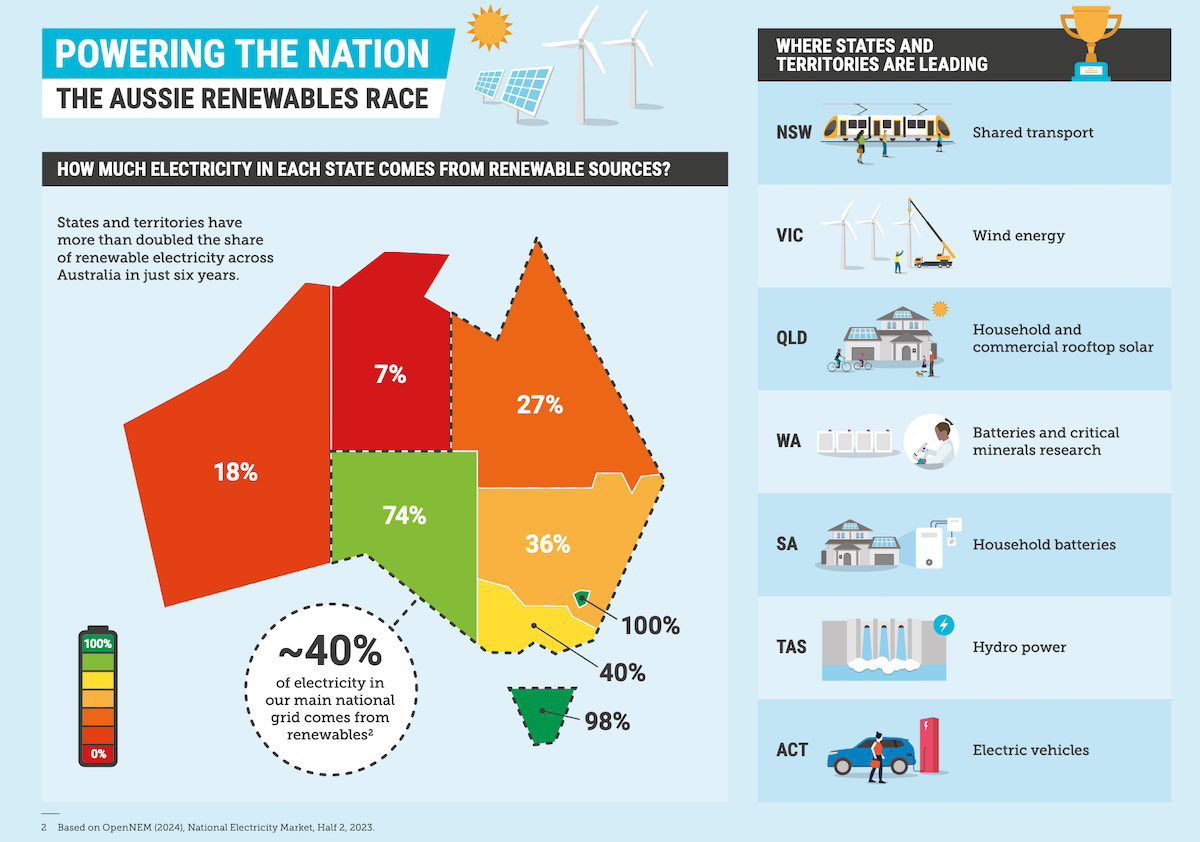
Queensland has emerged as the surprise front runner in Australia’s climate race, according to a study that found the state had sped up progress on renewable energy production and targets.
The environmental report card, issued by the Climate Council on Wednesday, praised NSW and the ACT for efforts to reduce transport emissions and gave South Australia and Tasmania credit for their renewable power.
But the Northern Territory and Western Australia were criticised for their low share of renewable energy and vague net-zero targets.
The Climate Council report, Race to the Top, analysed environmental measures across each state and territory including rooftop solar and batteries, electric vehicles and chargers, renewable energy targets and use, and shared transport.
While Australia doubled its share of renewable electricity over the past six years to reach 40 per cent, the report found the ACT (100 per cent), Tasmania (98 per cent) and South Australia (74 per cent) led the pack.
The nation’s capital won praise for having the highest share of electric vehicles, with more than double the rate of its rivals, while NSW had the greatest proportion of shared transport at 13.1 per cent, besting Victoria at 8.5 per cent.
But Queensland was singled out in the report for its progress on renewable energy, including clean energy projects in regional centres such as Townsville and Gladstone, and its target to cut 75 per cent of pollution by 2035.
The Sunshine State also had the greatest percentage of rooftop solar panels installed in the country, it found, with 50.2 per cent of all homes covered.
Climate Council chief executive Amanda McKenzie said most states had shown progress in their efforts to cut pollution, even though there were still a lot of work to be done to reach Australia’s 2030 and 2050 goals.
“Australia’s race to the top on climate is bringing enormous opportunities, particularly in Queensland, which now leads the nation on rooftop solar and clean energy investment,” she said.
“Most states have grasped that this is the critical decade but there is plenty of work still to do.”
Western Australia and the Northern Territory were criticised for their low share of renewable energy, at 17.6 and 6.7 per cent respectively, as well as increasing gas projects and their lack of interim pollution targets.
The report noted Western Australia led research into critical minerals needed to produce batteries.
Most states had low rates of household solar batteries, with South Australia leading the pack and modest rates of electric car chargers, with Tasmania the clear winner.
Climate Council spokesman Greg Bourne said he hoped the report would encourage lagging states to improve their climate credentials.
“As a Western Australian, I’m confident this great state can catch up by embracing clean energy to power its homes, businesses and industry alike,” he said.
Source: AAP
Australia's most powerful battery now free to trade its full capacity on market after its…
The site of one of Australia's very first wind farms now shows little evidence of…
The "35 by 35" electrification goal has an Australian origin that the government seems to…
If we fail to ensure data centres pay for new renewables and storage to cover…
Home batteries look like resetting the behaviour of households when it comes to responding to…
South Australia energy minister hints that the 100 pct net renewables target may not be…