The dome of Hinkley Point C’s Unit 2 being lifted into place in mid-2025Image Credit: EDF
Building nuclear for the first time in Australia would take longer and cost more than building offshore wind for the first time in Australia, according to modelling by Australia’s premier science agency that once again rules out nuclear power from any and all cost-efficient scenarios for a net zero grid.
CSIRO each year delivers an annual GenCost report, a collaboration with the Australian Energy Market Operator that provides an “objective benchmark” on the costs of electricity generation, storage and hydrogen production technologies, to guide policy.
Last week, the chief economist at CSIRO’s Energy Research unit and the lead author of GenCost report, Paul Graham, discussed the findings of the draft report for 2025-26 to the Australian Wind Energy conference in Melbourne, ahead of the release of the final report, due this quarter.
So far in Australia’s journey to net zero emissions by 2050, the electricity sector has done the vast bulk of the heavy lifting on decarbonisation, as solar and wind firmed by storage supply close to half of the generation mix of the National Electricity Market (NEM).
The job from here will be tougher, as the last of Australia’s coal fleet is ushered out. The job of the GenCost team at CSIRO is to work out what sort of contribution the electricity sector can continue to make to emissions reduction while still keeping costs as efficient as possible.
“What that means, in effect, is that the electricity sector should do enough abatement so that it doesn’t cost any more than abatement anywhere else in the economy, and to determine that, we can use scenario analysis,” Graham told the conference on Wednesday last week.
CSIRO’s draft GenCost modelling continues to find that a combination of wind and solar with firming technologies is the best way forward on both costs and emissions reductions.
As Graham told the conference, “mainly using existing mature solar PV and onshore wind is preferred, and what that looks like from a cost perspective is that the mature technology scenario is the lowest cost scenario.”
On the flip-side, Graham also shared some of the numbers on where “first-of-a-kind” technologies landed in the modelling.
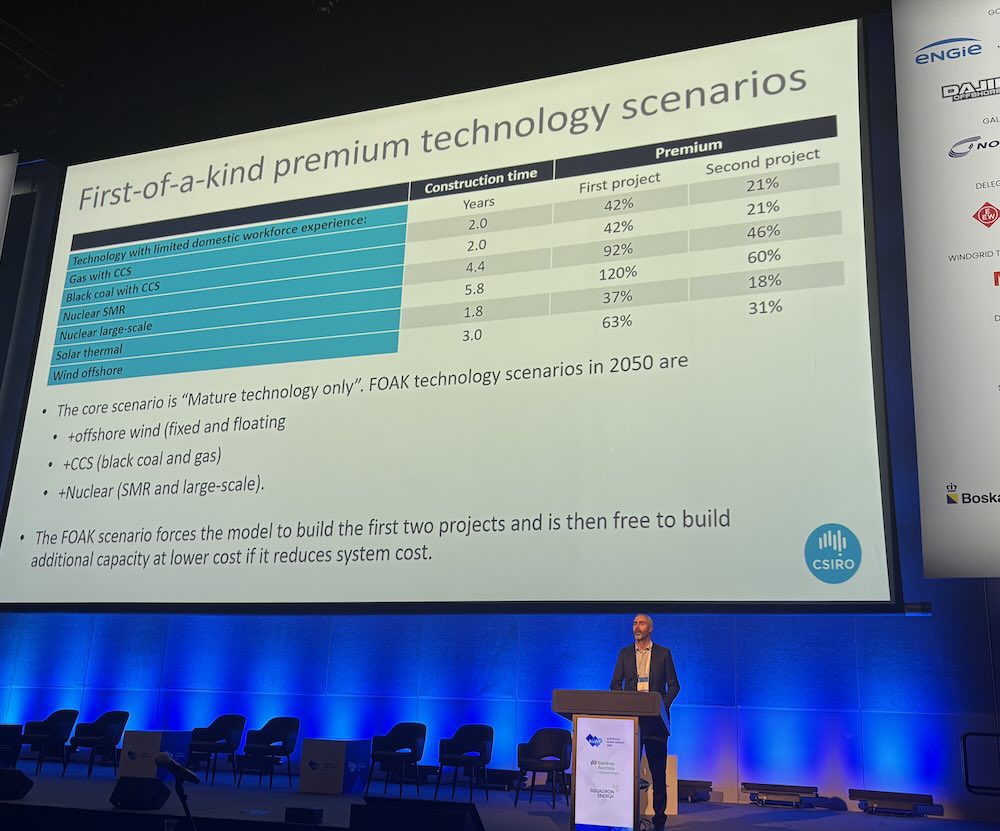
The below slide compares the construction times and cost premiums of a range of technologies not yet built at scale in Australia, before, including gas with carbon capture and storage (CCS), black coal with CCS, nuclear small modular reactor, nuclear large-scale, solar thermal and offshore wind.
CSIRO’s Paul Graham addresses the Australian Wind Energy conference in Melbourne, July 2026.
Image: S Vorrath
It’s a timely reminder of why the federal Coalition’s nuclear focused campaign was such a disaster for the party at the 2025 election, and yet remains the favoured energy policy path for the LNP at the same time as it promises to deliver cheaper electricity while also putting the brakes on renewables.
As Graham told the conference, the numbers still well and truly rule out nuclear, while leaving offshore wind still “in the pocket” as a potential part of Australia’s future generation mix.
“All these technologies on the left, on the left there of that table, we’ve never really built at scale in Australia before,” Graham told the conference.
“We have to expect that there’s going to be some sort of premium associated with delivering first project and probably the second project. We tried to work through what we think that premium could be, based on this global analysis that will support projects and how they’ve fared.
“The highest premium seems to be associated with projects that take longer to build, and nuclear … takes the longest, so it’s at least six years, probably eight years. Six years is probably best case scenario, just for the construction stage.
“The data says that those sorts of [nuclear] projects where the first time the country tries to build them, generally costs at least 100% more than the international best practice,” he told the conference.
“And so we’ve got assumptions about what these first of a kind costs will be after we’ve developed the first few projects we can then assume that the workforce is able to build these close to the world best practice and then we can build things at lower cost after that.
“So when we model these different emission intensity targets and we allow for the model to build, either with mature technologies like onshore wind and solar, or onshore wind and solar plus some of these first-of-a-kind projects, then what this shows is the generation mix that the model says is least cost.
“And what that looks like from a cost perspective is that the mature technology scenario is the lowest-cost scenario. It is a bit more expensive to have offshore wind and CCS, and but not too much more, but the most expensive in each case is nuclear,” Graham said.
“The modelling didn’t want to build … particularly a lot of CCS or nuclear, because it’s quite significantly higher than the cost we need to get to net zero, so adding those technologies would only increase the cost of getting to net zero.
“As offshore wind goes, it’s in the pocket. Potentially it would be better if the costs were at the lower end of the range … but we certainly can’t rule out, we certainly wouldn’t say that offshore wind is necessarily in or out, it just depends on where we land on that on that cost uncertainty range.”
If you would like to join more than 29,000 others and get the latest clean energy news delivered straight to your inbox, for free, please click here to subscribe to our free daily newsletter.
A massive 244-tonne transformer has completed a 2,165 km road trip to the site of…
The battery industry is about to witness another change in chemistry and technology. Valo Energy…
Energy minister says imminent closure of coal is "indisputable," and "ideology-driven" policies to scrap transmission…
The supplier to the biggest battery currently being built in Australia expects to announce its…
The federal government green bank has dusted off an old mandate, but has not ruled…
Fossil fuel interests spent $1.2 million on Meta ads in the last three months, a…