A family eats a snack by candlelight during a blackout in Barcelona, Spain, Monday, April 28, 2025. (AP Photo/Emilio Morenatti)
It was just over a week ago that the Spanish grid operator Red Electrica boasted of reaching 100 per cent renewables for the first time – meaning that its wind, solar and hydro resources were delivering more electricity than needed to meet local demand.
“Today, April 16, renewables are generating enough to cover the demand of the peninsular electricity system,” Red Electrica posted on LinkedIn. The share of renewables peaked at 100.6 per cent, just after 11am.
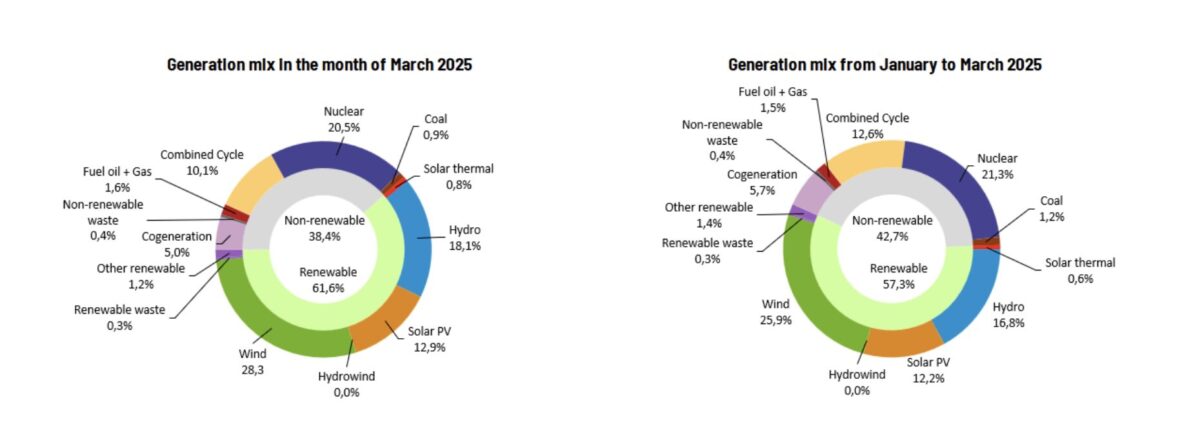
It was a landmark moment. A few days later, solar alone reached record output of more than 20 gigawatts, and over the last month, the share of wind, solar and hydro averaged 68 per cent of electricity demand in Spain, or 63 per cent over the first quarter of the year.
That is a lot higher than Australia’s 40 per cent share of renewables, although Spain does rely heavily on hydro, which makes up nearly a third of its renewable contribution and 18 per cent of overall supply.
Spain generation mix. Source: Red Electrica.
But Spain, and Portugal – which has an even higher share of renewables and has reached 100 per cent net renewables on multiple occasions – may have forgotten one important ingredient, the need for battery storage.
This technology, unheard of on the world’s major grids less than a decade ago, can act as giant shock absorbers, and their flexibility and speed make them good allies in efforts to soften the impact of the type of massive disruptions that hit Spain on Monday.
The early assessment of the blackout is that a power “oscillation” caused problems at the Spanish-French interconnector, and led to the Spanish grid “islanding.” The power oscillations triggered the shut down of generators, and a cascade of events took most, if not all, out of action.
Far right critics and climate deniers quickly took to the internet to blame renewables, because that is what they are programmed to do, as Ketan Joshi has written here. Blackouts are unusual, but they do happen. And they have done so in Europe before the onset of renewables.
As energy expert Gerard Reid has noted: In 2003, a problem with a hydroelectric power line between Italy and Switzerland caused blackouts for about 12 hours, and in 2006 an overloaded power network in Germany caused electricity cuts across parts of the country and in France, Italy, Spain, Austria, Belgium and the Netherlands.
Energy experts say it is too early to make a definitive call on what happened in Spain, but one of Australia’s foremost grid experts, Bruce Miller, couldn’t resist having a go at interpreting what was meant by “atmospheric oscillations” cited by the Spanish grid operator.
“Ok – whilst the dust has still not settled – this is my “guess” as to what happened,” Miller wrote on LinkedIn.
“Conductors clashed on the HV (high voltage power line) due to excessive sag caused by high temps and wind.
Spain grid frequency. Note the fall in middle of the chart.
“This caused a few faults which can be seen in the frequency traces and eventually resulted in the interconnector to France tripping. Power imbalance then caused the Iberian system to collapse. Looking forward to reading the actual postmortem report (if it is made public) to see how accurate or inaccurate this guess is.”
Many experts say that the lack of battery storage in the Iberian grid left both the Spanish and Portuguese electricity systems extremely vulnerable to the massive frequency excursions.
Spain has managed to convince itself that its grid is reliable – thanks to the vast resources of hydro and its interconnectors. But it appears to have downplayed the need for “grid security” – which are the essential grid services that help keep the lights on, respond to catastrophic events, and to get the grid back up again if the lights do go out.
Australia learned this lesson from the “system black” events in South Australia in 2016, which identified a vulnerability led to the construction of the world’s first big battery, at Hornsdale, in 2017.
South Australia now has a world record share of wind and solar share of 72 per cent – averaged out over the last few years – and peaks above 100 per cent renewables almost daily. It aims to reach an average of 100 per cent “net” renewables in 2027.
Its grid has proven to be both reliable and secure, thanks to the presence of half a dozen big batteries already operating, and this will be boosted by another half dozen or so under construction.
And their influence has extended to other states dealing with ageing, increasingly decrepit and unreliable coal fired power generators, where batteries have proved to be particularly useful when acting as shock absorbers to the grid.
The response to the storm-induced failure of the transmission line in Victoria last and the subsequent trip of the state’s biggest coal generator last year, and the intervention of battery storage when the Callide C coal plant exploded in 2022 – and helped prevent a state-wide blackout – are a case in point.
The biggest “shock absorber” of them all, the 850 MW, 1680 MWh Waratah Super Battery in NSW, is being commissioned now to perform exactly this service – to act as a buffer to any disruptions such as the loss of a major transmission line.
Spain has held capacity auctions to secure more dispatchable generation capacity – essential for a high renewables grid – but it has loaded it in favour, energy experts say, of thermal generation, which they say are simply going to follow the example of their peers and trip in the face of such an emergency.
“This event starkly highlights Europe’s critical need for improved power grid interconnections, enhanced grid-scale battery storage solutions (incl. for black start capabilities), greater co-operation between countries and grid operators,” Reid wrote.
Others agreed.
Ironically, despite the pile-in against renewables from the obvious sources, it appears that it was the thermal generator that were eliminated, and some wind and solar remained operating in Spain. Battery storage might have helped also with the multiple “black start” procedures required.
“It has also proven difficult to restore power with multiple black start (restart) procedures taking place but the issue is that at the time of the blackout there were no conventional power units in operation,” Reid noted. “This makes the restart complicated!
Spain has already recognised that battery storage will be useful. Earlier this year, Spain’s Ministry for the Ecological Transition and the Demographic Challenge (MITECO) said it would support a total of 2.5-3.5GW of new capacity, not including batteries to be located with wind and solar farms.
But they haven’t yet been built of commissioned. Recent reports in the European energy press say that while Spain has been tipped as an attractive market for battery storage, final investment decisions (FID) have been delayed by developers and operators waiting for the business case to firm up and for grid capacity to become available in upcoming auctions.
Australia, on the other hand, has been one of the most advanced in the world on battery storage technology, partly because of the world-leading share of wind and solar in South Australia, the decrepit nature of its ageing coal fleet, and the stringy nature of the country’s grid.
Apart from building the first and the biggest batteries, it has also pioneered the implementation of grid-forming inverters in batteries, which can replicate many of the grid services traditionally supplied by coal, gas and hydro, including inertia. Debate still rages around the capability on the elusive quality of “system strength”.
But while Spain has been slow on the uptake, Spanish energy companies have been active in battery storage in Australia, including Iberdrola (Lake Bonney battery, Smithfield battery), GPG (Cunderdin solar battery), and others. Perhaps it’s time to replicate that capability on home soil.
The current second wave of big battery projects will kill the economics of most coal…
Few organisations have so consistently campaigned to stymie climate action – possibly anywhere on the…
Tom Geiser from Good Heat on the technologies to provide carbon-free industrial heat. Plus: LNP's…
Days apart, one Australian minister called for reduced dependence on fossil fuels, while another literally…
Swiss storage giant completes purchase of the project site for big four-hour battery, setting a…
Installation of the "golden" turbine is being hailed as a "huge milestone" for a wind…