Hornsdale wind farm in South Australia
South Australia has reached another new landmark in the transition to wind and solar, setting a new record for “potential” wind and solar – a stunning 264 per cent of state electricity demand.
The number – reached at 1420 AEST on Saturday is a combination of dispatched renewables, which made up 137.5 per cent of state demand – with the excess either exported to Victoria or stored in batteries – and “curtailed” wind and solar, which on its own reached a phenomenal 126.5 per cent.
According to Geoff Eldridge from data collectors and energy advisory firm GPE NEMLog, the new record for potential wind and solar is a rise of 29.4 per cent from the previous record of of 234.6 per cent set on September 3.
It points, of course, to the growing need for more storage capacity – although batteries accounted for up to eight of native demand at appropriate times on Saturday, and underlines the need for the new link to NSW that should be complete in a couple of years, and more grid demand, such as hydrogen electrolysers.
The growth of wind and solar, and the significant excess, is one of the reasons why South Australia is committing nearly $600 million towards the creation of the world’s biggest green hydrogen electrolyser facility (250MW) , and the biggest hydrogen generation plant (200 MW) to be build near Whyalla.
Energy minister Tom Koutsantonis says green hydrogen is key to using excess wind and solar to value added products such as green iron, which he says could become a major export potential for the state, and solving issues such as minimum demand levels on the grid, and providing reserves for evening demand peaks.
South Australia is well ahead of the rest of the Australian grid both in terms of actual renewable generation (and average of more than 70 per cent of the last 12 months), and in “potential” renewable output.
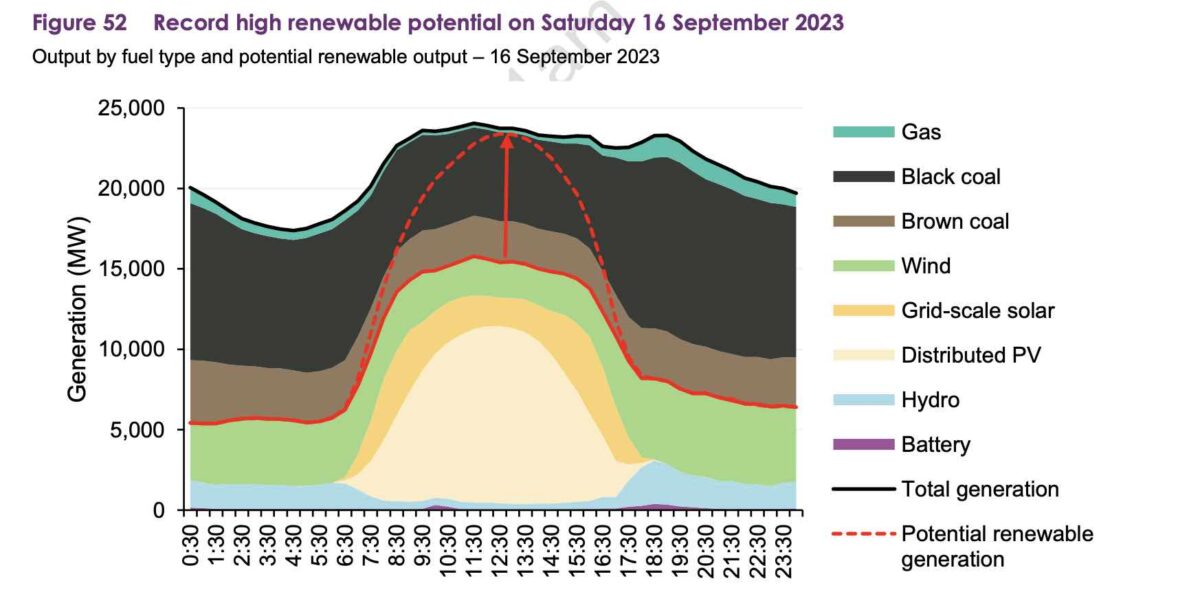
The Australian Energy Market Operator, in its latest Quarterly Energy Dynamics update of the main grid, notes that the NEM as a whole reached a new peak in “potential renewables” of 98.6 per cent at 1230 AEST on Saturday, September 16 this year.
This record is based on a 30-minute interval – as are all AEMO benchmarks – and as RenewEconomy wrote at the time, the 5-minute interval showed a peak of 101.7 per cent of renewable potential.
AEMO noted in its report that at the time of the “potential” peak, renewables supplied 15,410 MW (64.9%) of total NEM generation, and grid-scale solar and wind offered an additional 7,980 MW to the market at this time.
But they offered their capacity at prices above the prevailing spot price and were therefore not dispatched. (Some wind and solar generators do this deliberately because they choose, or their off take agreements demand, to not send output to the grid at negative prices).
AEMO is seeking to make the grid ready to accept short periods of “net” 100 per cent renewables as early as 2025, although it has many engineering challenges to overcome, and grid protocols to establish, mostly relating to maintaining grid security (services such as system strength and inertia).
The record renewable “potential” in South Australia was not the only record to fall in a busy weekend. As reported on Saturday, the instantaneous share of renewables hit a new peak of 70.5 per cent (for a 30 minute) period on Friday, according to AEMO.
And on Sunday, the share of wind in the Victoria grid hit a new peak of 88.5 per cent at 3.50 am (AEST), while the “potential” renewables in NSW hit a peak of 96.5 per cent at 12.05pm (AEST) on Sunday.
See also: Solar behind big price falls as grid demand and coal power pushed to record lows
And: South Australia names winners of world-leading hydrogen tender in race to 100 pct renewables
One state in Australia remains particularly vulnerable to global oil shocks because it hasn't built…
David Hochschild, the head of the California Energy Commission, on how the world's fourth biggest…
Fifty years of cheap gas and electricity and intensive marketing have distorted perceptions. Every element…
Australian Energy Market Operator says its system and market operation functions should not be separated…
The Clean Energy Council has approved a new PV module with around 25 per cent…
An in-depth webinar exploring the next phase of residential battery storage in Australia, brought to…