South Australia is leading Australia – and the world – with the amount of wind and solar within its state grid. And not only is it defying the skeptics that insisted wind and solar can’t power a modern economy, it’s also the grid facing the smallest reliability gaps over the coming decade.
South Australia sourced 70 per cent of its local demand from variable renewables in 2022 – nearly twice the percentage of the second best state grid (Victoria, with 38 per cent), and more than any other gigawatt scale grid in the world.
In the December quarter, that average lifted to 80 per cent wind and solar – and it’s doing this at the end of a long “skinny grid” that is connected to only one other state – and breaking the stranglehold that gas generators have over wholesale electricity prices in Australia and around the world.
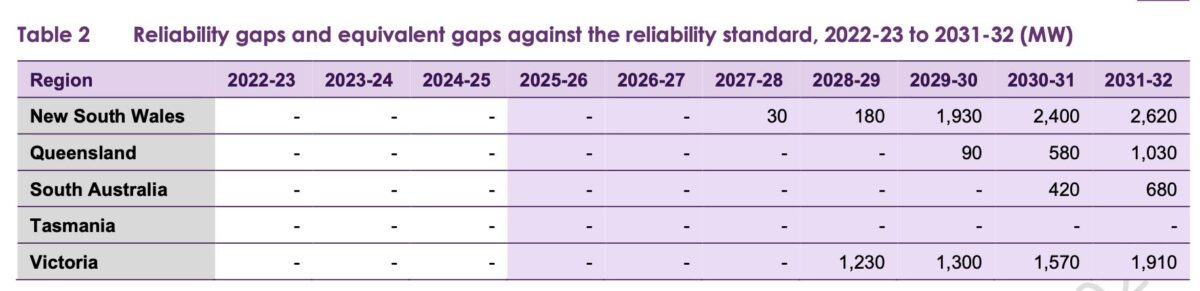
Now, according to the latest electricity supply assessment issued by the Australian Energy Market Operator, South Australia is facing the smallest reliability gap of any state in the country’s main grid, apart from the hydro-blessed Tasmania.
This graph above illustrates how. The green line (Tasmania) shows no reliability issues at all in the coming decade, thanks to its existing hydro facilities that cover nearly all its generation and dispatchable capacity needs.
NSW and Victoria face the earliest challenges, according to AEMO’s new update of its Electricity Statement of Opportunities (ESOO), mostly because they will witness the next rush of big coal plant closures.
They are predicted to breach the reliability standard within five years, if nothing is done, but AEMO’s assessment does not factor in the stated plans by those state governments to seek multiple gigawatts of new wind, solar and storage through their various auction and tender mechanisms over the coming years.
Queensland is the next state facing a potential breach of its reliability standards – from 2029 when the first of its big coal generators start to close down – although that state’s planned investments in large pumped hydro projects should lower the risk significantly if they go ahead.
That leaves South Australia, predicted in the latest ESOO update to possibly breach the reliability standard in late 2029, early 2030. But even that is unlikely to happen, given the amount of new generation, new storage, and some of the massive green hydrogen investments that will occur before then.
The ESOO notes that South Australia’s short term problems have been addressed by the decision to build a new big battery at Tailem Bend, next to the existing solar farm of the same name and a stage 2 project now being built.
It is also being assisted by confirmation that Iberdrola is building a new fast-start gas generator at Bolivar, relocating and replacing the emergency diesel generators installed by the state government after the 2016 system black, and by news that Origin will keep its Osborne gas fired generator open a few years longer.
Further down the track AEMO notes that a host of smaller gas plants are likely to close around the end of the decade, pushed out of the market by the new transmission link to NSW and the greater role of batteries and other technologies in delivering essential grid services.
That could create a potential supply shortfall if nothing was done, but AEMO notes that there are plenty of battery projects in the pipeline, along with the state’s green hydrogen plans, that would cover that.
It doesn’t name the projects, but Neoen has already signed a deal with BHP that supports the 200MW/400MWh Blyth battery, which will help deliver 24/7 green energy to the massive Olympic Dam mine, and Neoen is also keen to install battery storage as part of its massive Goyder South wind, solar and storage hub.
The state government’s green hydrogen plans also include a 250MW hydrogen power plant at Whyalla, powered by a 200MW electrolyser that in turn will be fed by more than a gigawatt of new wind and solar.
Indeed, if the Port Bonython green hydrogen precinct also goes ahead, there could be multiple gigawatts of new wind and solar capacity – and storage – that can fill any gaps that emerge.
And Vast Solar has now got most of the funding it needs for a 30MW concentrated solar plant with ten hours storage that it would like to ramp up to 150MW by the end of the decade.
At that stage, South Australia will be heading towards its long term goal of “500 per cent” renewables, shining the pathway for the other states still trying to shake their dependence on coal and gas.
Big batteries and households continue to have a big impact on Australia's main grid, helping…
The cost of Snowy 2.0 has doubled again, this time up to a potential $25…
Australian solar innovator 5B has landed a new order for 70 MW of its pre-assembled,…
Midday prices rose from around zero to $25–30 in the last 30 days, and that…
The extension of the SRES has triggered a jump in interest for solar panels -…
Fortescue gets ready to lift Australia's tallest and most powerful turbines into place, as the…