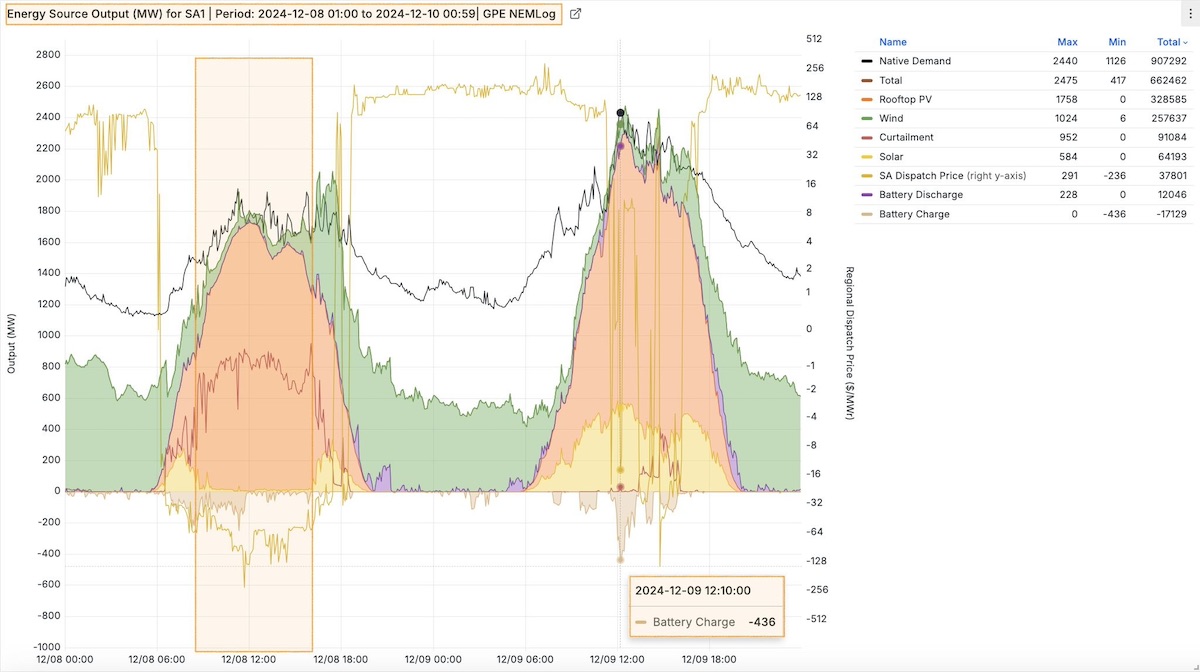
South Australia set two significant records on Monday this week, showcasing the dynamic interplay between solar generation and battery storage on the world’s most advanced variable renewable grid.
It was, in the end a perfect “pigeon pair” of complementary technologies balancing the grid, which leads the world in its share of wind and solar with an average 72 per cent plus share over the last 12 months, and a target of 100 per cent “net” renewables in 2027.
The two key records were a new peak for instantaneous solar Generation: At 12:00 hrs, SA reached a new record of 583.9 MW, surpassing the previous record of 567.7 MW, set last Wednesday.
It came about the same time as the state set a new record for Instantaneous battery charge: At 12:10 hrs, the instantaneous charge hit minus 435.7 MW, exceeding the previous record of minus 366.0 MW, set on November 30 this year.
Unlike Sunday, when utility solar output was curtailed from approximately 08:00 to 16:30 hrs due to low native demand, and high rooftop PV output, Monday’s higher weekday demand allowed more solar energy into the grid.
Also, on Sunday, the state’s fleet of big batteries were fully charged by noon, which extended the solar curtailment. Monday’s commercial and industrial activity created enough demand to enable utility solar to operate at full capacity while balancing the grid.
Periods of curtailment and low prices are driving the development of a more flexible grid, encouraging investments in energy storage systems at both the utility and household levels – another “pigeon pair” of complementary market responses:
– Utility-Scale Storage: Large batteries charge when solar output is high and prices are low, discharging when demand and prices increase.
– Household Batteries: Home energy systems store excess solar, reducing grid reliance while maximising returns from dynamic electricity prices.
As solar output rises, batteries provide a critical balancing service, reducing curtailment and preventing negative prices. The increasing number and size of the battery systems supports grid flexibility and enhancing energy security.
Looking ahead, more batteries will boost market participation – charging when solar is abundant and discharging when demand spikes, ensuring grid stability and enabling the energy transition.
South Australia’s ability to balance variable solar output with large-scale batteries reflects how renewable integration is becoming more effective and sophisticated. These records show how far we’ve come – and how much further we can go.
A version of this article was originally published on LinkedIn. Reproduced here with permission.
Earthworks begins on key substation for the Copperstring transmission line that will unlock some of…
Technology used to build world's tallest wind turbine, to tap into high altitude winds, similar…
State-owned utility cuts full-year loss after lifting generation and collecting a one-off insurance payment for…
New report shows Germany generated as much solar energy by end of September as in…
Plans by the owner of Australia's biggest wind farm to build a new stand-alone battery,…
A new scorecard tracking progress of the renewable energy sector against government targets reveals a…