Plans backed by international renewables giant Engie to build a solar powered, megawatt-scale hydrogen electrolyser plant to produce “green ammonia” in the Western Australia Pilbara region have been referred to the state’s Environmental Protection Authority.
Yara Pilbara Fertilisers and Engie said the project would initially build an 18MW solar farm and a 10MW hydrogen electrolyser within the Burrup Strategic Industrial Area (SIA), to provide a zero-carbon feed source for the existing YPF Ammonia Plant.
The longer terms plans are for a 100MW solar plant and an electrolysis system of around 66MW.
The two companies began actively investigating the feasibility of decarbonising Yara’s Pilbara ammonia plant in February of last year, with the backing of $995,000 in grant funding from the Australian Renewable Energy Agency.
Yara said at the time that the renewable hydrogen produced would displace 30,000 tonnes a year of hydrogen that was currently derived from fossil fuels. In documents submitted to the WA EPA this week, it was estimated the plant would produce around 640 tonnes of renewable hydrogen a year.
As Engie explained it in 2019, the goal is to transform the plant from one that relies completely on natural gas for hydrogen to one where a significant share of the hydrogen comes from renewable power.
“Engie is investing in clean hydrogen in the belief that it is likely to become a key component in clean energy networks because it can store energy in large quantities, over long periods of time and across great distances. Hydrogen can make the sun shine at night,” said Engie Hydrogen CEO Michèle Azalbert in comments at the time.
The documents this week said the footprint of the renewable hydrogen plant would be “discrete,” at just under 25 hectares, including the solar array, the hydrogen electrolyser and the associated infrastructure. These would be built adjacent to the existing ammonia facility, roughly 11 km north-west of Karratha.
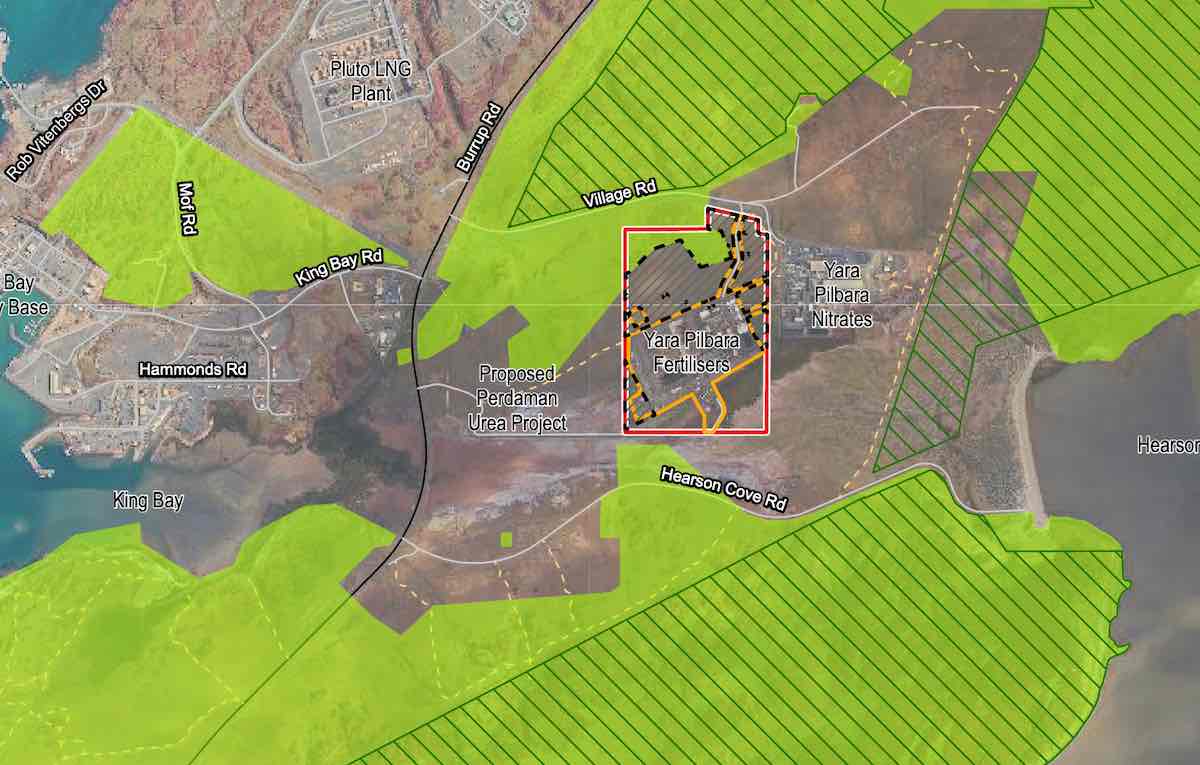
This will be important, as the project is proposed for land adjacent to a National Heritage listed area and the Murujuga National Park, as illustrated in the diagram below (the light green-shaded areas are the heritage listed parts and the thin dark-green stripes are the National Park area).
YPF and Engie also noted that the project would support decarbonisation on Murujuga (Burrup Peninsula) and support Australia’s developing ‘green hydrogen’ market, while keeping up the production of ammonia at the existing plant.
“It is expected to promote economic growth in the region and result in employment opportunities for the local population in both the construction and operational phase, including the opportunity to work together with the local Aboriginal traditional owner groups to develop commercial, employment and training opportunities,” the documents said.
The plans of Yara and Engie join a long and ever growing list of renewable hydrogen projects proposed for all around Australia, including the massive Asian Renewable Energy Hub project that proposes to develop up to 26GW of wind and solar capacity – also in WA’s expansive Pilbara region.
That project, which late last year gained major project status from the federal government as well as the backing of Copenhagen Infrastructure Partners, aims to invest more than $50 billion in establishing a massive renewable energy export hub, which would include the export of wind and solar energy to Asia, through the production of renewable hydrogen fuels and ammonia.
And last month, iron ore billionaire Andrew Forrest and his Fortescue Metals jumped on the band wagon, with plans to be producing green hydrogen at commercial scale as early as 2023, and to use much of it to make green steel in Australia.
Yara and Engie have the advantage, however, of a smaller-scale project and the existing ammonia plant and infrastructure. The companies said they expected construction to kick off sometime this year, when and if all regulatory approvals were secured, and continue until June 2023, all going to plan.
Senior CSIRO scientists discussed how to have an "open conversation" about the rising threats from…
New 150 MW solar farm joins the NZ grid on the South Island, matching Aotearoa's…
Pacific leader turned activist says his island nation urgently needs to start "radical adaptation measures"…
A study tested two wind forecast models and found that more accurate one does not…
Australia's biggest wind projects have mostly locked in approvals and contracts, but are still shaking…
New analysis says Australia's dependence on imported diesel means some households are getting hit twice…