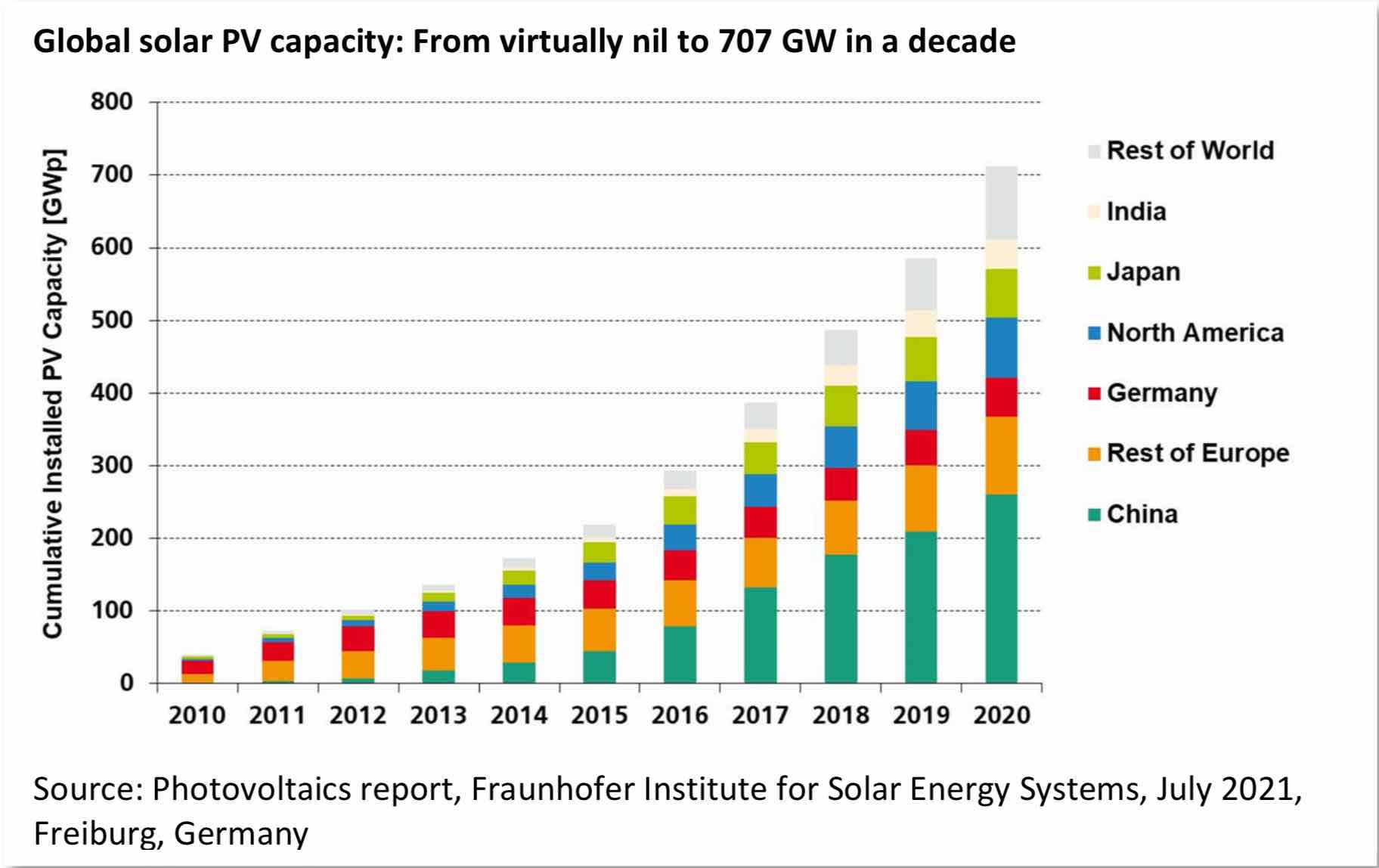
Solar Photovoltaics (PVs) have enjoyed compound annual growth rate (CAGR) of 34% between 2010 to 2020, including off-grid installations.
That explains how we reached cumulative installed capacity of 707.5 GW, generating 856 TWhs of electricity – roughly 3.2% of the global generation – by the end of 2020, according to a recently published report from Fraunhofer Institute in Freiburg, Germany (visual).
Impressive as it is, the technology keeps on getting better, more efficient at converting sunlight to electricity while using less raw material and energy in the manufacturing process.
The energy payback time of typical PV systems can be a year or less depending on the technology and the level of solar insolation. A wafer-based Silicon PV module installed in sunny Sicily, for example, has an energy payback time of around one year.
Assuming 20 years lifespan, it can produce 20 times the energy needed to produce it.
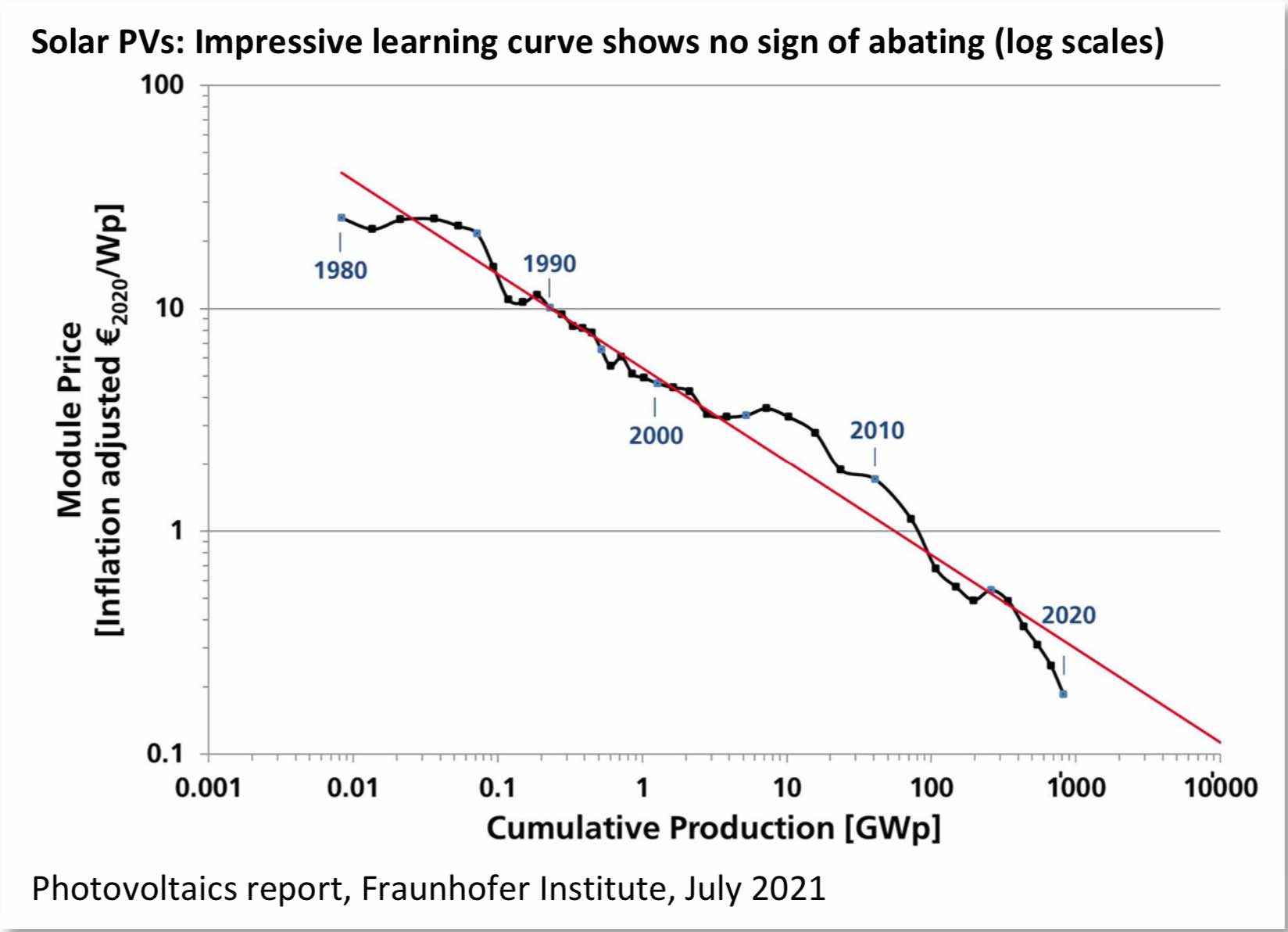
Solar PV technology’s Experience Curve – also called Learning Curve – shows that in the last 40 years the module price decreased by 26% with each doubling of production resulting from economies of scale and technological improvements (visual below right).
These impressive trends, it must be noted, were not experienced with thermal technologies, in particular nuclear power.
In contrast, nuclear construction costs have remained high and increasing rather than decreasing over time – and the time it takes to build a new reactor has gotten longer, not shorter, in the recent past, which explains why not many new reactors are being built anywhere in the West.
Similarly, other conventional thermal generation technologies, including coal- and gas-fired plants, have not seen such dramatic price reductions over the past 40 years and seem unlikely to experience it in the future. If anything, requiring fossil-fueled plants to capture and store their carbon emissions will make them more expensive.
Wind and solar technologies, by contrast, do not emit carbon to generate power and can produce far more energy over their lifetime to recover the energy that is used to manufacture them.
Fossil- fueled plants continue to spew significant amounts of carbon for as long as they operate. They need energy to produce electricity.
Solar and wind enjoy other advantages: neither requires water – increasingly a scarce resource. And unlike hydro, which is likely to be affected by droughts and extreme weather events, wind and solar should prevail.
Their main disadvantage is variability – you cannot depend on them for uninterrupted output. That is a serious challenge that cost-effective long-duration storage – along with more flexible demand – can hopefully address.
Fereidoon Sioshansi is editor EEnergy Informer. Reproduced with permission of the author.
Off-grid gold mine achieves 155 consecutive hours of running on 100 pct renewables, with "engines…
Regulator seeks feedback on range of updates to retailer guidelines, following a series of market…
CATL launches world’s biggest open-source energy storage testing platform, as it starts mass production of…
The economics of building new wind farms in Australia is "getting worse, not better," project…
Repairs to one of its three transformers allows Australia's most powerful battery to reach full…
Lightsource bp hails "new phase" in global power sector after announcing the start of construction…