The Phnnx solar system in action. Image: Phnnx
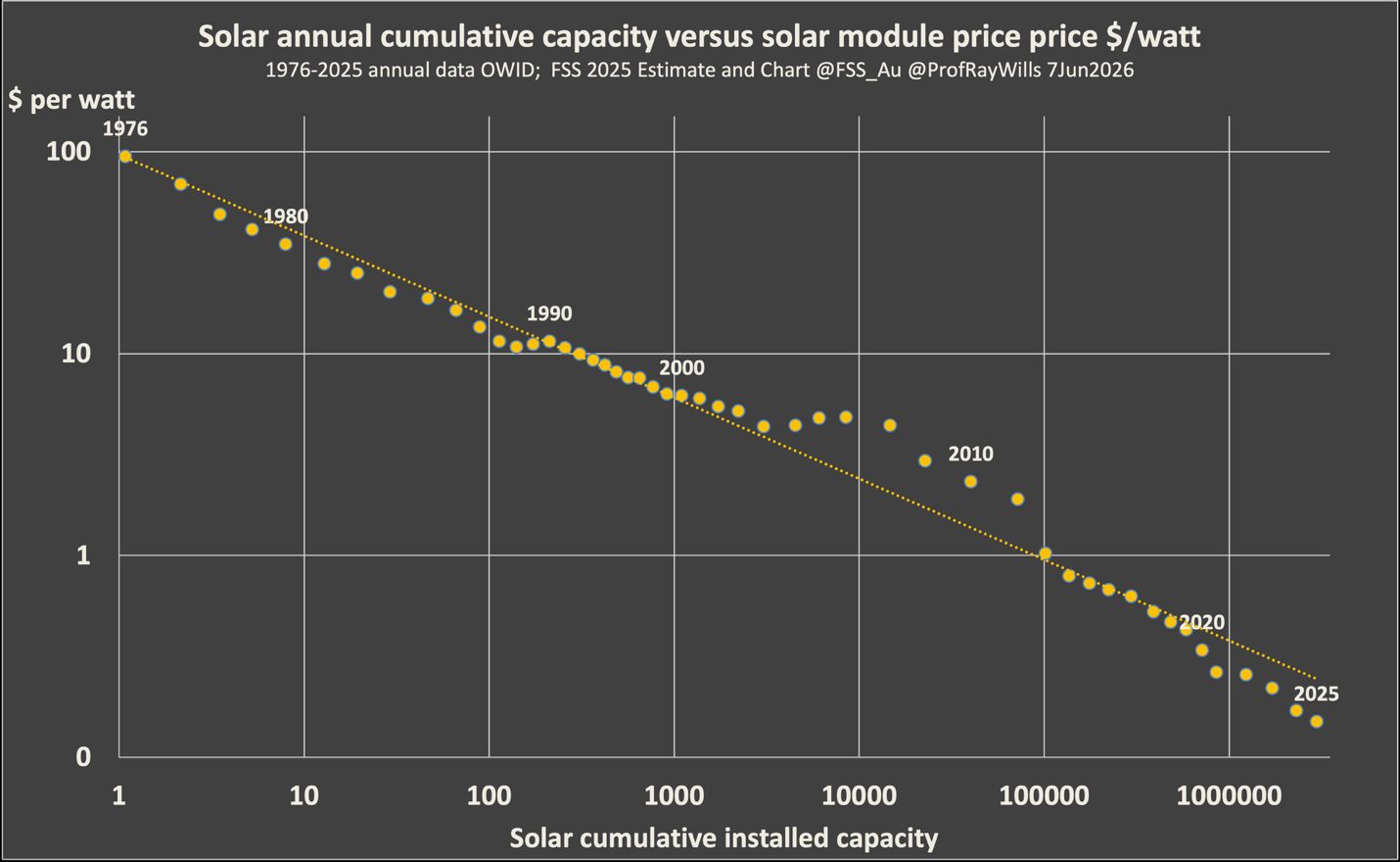
Solar is not just getting cheaper; it is sprinting down a learning curve that has held for half a century, with module prices falling about ten-thousand-fold as cumulative capacity has exploded.
That is my first message: a technology whose cost keeps dropping predictably as deployment grows, and where every new gigawatt makes the next gigawatt cheaper again.
And beating the trend line.
The second message is about speed.
When we line up all major power sources from the year each first exceeded a bigly amount of energy – 100 TWh – solar and wind are now racing ahead faster than coal, gas, hydro or nuclear ever did – nuclear did move fast for a while there, but then it stopped. Wind hasn’t.
And batteries are climbing even more steeply from their own 100 TWh “year zero”.
This is already the fastest shift in electricity generation in history, and it is still accelerating.
The third story is where it takes us.
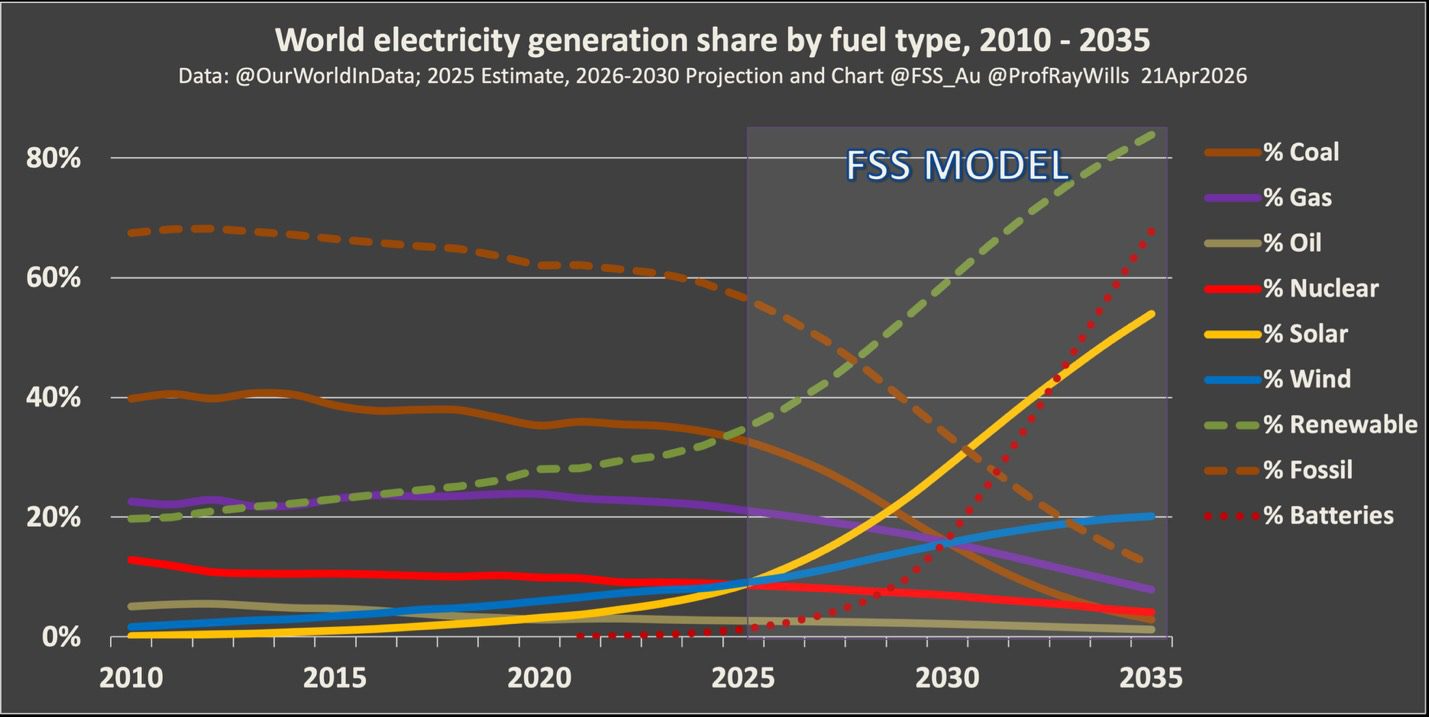
On current trajectories, the Future Smart Strategies model has solar, wind and batteries driving renewables towards around 80 per cent of global electricity by 2035, with coal, oil and gas pushed to the margins of the system.
Yet mainstream outlooks such as BNEF’s 2026 New Energy Outlook still assume a convenient slowing of this trend beyond the visible horizon, even though every call for a slowdown since 2015 has been wrong, and every retrospective look has had to revise growth up, not down.
Solar is moving fast. Really fast. Batteries are moving faster.
There is no evidence in either prices or deployment that the system is about to tap the brakes.
For our Future Smart global growth model, the logical response is not to ask why the transition is so quick, but to ask: why on earth it would be slow?
The battery industry is about to witness another change in chemistry and technology. Valo Energy…
Energy minister says imminent closure of coal is "indisputable," and "ideology-driven" policies to scrap transmission…
The supplier to the biggest battery currently being built in Australia expects to announce its…
The federal government green bank has dusted off an old mandate, but has not ruled…
Fossil fuel interests spent $1.2 million on Meta ads in the last three months, a…
Australian Renewable Energy Agency says the country can still become a major solar PV manufacturer,…