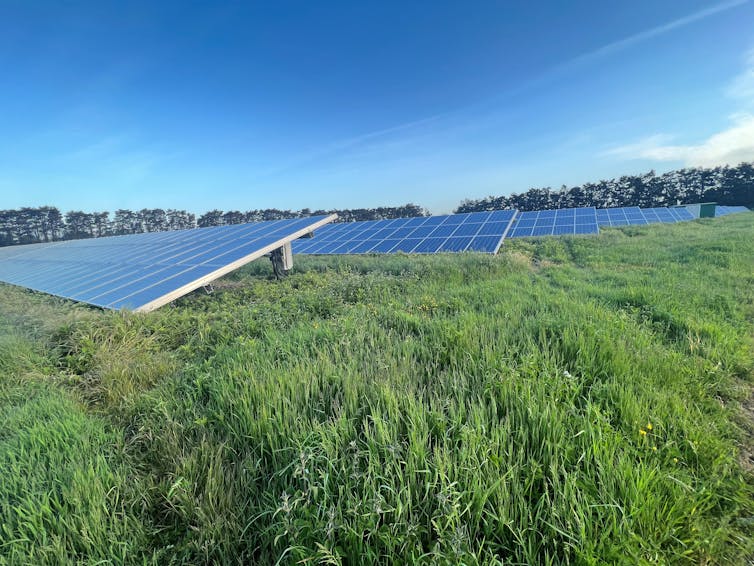
A stonechat on the edge of a solar farm. Credit: Joshua Copping
The UK’s installed capacity of solar power expanded rapidly over the past decade to reach 17.2 gigawatts (GW) in 2024 – enough electricity to power roughly 4 million homes.
The government aims to raise solar generation capacity to 70 GW by 2035. And by 2050, the government’s advisers estimate that as much as 90 GW of solar power may be needed to achieve net zero emissions.
Building solar farms – large-scale installations of solar panels on agricultural land – will have to be done carefully, to avoid exacerbating another environmental crisis: the dwindling variety of wildlife, or biodiversity.
However, surprisingly few studies have examined the impact of solar farms on biodiversity. Our new research is one of the first to study the impact of solar farms on birds in the UK.
And, hectare-for-hectare, we found that solar farms in the farm-rich East Anglian countryside that were managed with biodiversity in mind contained a greater number of bird species, and more birds overall, than surrounding cropland.
During spring 2023, we used the breeding bird survey method to survey solar farms in the East Anglian fens that were under different management styles.
These sites ranged from intensively managed solar farms, in which the grass surrounding panels is cut or grazed short throughout the year, with no hedgerows or small trees, to mixed-habitat solar farms where infrequent cutting or grazing has allowed wildflowers, trees and hedgerows to grow along boundary fences. For comparison, we also surveyed the surrounding farmland.
We found that the number of birds on the mixed-habitat solar farms was typically twice that of the intensively managed sites, and three times higher than adjacent high-yielding cropland. The number of species on mixed-habitat solar farms was 2.5 times higher than both of the alternatives.
Our study also showed that solar farms offer important habitat for a number of threatened bird species. In fact, birds such as yellowhammer, linnet, greenfinch and corn bunting, which are of particular concern to conservationists due to their declining national populations, were considerably more abundant on mixed-habitat solar farms.
Perhaps our results aren’t that surprising. After all, the mixed-habitat solar farms we surveyed contained many of the features birds prefer (similar to nature-friendly farms in less intensively farmed areas).
These features include hedgerows, which can offer berries to eat and crevices to shelter in, particularly for birds adapted to woodland habitats. The tall and diverse vegetation around the solar panels contains a variety of habitats, with insect prey or seeds for food. The intensively managed cropland and solar farms had none of these features.
By providing the right habitat, birds have been naturally drawn to these solar farms in an area that sorely lacks it.
So, solar farms can benefit biodiversity in rural landscapes dominated by intensive agriculture in the UK. Especially when they are designed to allow plants to grow around the panels, and have hedgerows or trees in the margins. Prioritising the needs of wildlife when planning solar farms could help the UK meet its climate commitments while helping nature.
When grass was allowed to grow long on solar farms, it appeared to encourage birds. Joshua Copping
What’s more, our previous research has shown that the UK has enough land to deploy 90 GW of solar power – enough to meet suggested capacity by 2050 – without damaging bird populations at a national scale or affecting food production. Our new findings should allay public concerns about some of the risks of renewable energy to wildlife.
We have a golden opportunity for finding multiple functions for land: generating clean energy while restoring biodiversity at the same time.
Catherine Waite, Research Associate, Department of Zoology, University of Cambridge and Joshua Copping, Conservation Scientist, RSPB & Visiting Researcher, University of Cambridge
This article is republished from The Conversation under a Creative Commons license. Read the original article.
A large-scale solar and battery project seeking federal environmental approval proposes to use an innovative…
Australia's solar waste investigation raises an interesting question of consistency. Where is the inquiry into…
Angus Taylor has been elected leader of the federal Liberal Party, deposing Sussan Ley just…
Another five-hour battery reaches financial close, this one to piggy back over an existing gas…
Sam Reynolds, the head of Octopus Australia, on why he hopes to build the country's…
Concern about system security has already delayed the closure of Australia's biggest coal generator. But…