The Stockyard Hill wind farm
New data from Rystad Energy has revealed that 4.5 terawatt-hours of large-scale solar and wind generation was curtailed over the course of 2024, the equivalent to the annual renewable energy output of the original Snowy Hydro scheme.
Energy curtailment, the deliberate reduction or shutting off of power generation, usually happens in response to overcapacity on the grid or for economic reasons, when the cost of generating energy is higher than the market price being paid for its supply.
In Australia, renewables have been bearing the brunt of grid congestion management on the National Electricity Market – even though their output is cheaper and cleaner than coal and gas generation.
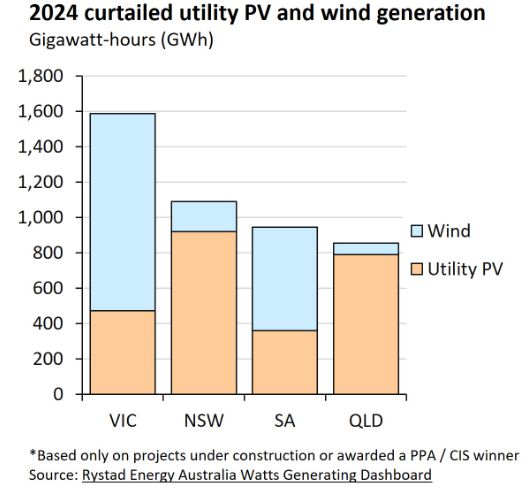
The Rystad data and table below – shared on LinkedIn by Clean Energy Council grid policy officer Ana Spataru – does not distinguish between the types of curtailment, but does differentiate between spilled solar and wind, while also offering a comparison of the level and type of curtailment for each of the states.
As the data shows, Victoria chalked up the highest total amount curtailment, mostly of wind generation but with a decent amount of big solar curtailment, too.
Rystad notes that this trend reflects Victoria’s remaining dependence on brown coal generation, which has a limit on how low it can be constrained in the middle of the day. The result, it says, is that despite high volumes of cheaper renewables, coal is dispatched and renewables curtailed.
For those who need reminding, this is a timely illustration of why “always on” nuclear power – would be such a bad fit for the Australian grid, even at the level of renewables in the mix today.
Elsewhere on the National Electricity Market, large-scale solar was almost exclusively curtailed in New South Wales and Queensland, while in South Australia it was wind that was most often pushed out of the equation.
Rystad says significant new big battery energy storage systems (BESS) being commissioned around the country throughout 2025 are ewxpected to improve curtailment.
Hybrid projects and renewable energy hubs – where solar and/or wind farms are paired with a battery or a combination of the three, are also becoming a part of the solution, Rystad says.
Australia's largest energy retailer confirms renewables are cheapest source of new generation, says batteries can "solve…
Upgrading all of Australia's public hospitals from gas to electricity could save millions of dollars…
Australian technology company PlasmaLeap is using renewable electricity to turn atmospheric nitrogen into fertiliser, offering…
Updated: The $2.5 billion deal to help Australia's biggest aluminium smelter go green will see…
We've seen impacts of the record-breaking El Niño in the Northern Hemisphere – including heat-related…
The NSW government's plan for a Great Koala National Park now includes seeking the rights…