Credit: Snowy Hydro
(Note from editor: Leading energy analyst Dylan McConnell recently read Snowy Hydro’s response to submissions to its controversial Kurri Kurri gas generator and published this thread on Twitter. With his permission, we have appended and (lightly) edited it with the appropriate punctuation for the long form).
I’ve just read part of Snowy Hydro’s response to submissions on the Kurri Kurri gas project in the Hunter Valley. What can I say – but wow.
It is hilarious that a response that purports to correct “misuse” of reliability numbers gets so, so many things wrong. It seems real amateur-hour stuff from Snowy Hydro and (consultants) Jacobs, to be honest.
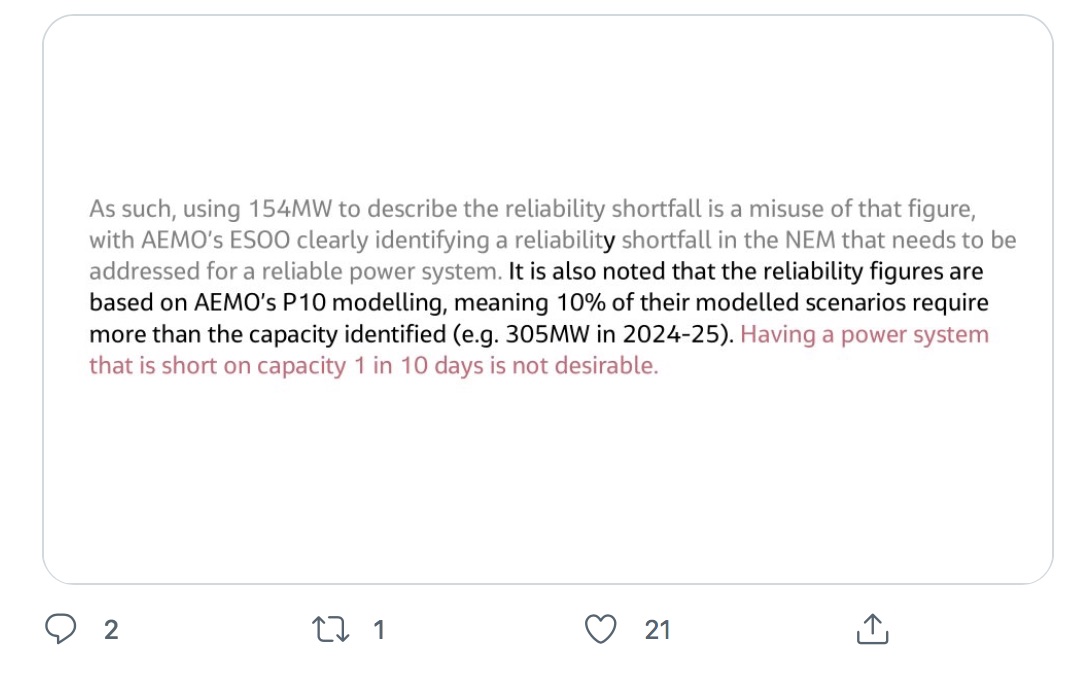
Take this first excerpt from the Snowy response (above, see line in red). AEMO (the Australian Energy Market Operator) does not do system planning on the basis of the system being short 1 day in 10.
For the record: “… a 10% POE (probability of exceedance) maximum demand forecast, for example, is expected to be exceeded, on average, ‘one year in 10’.” That means Snowy and Jacobs are out by a couple of orders of magnitude.
And it certainly doesn’t mean that “10% of their modelled scenarios require more than the capacity identified”. That’s not even close. More on this later.
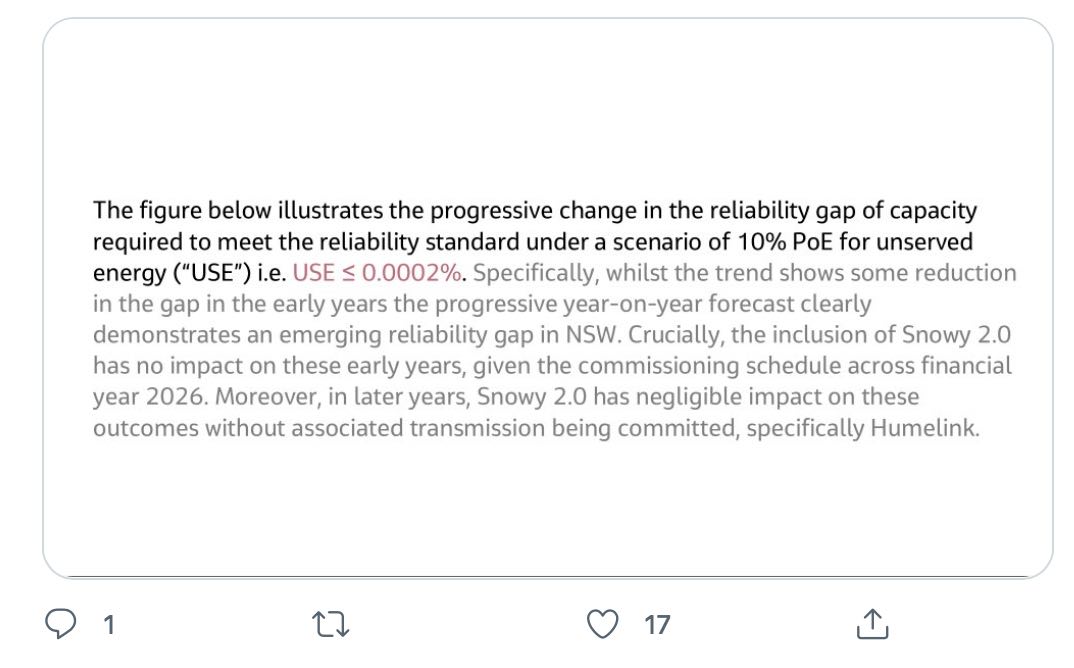
Okay, next. This one (above, highlighted in red) just hurts my brain. Firstly, the reliability standard is 0.002% (and the interim reliability standard is 0.0006%).
So, it’s also out by an order of magnitude (Let’s be generous and put that down as a typo). That aside – the sentence makes zero sense, when you think about how it’s calculated (and what it means).
This requires explanation…
The reliability standard is measure in terms of *expected* Unserved Energy (USE). AEMO uses a Monte Carlo simulation approach (to capture things like unexpected outages etc) and different demand scenarios (i.e. like a POE10% – as described above).
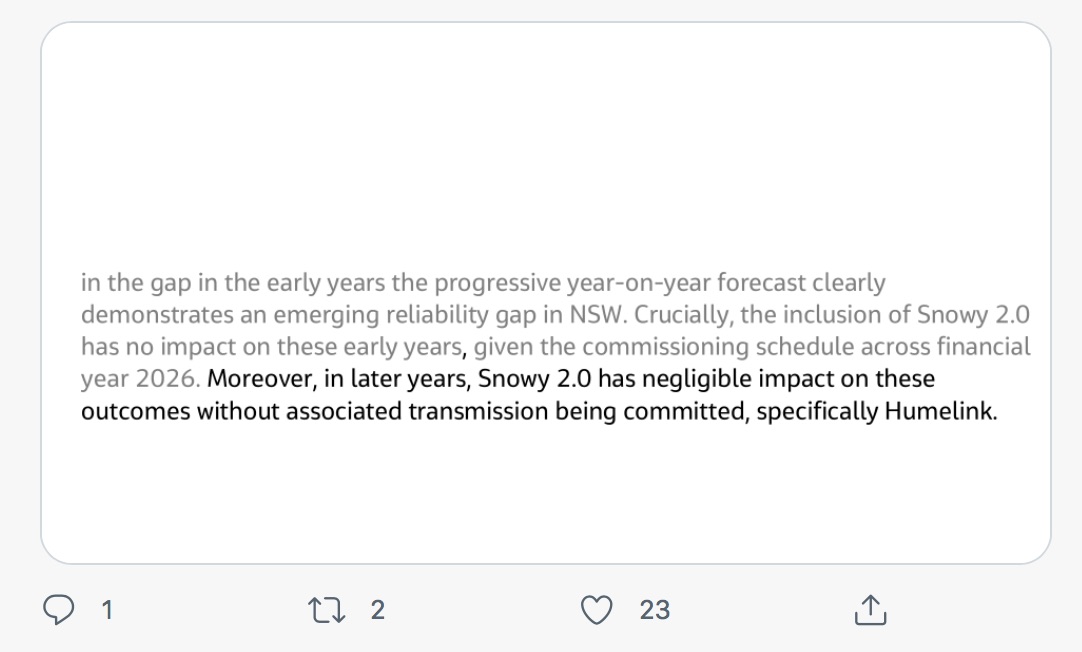
These are combined with various weights for different scenarios to give an *expected* unserved energy amount. So the sentence here (below in black) is nonsensical, at best, or just plain wrong.
It’s just not even close to how expected USE is calculated or should be thought about.
On a less technical vein, it’s extremely amusing that part of Snowy Hydro’s justification for building Kurri Kurri is that their other project (the 2GW Snowy 2.0 pumped hydro) won’t be connected.
To be clear, this is essentially arguing that it’s better to build a new gas plant, than connect “an already built” Snowy 2.0, that will presumably be sitting there, idle – in order to close the supposed reliability gap (which doesn’t actually exist).
(The most recent ESoO – Energy Statement of Opportunities – actually makes clear that HumeLink will “increase the delivery of additional firm capacity from Snowy 2.0 to Sydney, with a projected reduction in USE from 2025-26).
A quick reminder here: there is actually no “gap” or reliability shortfall to meet the actual reliability standard (0.002% expected USE) in NSW in the near term. (There is a slight gap with the tighter interim reliability measure of 0.0006% expected USE).
That brings us to a rather bold claim:
“There are further developments since the AEMO 2020 ESoO that will increase the reliability risk to NSW.”
That could go the other way, I reckon. I guess we’ll find out in a couple of weeks time when next ESoO due out.
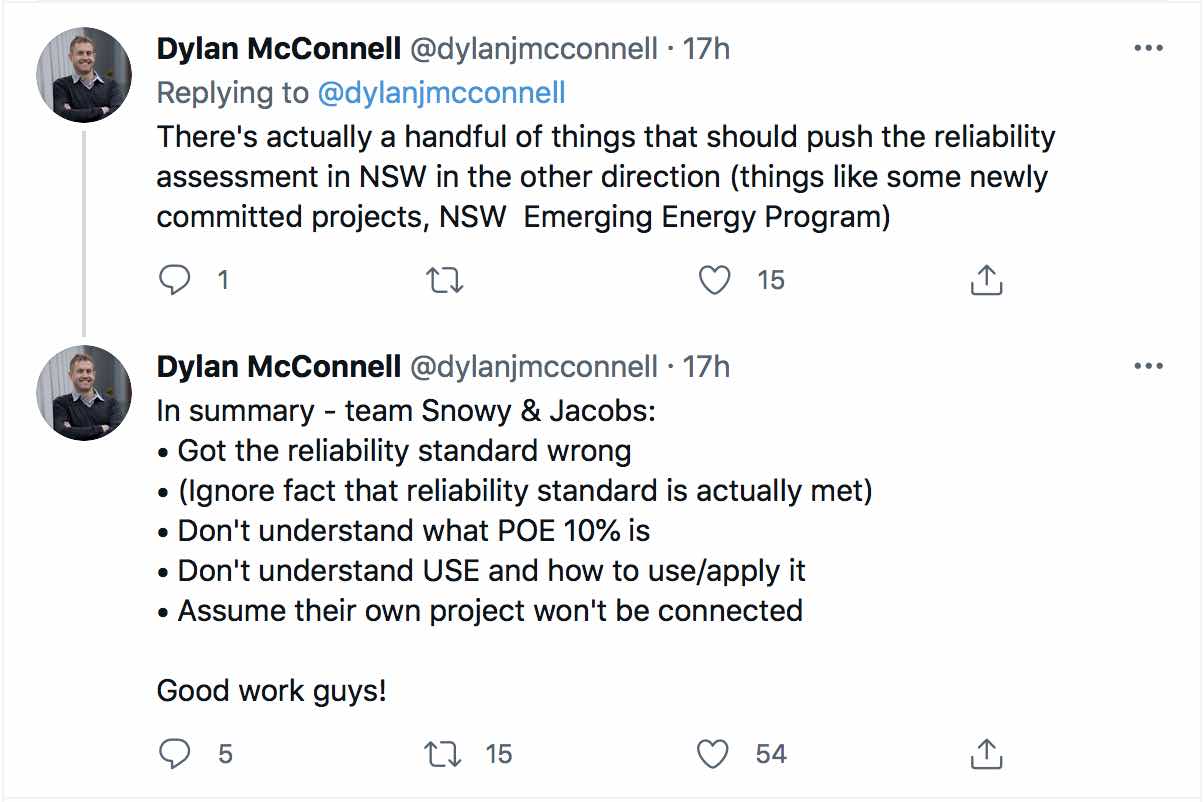
There’s actually a handful of things that should push the reliability assessment in NSW in the other direction (things like some newly committed projects, and the NSW Emerging Energy Program).
In summary – team Snowy and Jacobs:
• Have got the reliability standard wrong
• (Ignore the fact that reliability standard is actually met)
• Don’t understand what POE 10% is • Don’t understand USE and how to use/apply it
• Assume their own project won’t be connected.
Good work guys!
Dylan McConnell is an energy analyst with the Climate and Energy College in Melbourne.
Few organisations have so consistently campaigned to stymie climate action – possibly anywhere on the…
Tom Geiser from Good Heat on the technologies to provide carbon-free industrial heat. Plus: LNP's…
Days apart, one Australian minister called for reduced dependence on fossil fuels, while another literally…
Swiss storage giant completes purchase of the project site for big four-hour battery, setting a…
Installation of the "golden" turbine is being hailed as a "huge milestone" for a wind…
A paddock of solar and an innovative converter could allow Visy to cut gas use…