Image: Orsted
Australia has moved a major step closer to building its first ever offshore wind farm with the first round of long-awaited feasibility licences handed out to projects proposed for development off the coast of Gippsland in Victoria.
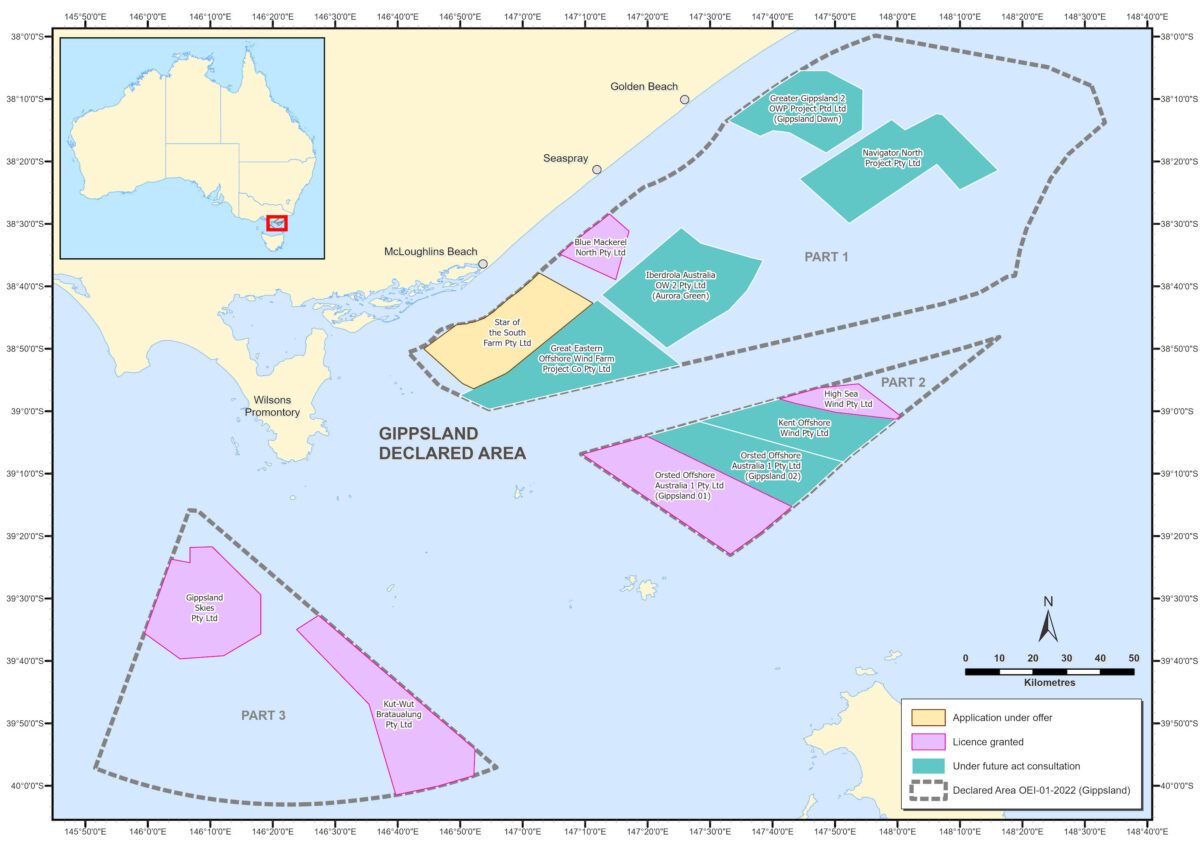
Six potential offshore wind projects have been awarded feasibility licences by the federal government in the country’s first offshore wind zone, with another six to follow, pending further engagement with Traditional Owners. Altogether, the 12 projects could total 25GW of renewable capacity.
And while this might seem like a lot of prospective projects for one 15,000km2 offshore wind zone, the number was whittled down from the 37 applications the federal government is said to have received.
The first-round winners include the project billed as most likely to be Australia’s first completed offshore wind farm, the 2.2GW Star of the South being developed by Copenhagen Infrastructure Partners, Cbus and its original Australian co-founders Andy Evans, Terry Kallis and Peter Sgardelis.
Indeed CIP emerged as the biggest winner of the tender as it is also involved in the Kut-Wut Brataualung Project.
Other big winners included Ørsted, the Danish wind giant whose Ørsted 1 has been awarded a feasibility licence, and a second project is included in the possibles, and High Sea Wind Project North, proposed by Madrid-base EDP Renewables and Paris-based Engie.
Australian energy giant AGL is also part of a consortium that won a feasibility licence for the 2.5 GW Gippsland Skies project. AGL has a 20 per cent stake, and its partners are Mainstream Renewable Power (35%), Reventus Power (35%) and Direct Infrastructure (10%). The other winner was Blue Marlin, owned by Parkwind/Jera.
The licences allow developers to make a start on detailed assessments of their proposed projects, including environmental studies and management plans. If feasibility is proven, they can apply for a commercial licence to build and operate an offshore wind farm.
This will be an enormously costly process. An industry insider estimates the pre-construction development spend for offshore wind projects to be up to $200 million, possibly more.
“These feasibility licences will allow developers to undertake detailed environmental assessments, geotechnical surveys, obtain approvals and undertake further consultation on their proposed projects,” federal energy minister Chris Bowen will say in a speech to an energy users group in Melbourne on Wednesday.
“Crucially, the Gippsland community will have several further opportunities to have their say before any construction commences.
“That includes when proponents develop management plans, seek approvals, and apply for commercial licences. And we’ll listen to that feedback – just as we listened to community views on the zone itself,” Bowen will say.
The six offshore wind projects in line to be awarded feasibility licences, subject to further consultation, are Ørsted 2, Iberdrola’s Aurora Green, the Great Eastern Offshore Wind Farm Project owned by Macquarie’s Corio, Bluefloat’s Gippsland Dawn, Origin Energy and RES’ Navigator North, and RWE’s Kent Offshore Wind.
Out of the running for a berth in the Gippsland zone is (as predicted) Flotation Energy’s 1.5GW Seadragon project. Another notable omission is the EnergyAustralia-backed Elanora Offshore project, a 5GW project proposed by a consortium including Dutch offshore specialist Boskalis.
“Granting feasibility licences is the next step to helping deliver a new clean energy industry for Australia, as well as future proof energy security and reliability for Victoria,” said federal energy minister Chris Bowen in a statement.
“I’ve awarded feasibility licences to projects that would bring the most rewards for Gippsland, its workforce and for our energy security.”
Victoria’s energy minister Lily D’Ambrosio will be glad of the progress, too, with the state having set targets of at least 2 gigawatts of offshore wind energy generation by 2032, 4 GW by 2035 and 9 GW by 2040.
“We’re proud to be paving the way for the country’s first offshore wind farms which will harness our world class offshore wind resources and power homes and businesses across Australia with renewable energy,” D’Ambrosio said on Tuesday.
“These offshore wind projects will also support thousands of jobs in Gippsland and across the supply chain – opening up new opportunities for skills development within the renewable energy industry.”
Andy Evans, one of the originators of the Star of the South (SOTS) project, told Renew Economy the awarding of feasibility licences marks a “big day” for him and co-founders Terry Kallis and Peter Sgardelis.
“Everyone thought we were a little crazy when we founded SOTS in 2012,” Evans said. “We’re delighted we now appear to have a legitimate industry!”
Evans says the next priority is to “crack on and build a local supply chain” in collaboration with established global players and to get turbines in the water.
“The support from the Gippsland community has been incredible and the region maintains its status as the energy hub of Victoria,” he said.
AGL COO Markus Brokhof said the development of Gippsland Skies could be “an ideal complement” to the transition of the gentailer’s Loy Yang coal plant in the Latrobe Valley, following its targeted closure in 2035.
“The build out of new infrastructure, new skills and local supply chains will be critical for both. As we progress the development of this offshore wind project, we hope to create a new era of innovation and new careers for the Gippsland region,” Brokhof said.
See more details on those projects here: Offshore wind: Who’s who in the race to build Australia’s first project
The grid is changing rapidly, battery storage durations are getting longer, and chemistries are changing…
Allowing balcony or plug in solar will make it easier to access cheaper, cleaner electricity…
Industry expert Claire Elkin on why Australia is missing out on global capital to fund…
MELBOURNE, Australia, 28 October 2026 — Fox ESS (Fox) showcases Power Beast, G-Max Plus, Power…
Join our experts to explore how expanded rebates could unlock an 80 GW market and…
Australia is home to 163 operational data centres with almost 100 more in the national…