Kennedy Energy Park construction. Supplied
The developers of a 1 gigawatt wind project in Queensland are proposing to use shorter turbines with longer blades, a move it says will halve the footprint of the project, but still bump up its capacity by 195 megawatts (MW).
Iberdrola bought the rights to the Mount James wind project in 2022, just before it wrapped up final state and federal approvals. The Queensland government still lists the project as having a capital cost of $2.6 billion.
This month it’s asked federal environment planners to change the original plans, now that it has a firmer idea of what it wants in a wind turbine, and after consultation with locals.
Instead of turbines with a 120-200m hub height and blades of 75m, it wants to install 7.2 MW turbines with a 166m hub height, but longer blades of 84m, according to a variation request sitting with the EPBC.
The change will alter one vital detail: a change in the swept area from 20,000 metres squared to 23,235 m2.
A larger swept area – the space the blade travels through – means the rotor can capture more wind and thereby generate more energy, which in turns lowers production costs per unit of electricity generated.
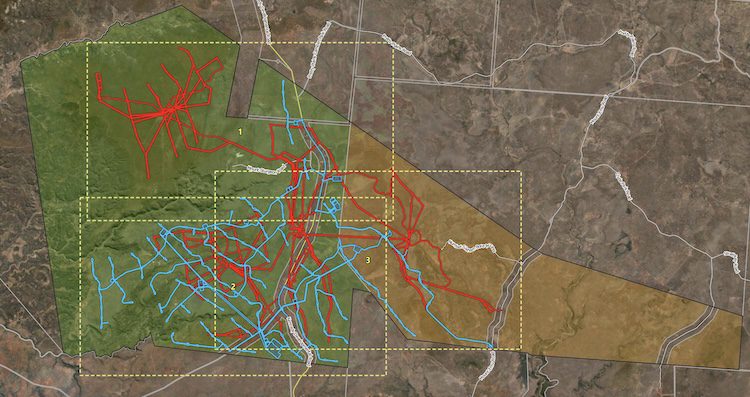
The wind farm will still host 166 turbines, but with a redesign that’s shifted from the north and east to the south and west that reduces the operational footprint by 40 per cent to about 700 hectares.
It also now factors in using on-site gravel pits after finding that the original regional options were too far away and couldn’t guarantee supply or a price, and accommodation for 22 people as short term housing in the area is limited.
Two new gravel pits, accommodation, more and bigger work areas, as well as a design that now includes plans for a battery, means the total area disturbed will be about 1500 hectares.
The red lines are the original design, and the blue lines are the proposed variation. Image: Iberdrola
The changes will need to be approved by Queensland regulators as well. What is unclear is whether Iberdrola is opening the whole project up to reassessment by a state government that is heavily scrutinising particularly wind farms.
In May, the state government reversed approval for the Moonlight Range wind farm near Rockhampton using new planning powers, on the basis of potentially dubious community objections.
It now also requires projects to have community benefits agreements signed ahead of lodging a development application.
In response to questions of whether going back to the state government creates a risk for the whole project to be reassessed, an Iberdrola spokesperson said consumer and community benefits will continue to evolve.
“We are currently working with State, Council and regional stakeholders to ensure that genuine consultation continues to occur, that the benefits of the project are shared fairly with the region, and the project continues to be supported by our stakeholders,” he said.
The original plan for the Mt James wind farm, which is located around 80km north of Hughenden in north Queensland, was partly destined to tap into the state’s green hydrogen ambitions.
Those are now dwindling, and the state and now Fortescue have pulled the plug on those plans.
The other part was to tap into the 1,100km, $14 billion CopperString transmission project being built by the state government.
The 500kV eastern length of the proposed transmission line connects to the 330kV section running west just to the south of Mount James. And it’s not the only project clustering in the Hughenden area in the hopes of tapping into the massive project.
South of Mount James are Fortescue’s approved 1.4 GW Wongalee and 800 MW Prairie wind projects, and Ace Power’s proposed 1.04 GW Pa Rooga wind project, which straddles the transmission line.
Also in the area is the groundbreaking 43.2 MW of wind, 15 MW of solar and a 2 MW/4 MWh battery which was the first to combine all three technologies behind a single connection point.
The project was a challenging one to finish: delays in the initial connection led to a dispute with the contractors, significant write downs, and an emergency loan to cover its cash needs.
Legal bid to overturn state approval of a NSW wind project ends with a whimper,…
Safety has become one of the most defining priorities for solar and energy storage developers.…
The latest gas market outlook is less of a temporary supply-gap reprieve and more the…
Andrew Forrest says fossil fuels carry volatility, political cost and risks for mums and dads…
Tony Abbott's climate attacks inspired a local community to build a first of its kind…
A solar farm inspired by Tony Abbott's climate attacks has finally been opened. Mhairi Fraser…