Image Courtesy of NextTracker
As we contemplate and seek to accelerate the next stage of the shift to green energy, in Australia and around the world, it is worth reflecting on just how far the technologies have come in just a short period of time.
In 2010, a little over a decade ago, the cost of solar PV was eight times more expensive than the cheapest source of fossil fuels, with a levelised cost of energy (LCOE) of US44.5c/kWh.
Since then, the fall in costs has been spectacular – 95 per cent. According to a new report from the International Renewable Energy Agency, the LCOE of solar PV fell to a global average of US4.9c/kWh in 2022 – making it 29 per cent cheaper than the lowest cost fossil fuel-fuelled option.
In the case of wind energy, the story is much the same. In 2010, the global weighted-average LCOE of onshore wind was US10.7c/kWh, according to IRENA – or nearly double the cost of the cheapest fossil fuel – and it has since fallen 69 per cent to just US3.3c/kWh, or 52 per cent lower than the cheapest fossil fuel option.
Over the same period, offshore wind has gone from being 258 per cent more expensive than the cheapest fossil fuel option to being just 17 per cent more expensive, as the cost fell from US19.7c/kWh to US8.1/kWh.
As we have reported before, the fall in costs means that wind and solar built since the year 2000 helped slash the fuel bill of the electricity sector in 2022 alone by at least $US520 billion. In non-OECD countries, the saving over the lifetime of new capacity additions in 2022 alone will reduce costs by up to $US580 billion.
The report notes that in 2022 the story of prices of wind and solar varied across different parts of the world.
In Europe, and in Australia also, the cost of these technologies rose appreciably – up by about one third in some markets such as France and Germany and 50 per cent in Greece – because of higher labour and construction costs and commodity inflation.
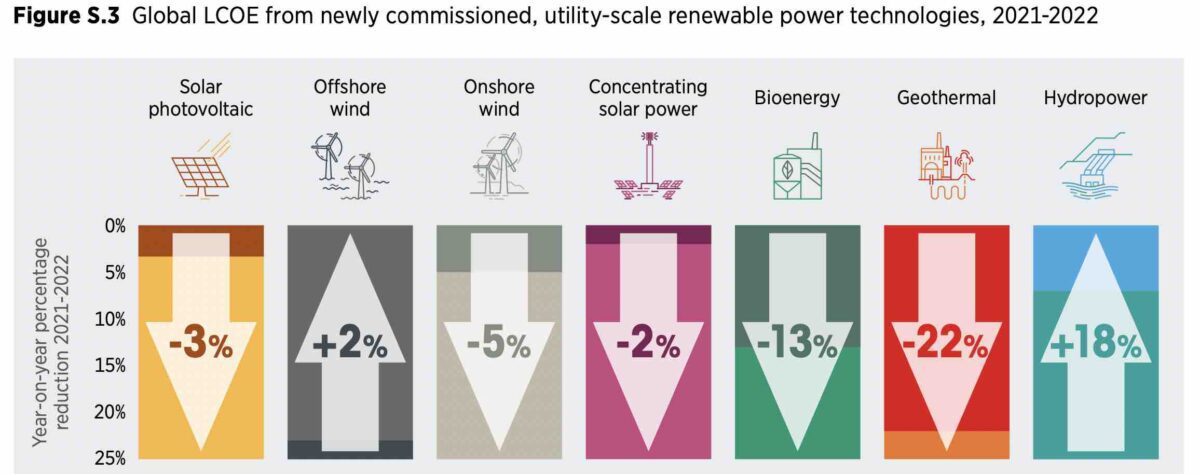
In China, however, the manufacturing and deployment costs continued to fall, and its share of global utility scale solar PV rose to 45 per cent from 38 per cent. That meant that, overall, the global weighted average of solar PV fell by three per cent.
The only variable output technology to rise was offshore wind. Again, on a global basis, the two per cent global rise was mitigated by a fall in costs in China. In some countries, the cost rises were considerable, which is why some projects bid at low prices several years ago are now running into trouble.
IRENA, however, points out that the inflated costs of fossil fuels is even greater, and across the globe.
“IRENA sees 2022 as a veritable turning point in the deployment for renewables as its cost-competitiveness has never been greater despite the lingering commodity and equipment cost inflation around the world,” says Francesco La Camera, its director general.
“The most affected regions by the historic price shock were remarkably resilient, in large part thanks to the massive increase of solar and wind in the last decade.
“Today, the business case for renewables is compelling, but the world must add 1 000 GW of renewable power annually on average every year until 2030 to keep 1.5°C within reach, more than three times 2022 levels.
“There is no time for a new energy system to evolve gradually as was the case for fossil fuels.”
Interestingly, the cost of hydropower increased by 18 per cent, due to the cost overruns in a number of large hydropower projects, including in Australia, where it has since been revealed that the projected cost of Snowy 2.0 has doubled again to at least $12 billion.
IRENA says it expects high fossil fuel prices will cement the structural shift to renewables, even undercutting existing fossil fuel generators. It says renewables can protect consumers from fossil fuel price shocks, avoid physical supply shortages and enhance energy security.
“The experience of the last two years has changed stakeholders’ understanding of price expectations in fossil fuel markets, while also demonstrating the vulnerability of countries dependent on fossil fuels for power generation,” it notes.
“When new electricity generation capacity was required in 2021, renewables significantly undercut new fossil fuel additions, while in many locations renewables even undercut existing plants, once the impact of financial support was factored out.
“The competitiveness of renewable power saw a significant leap in 2022 as fossil fuel prices spiked.”
The current second wave of big battery projects will kill the economics of most coal…
Few organisations have so consistently campaigned to stymie climate action – possibly anywhere on the…
Tom Geiser from Good Heat on the technologies to provide carbon-free industrial heat. Plus: LNP's…
Days apart, one Australian minister called for reduced dependence on fossil fuels, while another literally…
Swiss storage giant completes purchase of the project site for big four-hour battery, setting a…
Installation of the "golden" turbine is being hailed as a "huge milestone" for a wind…