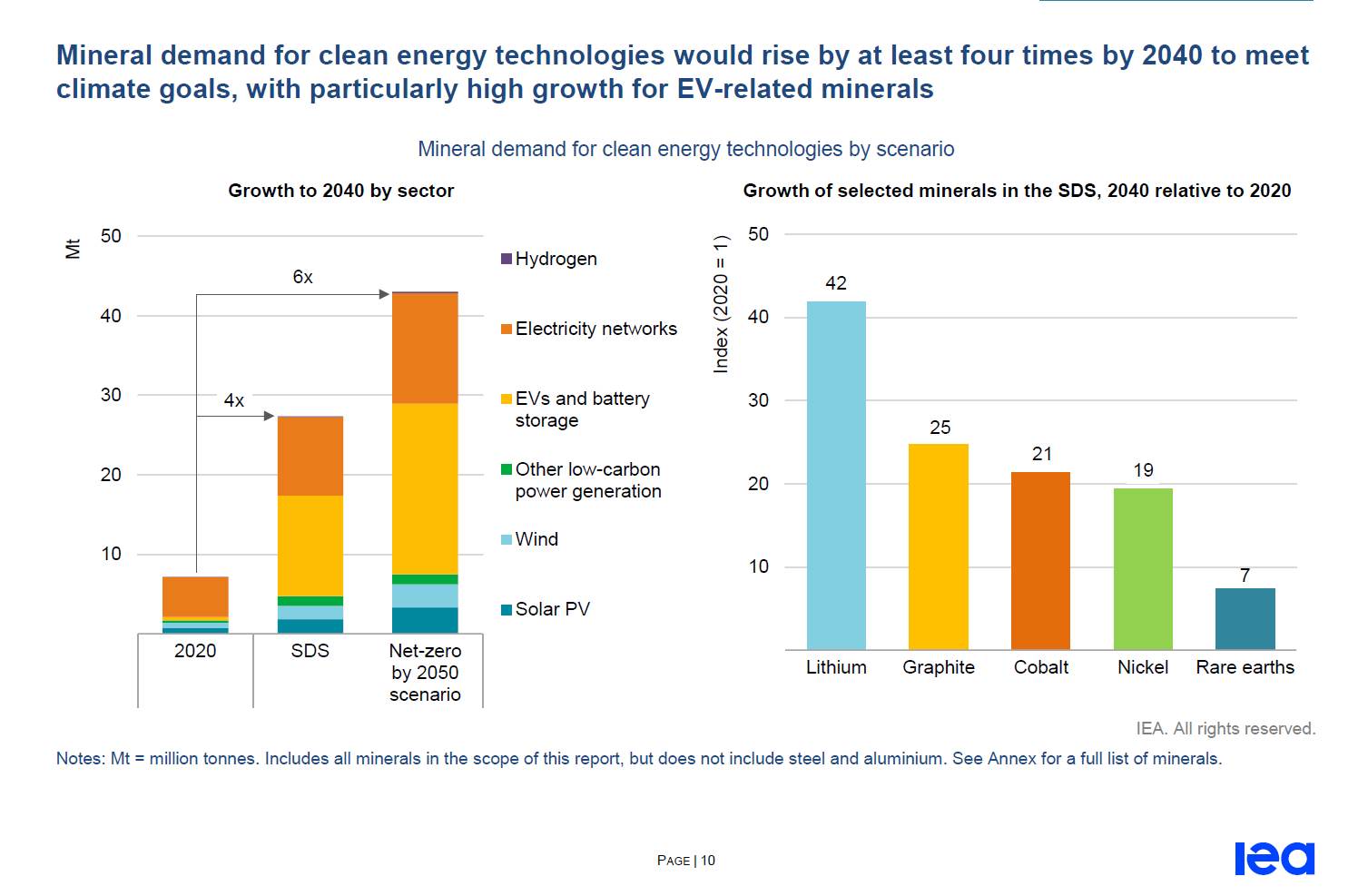
A major new study released by the International Energy Agency (IEA) has found that several key critical minerals will play a major role in the provision of a suite of new clean energy technologies required to replace the functionality of fossil fuels in meeting climate goals.
The demand for minerals such as lithium, graphite, cobalt, nickel and rare earths will rise by nearly four times by the year 2040, with lithium dominating that growth in terms of magnitude. Electric vehicles and network augmentations (mainly copper) dominate the demand sources for critical minerals, with solar, wind and other low carbon generation only a fraction of total demand. This is due to the widespread and decentralised nature of transmission and private transport, compared to the relatively centralised nature of utility scale power generation.
Australia is one of the key countries for the production for lithium, comfortably holding the majority share of the product for extraction. China holds the lions share of processing for nearly all critical minerals for energy transition technologies:
Australia is noted in the report not only for its unique lithium reserves but its exposure to climate risk. “Mines in South America and Australia are exposed to high levels of climate and water stress”, relating to copper and lithium. Most of Australia’s produced lithium is exported to China for processing, and the Greenbushes site in Australia is due to expand production capacity by more than 2.5 times, report the IEA.
“Today, the data shows a looming mismatch between the world’s strengthened climate ambitions and the availability of critical minerals that are essential to realising those ambitions,” said Fatih Birol, Executive Director of the IEA. “The challenges are not insurmountable, but governments must give clear signals about how they plan to turn their climate pledges into action. By acting now and acting together, they can significantly reduce the risks of price volatility and supply disruptions.”
“Left unaddressed, these potential vulnerabilities could make global progress towards a clean energy future slower and more costly – and therefore hamper international efforts to tackle climate change,” Dr Birol said. “This is what energy security looks like in the 21st century, and the IEA is fully committed to helping governments ensure that these hazards don’t derail the global drive to accelerate energy transitions.”
A wind turbine with a record-breaking hub height of more than 200 metres has been…
As opposition parties talk nuclear, a new global report from energy experts say it would…
Australia's most powerful battery now free to trade its full capacity on market after its…
The site of one of Australia's very first wind farms now shows little evidence of…
The "35 by 35" electrification goal has an Australian origin that the government seems to…
If we fail to ensure data centres pay for new renewables and storage to cover…