Image source: transgrid.com.au
The Australian Energy Regulator has approved final costs for Transgrid’s massive, multi-billion dollar HumeLink transmission link, which will boost the connection of the Snowy Hydro 2.0 pumped hydro project to the rest grid in southern New South Wales, but has trimmed the budget by around $300 million.
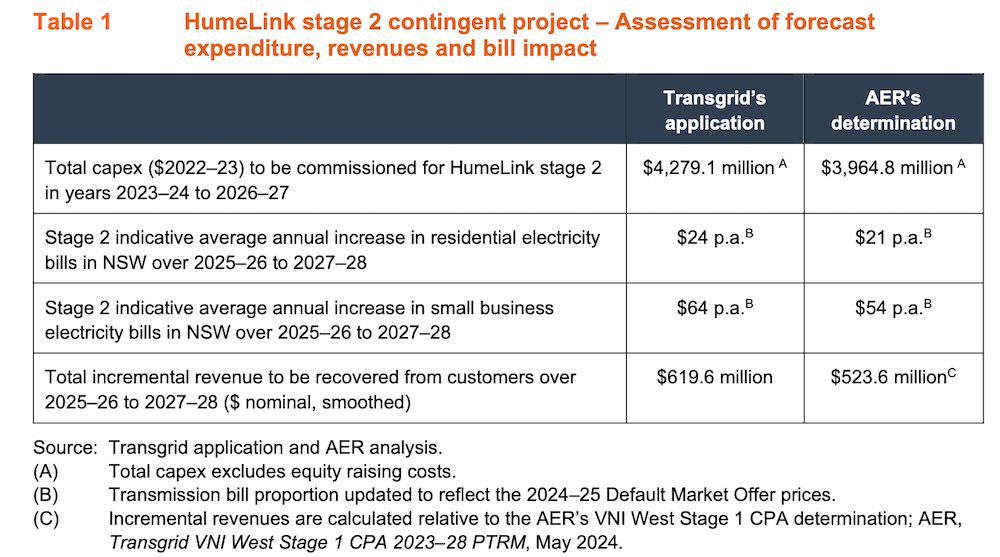
The AER said on Friday it had accepted project costs at $314.4 million less than what was proposed by Transgrid in its application, signing off on a $3,964.8 million bill for Stage 2 of HumeLink, instead of the $4,279.1 million it was originally presented with.
The $3,964.8 million adds to the $608.6 million previously approved for the first initial stages of the project, taking the total cost for the 330km 500kV transmission line proposed to connect Wagga Wagga, Bannaby and Maragle to nearly $4.6 billion.
The AER says this means a small reduction in the costs passed on to households, from $24 a year to $21 a year over the coming three years.
AER chair Clare Savage says the AER has undertaken a rigorous assessment of proposed costs to the project to ensure consumers pay no more than necessary for its delivery, and discovered that Transgrid had made some errors in its costings.
The huge costs of HumeLink – and who should pay them – are already a major point of contention, having blown out considerably from initial estimates of $1.3 billion, along with problems of securing landowner approval along the proposed route.
Savage says there has been “considerable stakeholder interest” and a “diverse range of views” put forward on HumeLink, which no doubt includes criticism from environmental groups for its proposed path through the Kosciuszko National Park, and concerns around other parts of the preferred route.
“While HumeLink is a complex project of national significance, we recognise that it affects landholders and local communities on the transmission route and impacts electricity bills,” Savage said on Friday.
“We are conscious that this decision comes at a difficult time for energy consumers, with many customers facing challenges to absorb higher electricity prices in the current economic climate.”
On the subject of the trimmed costs for HumeLink stage 2, the AER says it found Transgrid’s proposed capex to be “overstated due a number of key reasons, including outdated information and overblown risk cost estimates.
“Transgrid provided a detailed cost build up for 74 individual risk costs it expects to incur in the construction phase, which are not already included in its forecast of tendered works expenditure.
“We consider that Transgrid overstated these costs by including risks not consistent with our guidance and overstated the value of these risks,” the determination says.
“Our alternative estimate includes a lower cost estimate of $382.1 million for risk costs, which is $217.0 million (or 36.2%) lower than Transgrid’s forecast of $599.1 million.”
On the other hand, the AER says it accepted all of Transgrid’s proposed costs for engagement and social licence activities for HumeLink.
“We expect Transgrid to build and maintain social licence throughout the life of this project and respond to community feedback,” Savage said on Friday.
“This includes undertaking meaningful and high-quality engagement, as well as providing communities with additional benefits and activities to recognise the impact and costs borne by local communities as the project progresses.”
In a statement emailed to Renew Economy, Transgrid says it will assess the AER’s determination and await finalisation of environmental planning approvals and CEFC financing arrangements before making a final investment decision on HumeLink.
Plan to expand the big battery built at the site of what was once the…
Andrew Forrest's iron ore miner says a demo plant in Brisbane that strips arsenic from…
Queensland LNP's first major energy tender in a long time - for fossil gas generators…
South Korea unveils a $A1.1 trillion energy transition strategy, aimed at expanding renewables and transforming…
State to introduce bill allowing mine at centre of High Court ruling to continue with…
Join Envision Energy and Renew Economy for a webinar exploring the technologies shaping Australia’s next-generation…