Wind farm at Geraldton WA. By Kshithij Chandrashekar on Unsplash.
A record amount of generation from grid-scale renewables and rooftop solar has triggered another sharp fall in wholesale electricity prices in the latest quarter, although Australia’s most coal-dependent state grids are still the costliest for energy users.
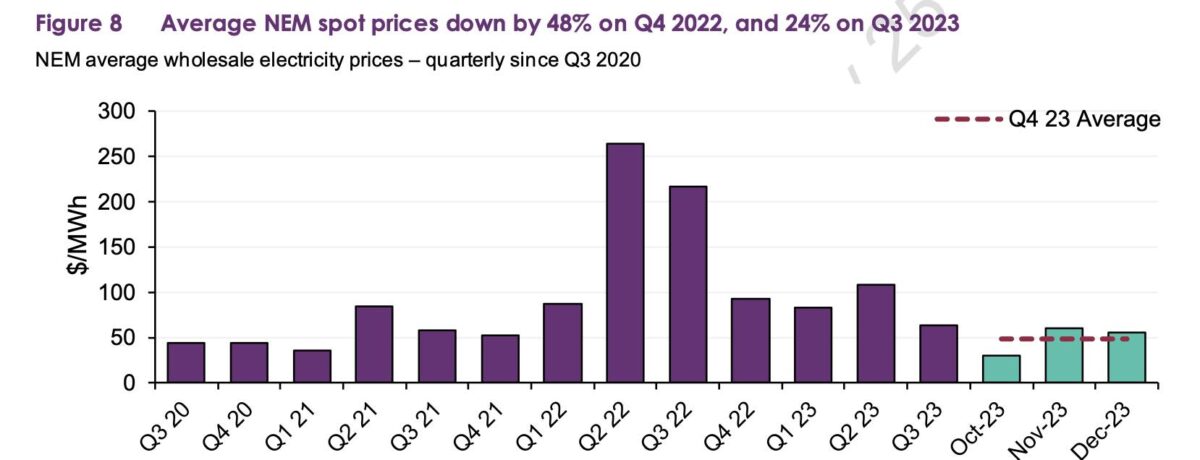
The latest Quarterly Energy Dynamics report from the Australian Energy Market Operator revealed that wholesale electricity prices have halved from their fossil fuel-driven peaks in 2022, and according to CEO Daniel Westerman it is because low-cost renewables are having an increased role in daily generation.
“More low-cost renewable energy was generated and wholesale energy prices have fallen – a record number of times to zero, and beyond, into negative territory,” Westerman said in a statement accompanying the report.
The results confirm the narrative of AEMO, the CSIRO, federal and state governments and nearly all energy experts that Australia’s path to low cost and zero emissions electricity is through renewables, and storage – and not with the nuclear path pushed by the Coalition and conservative media.
The latest QED notes that wholesale electricity prices averaged just $48/MWh in the December quarter, with increased renewables also driving emissions and emissions intensity in the country’s main grid to record lows.
Victoria – which has a 95 per cent renewable energy target for 2035 and had a 47 per cent share in the December quarter – recorded the lowest average quarterly prices of $26/MWh.
It was followed by South Australia, already at 71 per cent wind and solar, which had an average wholesale electricity price of $33/MWh) and Tasmania, at or near 100 per cent renewables thanks to its hydro and growing wind portfolio, which average $50/MWh.
The country’s two most coal dependent states – New South Wales (54 per cent coal and 10 per cent imports in the latest quarter) and Queensland (64 per cent coal) had the most expensive average wholesale electricity prices at $66/MWh and $68/MWh respectively.
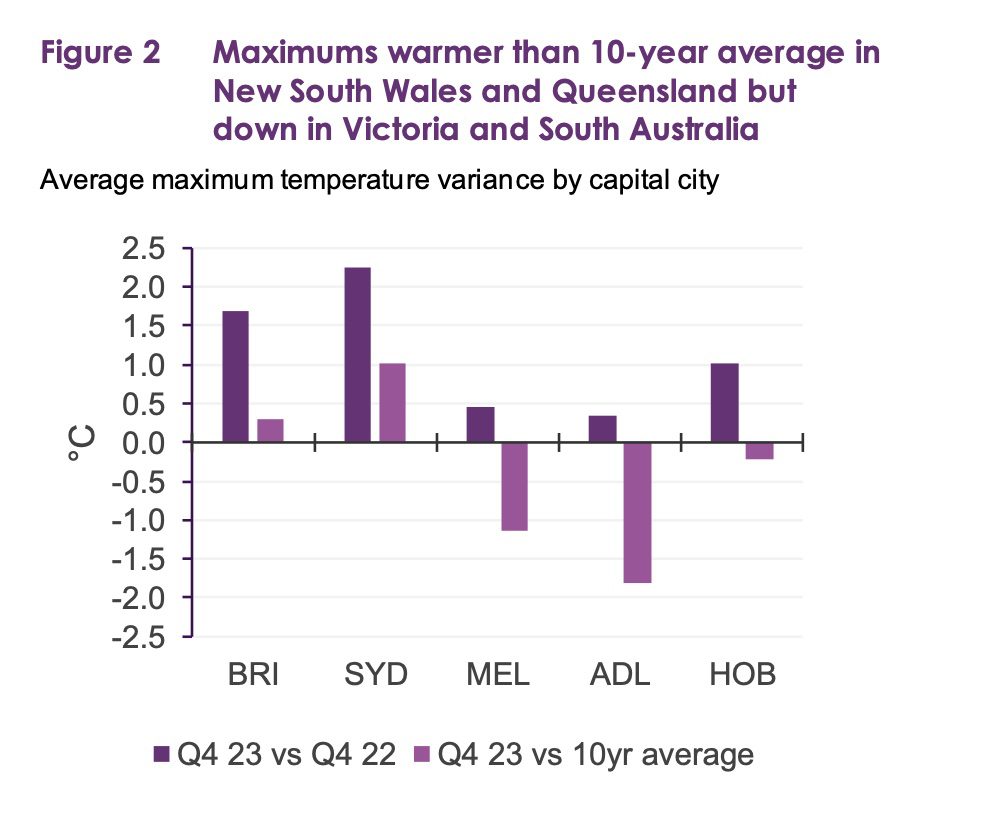
This is despite a sharp fall in the prices asked by the remaining coal generators (an average $58/MWh), and because these states were also affected by higher temperatures, rising demand in response to those changes, and restrictions on the major transmission links.
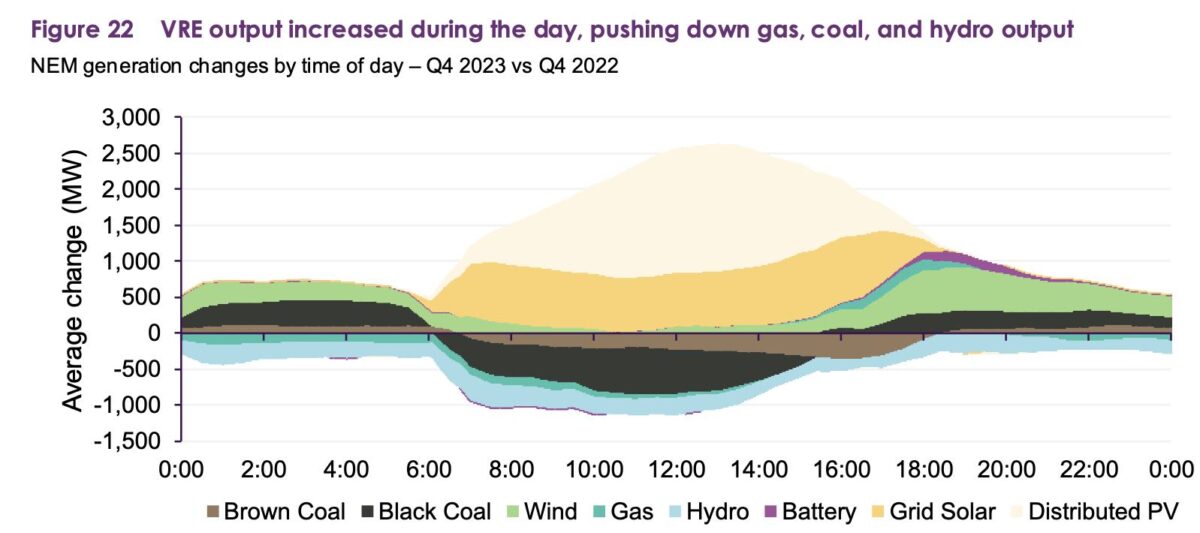
Westerman pointed to the growing influence of rooftop solar, which has been by far the strongest sector in the country over the last 12 to 18 months, and which is hastening the transition by helping to reshape the grid,
“Early in the afternoon of 31 December rooftop solar met 101% of South Australia’s total electricity demand,” Westerman said.
“While on the afternoon of 24 October rooftop solar and grid-scale renewables provided 72% of all electricity across the east coast.
“These events are snapshots of the transition that’s happening, and they are becoming more frequent.
“We are regularly seeing records set for the higher contribution of renewables, and lower levels of energy drawn from the grid because of rooftop solar.
“As our coal fired generators retire, renewable generation, batteries, hydro, new gas fired power plants, and new transmission will power our homes and businesses.”
Solar – be it deployed at rooftop or utility scale – remains the cheapest form of energy thanks to the steep fall in module prices over the last 18 months, but the growth of solar is also having an impact on the grid, increasing the number of negative price events, which made up a record 20 per cent of trading intervals in the last quarter.
Westerman says this presents a great opportunity for more storage, including batteries and pumped hydro.
““We know zero prices mainly happen in the middle of the day, and are being driven by low-cost renewable generation,” he said. “With the right energy storage, like batteries and pumped hydro, the benefits of free and low-cost energy can be spread further across the day.
“The right storage means we can charge batteries and pump water up hills in the middle of the day when prices are low, and that energy can be released back into the grid during the evening peak when people get home from and school and work.”
There were some other interesting trends from the latest quarter, including higher demand in the northern states because of rising temperatures, and some record demand lows in the south states due to the growing impact of rooftop solar.
Overall demand was up by 1.6 per cent to an average 19,745 megawatts, even though rooftop PV also grew by 16 per cent to an average 3,433 MW.
The output from grid-scale wind and solar reached a record quarterly average of 5,168 MW, up 14 per cent over the year thanks to new projects commissioned in NSW and Queensland. Grid scale solar output jumped 23 per cent to an average of 2,021 MW, also a record high.
The average output of black-coal fired generation hit a new quarterly low of 9,189, partly due to the closure of Liddell in April, and despite an increase in overall availability. However, a series of coal plant outages in November forced AEMO to issue its first direction to a coal plant in NSW during the month,.
AEMO says the increase in renewable output drove NEM total emissions and emissions intensity to new all-time record low levels of 25.4 million tonnes of carbon dioxide equivalents (MtCO2-e) and 0.59 tCO2-e/MWh respectively.
For renters watching rooftop solar spread across the neighbourhood, Australia’s energy transition can feel frustratingly…
Since 2020, Australia's subsidies for fossil fuels have totalled almost six times the amount given…
One minute, Victoria's new energy minister was promising industry stakeholders that Labor will hold the…
First battery units arrive at what will be the biggest storage facility in Australia's most…
Individual states may choose their own path on reliability and market design details as consultation…
Australia will miss its 2030 climate targets unless more renewable energy projects move beyond the…