Image Credit: Sigenergy
Australian households added more than 180,000 solar batteries in just six months in 2025, as federal Labor’s Cheaper Home Batteries rebate “strapped a rocket” to demand and blasted the number of systems installed nationally to a total of more than 450,000 at year’s end.
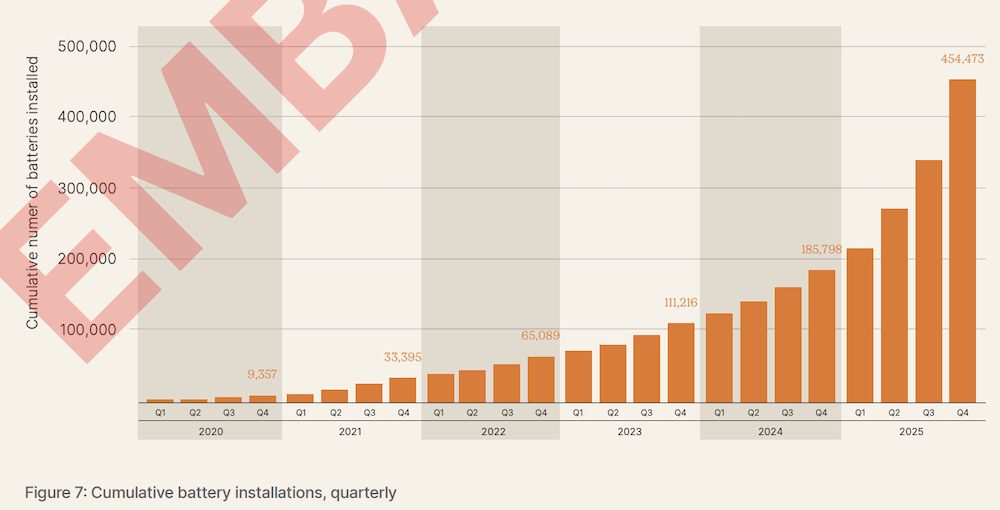
The Clean Energy Council’s bi-annual tally of rooftop solar and storage shows a record 183,245 home battery units were sold in the second half of 2025 – a huge number almost equal (99%) to the total number of home battery sales recorded in the four years between 2020 and 2024.
Things didn’t slow down in January, either, with federal energy minister Chris Bowen announcing halfway through the month that the number of home batteries installed since the July 2025 launch of the rebate had climbed to 200,000.
Bowen says that number has now increased to 218,000. “That means more Australians are taking control of their power bills and using their own clean, cheap energy when they need it,” he said in a statement.
“Cheaper Home Batteries deliver real, lasting cost of living relief for Aussie households, while working to make the energy grid fairer, more affordable and more reliable during peak demand times.”
According to the CEC report, published this week, the rolling 12-month average of quarterly battery sales has also increased to a new record of 67,169.
Cumulatively, a total of 454,473 battery units were installed across Australia by the end of 2025 – a figure that has more than doubled since the end of 2024, when it reached 185,798 units sold.
“Clearly the appetite Australians have for … independent energy generation and storage is huge,” CEC chief Jackie Trad told Renew Economy.
“I mean, we know that people have been buying batteries for a while, but the Cheaper Home Battery program … has just basically strapped a rocket to Australians appetite.
“It’s made it more affordable, clearly, for a lot of Australians. And … they understand how financially savvy it is for them to invest in batteries as well as solar,” Trad said.
On solar, the report confirms that the rate of uptake of small-scale rooftop PV continues to slow, prompting the CEC to suggest – as BNEF did earlier this week – that the once world-leading market might have peaked.
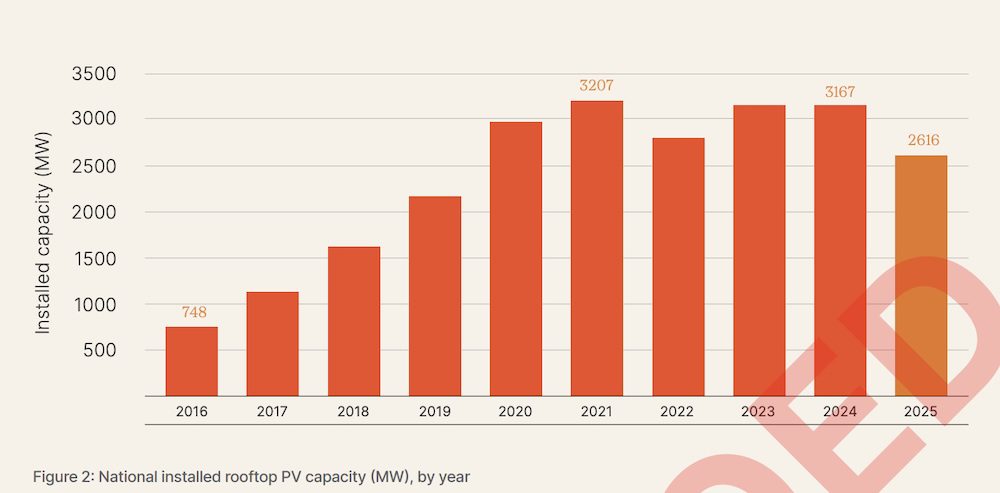
A total of 139,080 rooftop PV systems were installed across Australia in the second half of the year, amounting to 1.5 gigawatts (GW) of installed capacity and taking total installed capacity for 2025 to 2.6 GW from 254,664 installations.
“This was the first time since 2020 that total annual rooftop PV installations did not surpass 300,000, suggesting we have now passed the peak of rooftop PV installations as consumers turn their demand towards small-scale batteries,” the report says.
But Trad says Australia’s love affair with solar is still delivering significant dividends, with the 2.6 GW of new capacity installed in 2025 almost equal to the capacity of the Australia’s largest coal plant – the 2.9 GW Eraring power station in New South Wales.
As Renew Economy reported last month, all this home solar and battery storage in houses around the country has helped to reduce grid demand at critical times, and to avoid blackouts during the latest spate of summer heatwaves.
“Australia’s rooftop solar uptake is a national triumph and now accounts for 28.3 GW of installed capacity, eclipsing that of the country’s entire fleet of coal-fired generators (22.5 GW). It not only leads our national renewables rollout but also leads the rest of the world on a per capita basis,” Trad said on Wednesday.
“Our biggest power station now resides on the rooftops of more than 4.3 million households, which is helping to drive downward pressure on power bills for consumers and businesses, with less reliance on expensive gas or unreliable coal to power our grid.”
“[Coal plants] like Callide [in Queensland] are closing down in unexpected ways, more frequently, driving up the cost of wholesale electricity prices, which is being fed through to people’s electricity bills,” Trad told Renew Economy.
“So as these really old coal-fired power stations become more and more unreliable and keep pushing up the price of wholesale electricity, we can’t get on with the transition and replacing them with clean energy fast enough, in my mind.”
Trad says that the runaway success of the home battery rebate means that encouraging and incentivising stronger participation in virtual power plants has become more important than ever.
“We know energy customers who sign up to a VPP are currently paying the lowest power bills in Australia,” Trad says, pointing to ACCC analysis which found that households with rooftop solar and a battery could save an additional $106 through a VPP, cutting bills to $217 per quarter on average.
“That is why it is critical industry and governments work together to raise greater consumer awareness, trust and understanding about the many benefits of participating in VPPs, which is the next step to driving consumer energy bills down even further,” she said.
If you would like to join more than 29,000 others and get the latest clean energy news delivered straight to your inbox, for free, please click here to subscribe to our free daily newsletter.
The hotly contested New England renewable energy zone has finally put in its application for…
Balcony solar has taken off overseas, but Australian rules mean apartment dwellers and renters are…
Regulator pings two businesses for allegedly breaching the rules of state-based energy upgrades scheme, including…
Offshore wind project canvasses turbines of up to 23 MW, as locals raise concerns about…
A rule change request quietly put through in December wants to radically change how the…
Video shows dramatic collapse of a 20-year-old wind turbine that falls on to a neighbouring…