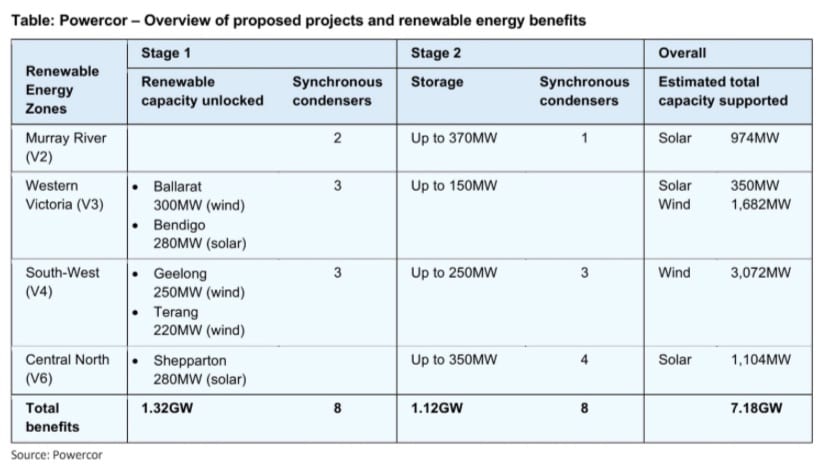
Victoria electricity network operator Powercor has put forward a plan to install up to 20 big batteries totalling more than 1.1 gigawatt at key network centres to help strengthen the grid and deliver on the state’s renewable energy target.
The proposal from PowerCor also pitches a plan for up to 16 spinning machines known as synchronous condensers to help fast-track the renewable transition and facilitate another10 gigawatts or more of new wind and solar capacity over the coming decade.
Powercor is making a bit of noise about the pitch because it wants to point out that local distributed networks can play a key role in supporting wind and solar projects, and not just the larger transmission lines which are normally the main focus.
“Connecting renewable energy at the distribution network level is fast, simple and generates greater benefits more broadly spread out at the local level,” Powercor’s head of networks Mark Clarke says.
“We can support new renewable generation while also improving power reliability and network capacity for more solar, EV charging infrastructure and battery programs in local communities.”
Its pitch includes the fact its proposal requires no easements for new transmission lines – which is likely to emerge as a major issue in Victoria and elsewhere – and it uses existing land and assets that it already owns. And there will be no new poles and wires, just a lot of boxes, and it can be built quicker too.
The battery storage component comprises 20 big battery installations totalling 1.1GW. It doesn’t give the storage duration, but because it’s essentially a network asset, this is unlikely to be long – probably half an hour to an hour, based on the contract for a part of Neoen’s new 300MW/450MWh “Victoria big battery” near Geelong and the 30MW/30MWh Ballarat battery currently operated by EnergyAustralia.
Clarke says having comparatively smaller projects connected via the distribution network means more projects can be built at the same time, creating more jobs.
The proposed mass deployment of syncons is also interesting, and potentially controversial. South Australia is rolling out syncons in an organised fashion in the next few months, and the grid operator expects this will enable fewer constraints on wind and solar output, less reliance on gas, and very few market “directions”.
Clarke argues that using syncons at the distribution level will create benefits at both the distributed and transmission level. Installing them on transmission lines only delivers benefits at the transmission level, he says.
However, in main states, including Victoria, syncons have been rolled out in a haphazard manner at various wind and solar projects under the soon-to-be-ditched and unlamented “do no harm” rules, and many experts say the focus should be on “grid-forming inverters” rather than syncons, which are decades-old technology.
Sill, Powercor says rolling out eight syncons in “phase 1” of its proposed program will allow another 1.3GW of wind and solar to be connected to the grid, while another eight syncons and the battery storage – spread over four different renewable energy zones – will facilitate yet more out to 2030.
PowerCor says the battery storage will also help more rooftop solar to be added and will increase reliability on the network. It identifies Nhill, Charam, Cobram, Robinvale, Boundary Bend and Ouyen as good places to install batteries.
For maximum readings, September came in as Australia's third warmest. For minimums, last month narrowly…
Diesel fuel tax credits earned over 10 years nearly equate the price of a huge…
Updated: The biggest wind farm to reach financial close in Australia in the last two…
Australian battery maker whose customers include the federal energy minister has gone into voluntary administration,…
A major new transmission line that the state opposition has vowed to scrap is seeking…
One of Australia's largest technology companies has signed a decade-long deal with a community-owned solar…