Acciona's Mt Gellibrand wind farm in Victoria
Victorian Liberal and National Party plans to require a renewable energy buffer zone of 2 km between all new wind, solar and battery projects in the state would wipe out hundreds of millions of dollars in landholder and community benefit payments and tens of millions in regional council payments, new analysis claims.
The warning, which says that new projects would be “unviable,” comes just months ahead of a state election, and fears that a Coalition government – if elected – could be as damaging to Australia’s green energy transition as the LNP government has been in Queensland.
The Victorian Liberal and National Parties first flagged plans to resurrect the 2km buffer zone rule for new renewables projects in October of 2024, as part of a Regional Energy Development Policy released by the former leader of the opposition (once removed), John Pesutto.
The policy proposal has survived the various changes in Victorian Liberal Party leadership since then and will be taken to the upcoming state election, on November 28, this year.
The rule picks up where the former Coalition Victorian government left off nearly 15 years ago, when a wind turbine buffer zone was introduced by then premier Ted Baillieu alongside no-go zones that banned wind development in some of the windiest parts of the state – bans that are still in place today.
At the time, the restrictions – alongside the then federal Abbott government’s attack on the national Renewable Energy Target – were disastrous for wind development in Victoria, costing the state an estimated nearly $900 million in lost or stalled investment and bringing new wind farm proposals to a halt.
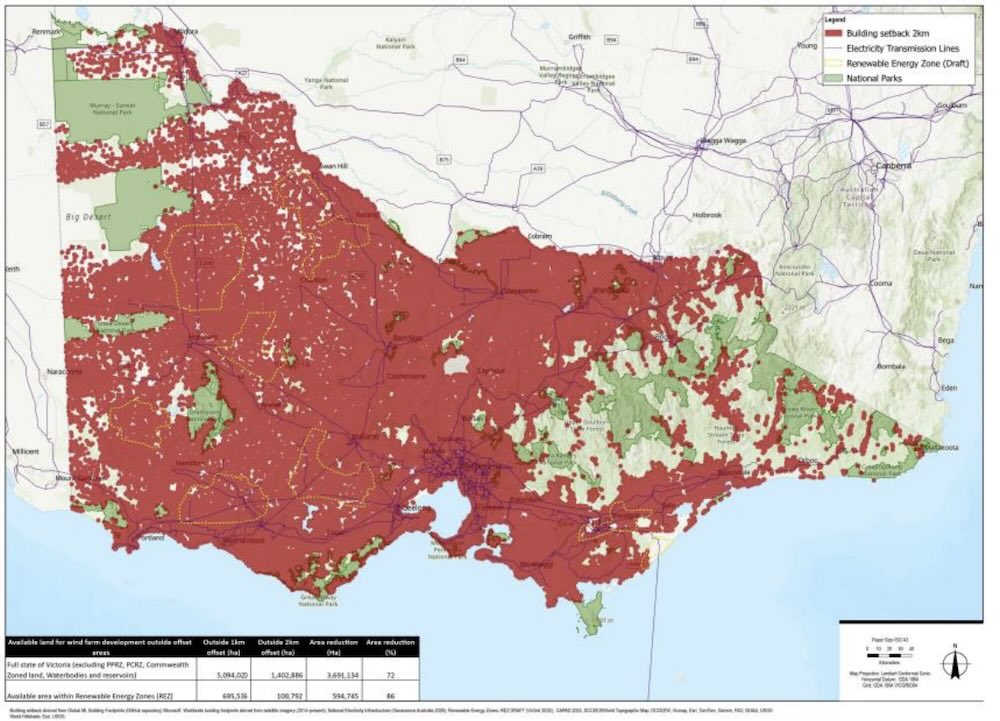
Fifteen years later, the Clean Energy Council (CEC) says a renewed and expanded setback rule would have a similarly devastating impact, “sterilising” almost all land near existing and planned transmission infrastructure and in large parts of state Renewable Energy Zones – illustrated by the sea of red in the map below.
Source: Clean Energy Council
The CEC says its analysis projects that the 2km buffer zone rule would remove around 70 per cent of available land for renewable energy development, leaving the land that remains fragmented and lacking in transmission access and making new development “effectively unviable.”
The flow-on effect of this, says the analysis, would be to wipe out 26,000 full-time equivalent job-years by 2035, $3.9 billion in wages, $3.2 billion in procurement opportunities for local businesses, $213 million in landholder and community benefit payments and $93 million in Payments in Lieu of Rates (PiLoR) for regional councils.
“Regional communities stand to benefit from billions of dollars in investment, thousands of jobs, new income streams for farming families and long-term revenue for local councils,” CEC chief Jackie Trad said in a statement on Monday.
“The question Victoria needs to answer is where the next generation of electricity supply will come from, and will it be ready for coal’s scheduled retirement.”
The state opposition says the concerns – and findings of the CEC analysis – are overblown, because they fail to account for the fact that the 2km rule would be “rebuttable,” with project proponents and local communities “able to argue for an alternative distance in specific circumstances.”
“The Liberals and Nationals support a balanced approach to Victoria’s energy future – protecting regional communities while investing in practical initiatives like Urban Solar Parks to generate power closer to where it’s needed,” the shadow minister for energy David Davis told Renew Economy in an emailed statement.
“The Liberals and Nationals will institute a default 2-kilometre buffer zone around proposed regional energy projects (including wind towers), to minimise the impact on residential properties and local communities.”
But the 2km buffer rule was also “rebuttable” – via a written agreement with the relevant landowners – back when it was first introduced in 2011, when it appears to have had the effect of bringing wind project investment and development in Victoria to a halt.
Back then, the CEC said it had never been consulted by the state LNP on the setback law, and had never seen any evidence of why a 2km zone was chosen.
“We have not seen any scientific evidence – other than the Victoria government saying it wants to re-balance the planning system – of why a 2km setback has been imposed,” Russell Marsh, who was policy director at the Clean Energy Council in 2012, told RenewEconomy.
Currently, the rules in Victoria impose a 1km minimum setback from existing homes, or closer if the affected homeowner provides written consent.
The Australian Energy Infrastructure Commissioner notes that buffer zone rules vary between states: Queensland has a setback distance of 1.5 km, while the New South Wales framework is currently based on a merit assessment of each project. Western Australia has recommended a 1.5 km setback.
But the AEIC also notes that as turbines get bigger and taller, effects of increased visual amenity and shadow flicker impacts “may give rise for a need to revisit current set back distances and increase them accordingly.”
If elected in November, the Victorian Liberal Party has also pledged to review review the newly minted Victorian Transmission Plan and pause two long-delayed grid upgrade projects, including the Victoria to New South Wales Interconnector West (VNI West), and the Western Renewables Link.
Davis said last month that the review would put the “spiralling cost of new transmission lines” through a rigorous assessment process while the pause on projects would allow time to “properly consider” alternatives – including a “Plan B” put forward by the Victorian Energy Policy Centre in 2023.
At the 2026 Wind Industry Forum in Melbourne last month, developers warned that any pause to major transmission projects in Victoria would cause a flight of capital from the state.
If you would like to join more than 29,000 others and get the latest clean energy news delivered straight to your inbox, for free, please click here to subscribe to our free daily newsletter.
Trump administration appears to have bet on the wrong horse, with renewables surging and coal…
Few home battery owners have signed up to join virtual power plants, with concerns about…
Zenith Energy’s Michael Buzzard on the remarkable energy transitions achieved in off-grid mines, and plans…
It is 10 years since South Australia's state-wide blackout: Far from being the end of…
First urban renewable energy zone to host pilot program to demonstrate how social housing tenants…
I first realised there was a problem with coal productivity when looking at diesel consumption,…