The fleet of remaining coal-fired power plants on Australia’s main grid suffered a combined 119 breakdowns, or unscheduled outages, over the past six months, new data has revealed, and were out of action for an average of 22 per cent of that time.
The analysis from Reliability Watch is its latest report using data submitted to the Australian Energy Market Operator (AEMO) on the capacity coal plants have available to the National Electricity Market (NEM) every five minutes.
The report shows that at the beginning of April, 2025, the 15 coal plants spread across Queensland, New South Wales and Victoria submitted 23 planned maintenance shutdowns for the period until the end of September.
But instead of the 23 outages expected by AEMO, there were actually 142 outages – including 119 breakdowns – over the six months.
All told, the coal plants were unavailable to meet their generation commitments 22 per cent of the time, the report says. This means an average of 4.7 gigawatts (GW) of electricity generation capacity was not available to the NEM on any given day.
The data confirms what AEMO, the Australian Energy Market Commission (AEMC), CSIRO and the vast majority of the energy industry already know – but certain state governments and federal politicians seem determined to deny:
“Coal-fired power stations are no longer capable of delivering reliable, affordable electricity, even under favourable conditions,” says Reliability Watch.
And some of the worst offenders are in the states where governments have committed public money to keep coal plants running past their use-by dates, or are planning to.
In Queensland, for example – where the LNP Crisafulli government has wound back renewables policies and abandoned targets, opting instead to keep coal running without planned closure dates – an average of 26% of the state’s coal power capacity was offline from April to September.
Across the entire state, Queensland coal power had 69 outages, 61 unplanned breakdowns over the winter period – a period where lower overall demand means coal plants are under less pressure and should be less prone to outages, and more likely to schedule planned maintenance.
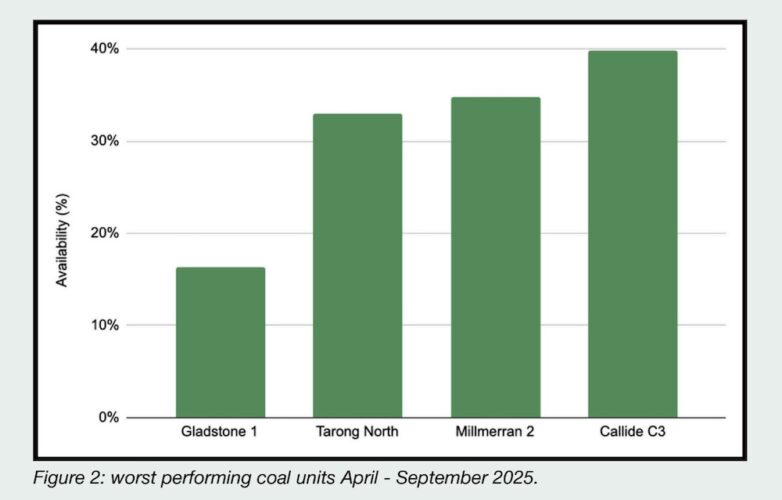
The worst performer was the 49 year-old Gladstone power station, which had 33 unscheduled outages over the six months. The worst performing units were Gladstone 1, Tarong North, Millmerran 2, Callide C3, all being available less than 50% of the time.
Tarong North had the worst availability, offering on average only 33% of its capacity to the market.
“This report demonstrates how fanciful the Crisafulli government’s Energy Roadmap really is because it chains Queenslanders to ageing coal for decades and doesn’t plan for the fleet’s inevitable and necessary retirement,” said Queensland Conservation Council (QCC) energy strategist Clare Silcock, on Tuesday.
“[The report’s] findings are hard, indisputable evidence that our coal clunkers are failing and need to be replaced,” Silcock said.
In New South Wales, where the state Labor government has stepped in to keep the Eraring coal plant open longer,
the Bayswater coal plant in the Hunter Valley near Muswellbrook suffered 14 outages over the six-month period, having forecast only a single maintenance outage across its four units.
In Victoria, the availability Yallourn power station – which is scheduled to close in 2028, at 50 years old – has remained “dismally low,” according to Reliability Watch, at 67 per cent.
“It has suffered 24 breakdowns, only five of which were scheduled before April. Yallourn’s units 1 and 4 have each recorded 9 breakdowns over the six months,” the report says.
Across the NEM, 24 coal-fired power station units were entirely offline for more than 1000 hours during the six-month period, including all units at Gladstone, Bayswater and Yallourn, except for Bayswater 3.
And yet, the federal Liberal Party’s, too, has recently committed to an energy plan that would hit the brakes on renewables and instead funnel funding into helping the states to prop up old coal.
“State governments … who are already sweating their coal assets… we will support them … to make sure we keep capacity in the system,” shadow energy minister Dan Tehan said at the unveiling of the Liberal Party’s policies on climate and energy.
Reliability Watch says that the latest evidence of “persistent, clustered breakdowns” show most of the NEM’s remaining coal plants are already operating beyond what their ageing systems can reliably sustain.
According to the report, the average age of coal plants on the NEM is 35 years. The average age of retirement of the 12 coal plants that have closed since 2007 was 45 years. Figure 6 shows that many still operating coal plants are older than those that have already retired due to old age.
“Waiting longer does not reduce risk, it increases it,” the report says. “Governments that fail to plan now are setting communities and energy users up for avoidable disruption and higher costs later.”
The Clean Energy Council says the Reliability Watch data gels with the findings of the AEMC’s latest Residential Electricity Price Trends report, that leaning on unreliable 40-year-old coal generators will drive up consumer bills.
The CEC notes that wholesale electricity prices increased from $70 per megawatt-hour (MWh) to $177/MWh during October in Queensland, and from $70/MWh to $220/MWh in NSW.
“Electricity prices are under pressure because Australia’s ageing coal stations are breaking down more often and more severely,” CEC chief policy and impact officer William Churchill said last week.
“The task for Australia now is to get the new system built to schedule – renewables, storage, transmission and modern grid-stability assets, so Australia isn’t stuck relying on ageing generators that are breaking down more often and driving up costs.”
If you would like to join more than 28,000 others and get the latest clean energy news delivered straight to your inbox, for free, please click here to subscribe to our free daily newsletter.
South Korean car and EV maker invests nearly 9 trillion won in an “innovation hub”…
Another big battery proposal heads to Queensland planning purgatory following requests to call in the…
A rule change request from Energy Networks Australia seeks to shift some projects out of…
Reducing oil dependence and boosting renewables and electric transport is often framed as climate policy.…
The Australian electricity grid has closed out the summer of 2025-26 with a month of…
New data on Australia's solar, wind and battery development pipeline confirms that the constraint has…