People cool off along the Canal Saint-Martin in Paris, France, 25 June 2026. EPA/YOAN VALAT
As Pauline Hanson seizes a moment of winter dunkelflaute to wax philosophical on the folly of weather-dependent energy, French utility EDF is busy explaining what happens to nuclear power – Hanson’s preferred power generation source – when record-breaking heatwaves, intensified by climate change, just won’t let up.
EDF has taken a series of its 57 nuclear reactors offline this week – around 6.2 gigawatts in total, and nearly 10 per cent of its total fleet – in response to the heatwave gripping France, part of a weather system described as an Omega block which allows temperatures to build over an area, without relief.
EDF has taken this action because its nuclear plants are subject to strict environmental regulations limiting the use of rivers to cool the plants if the river water passes a certain temperature threshold.
The nuclear shutdowns included two reactors at the Nogent-sur-Seine plant on the Seine river, north of Paris, “to limit the temperature increase between the water withdrawn from the Seine and the water discharged back into it, thereby protecting aquatic plant and animal life,” EDF said.
According to Reuters, the heat has also reduced output at the Saint-Alban 2 and Bugey 3 reactors on the Rhône river in eastern France, and the Nogent 2 reactor on the Seine southeast of Paris. The Golfech 2 reactor on the Garonne river in southwest France went offline late Monday due to the heat.
As AAP reports, much of France has been under severe heat alert this week, with temperatures hitting 40°C on Tuesday, and up to 43°C in some parts of western France.
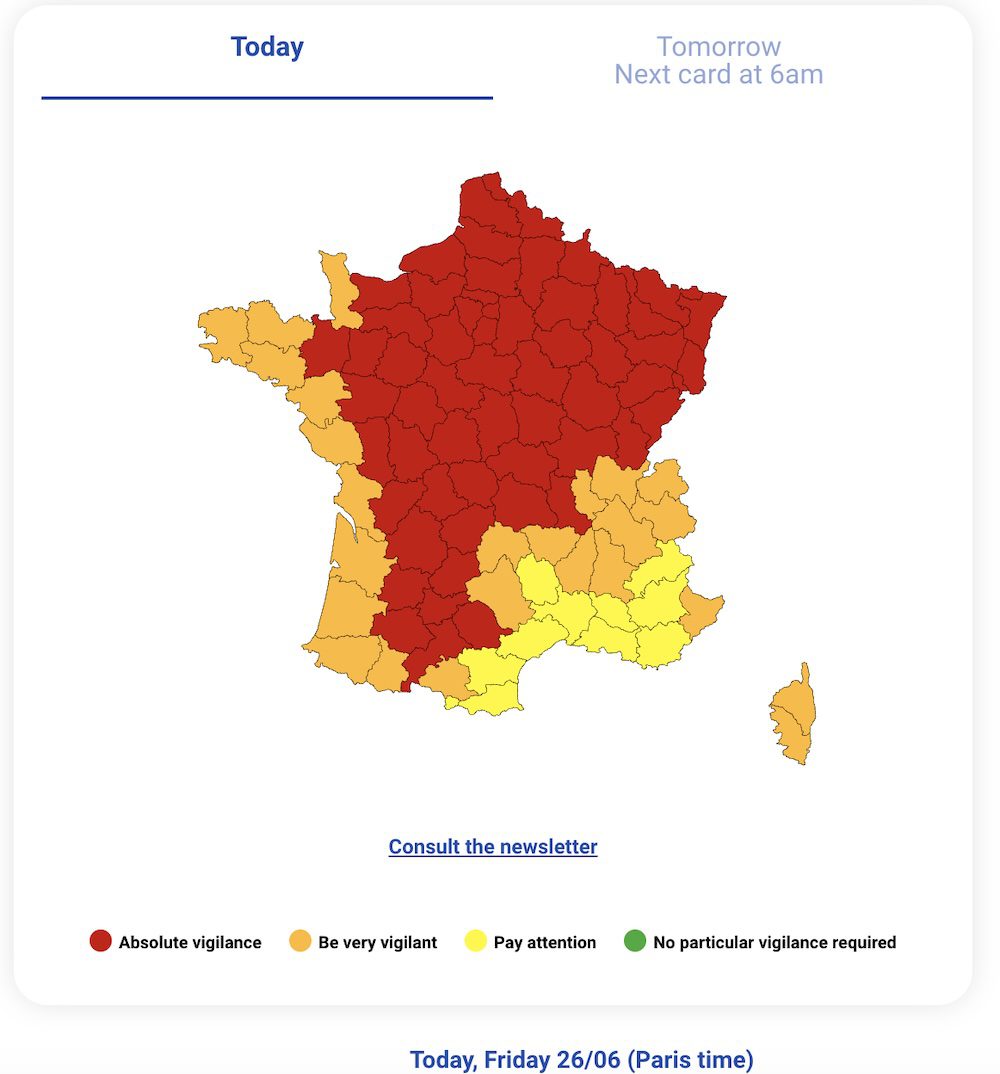
The country recorded its hottest afternoon and night since records began in 1947, and 54 departments are under red alert in what forecasters said was unprecedented.
Météo-France said conditions were comparable to the August 2003 heatwave, which lasted 16 days and led to an estimated 80,000 excess deaths across Europe, according to the EU.
Image: Météo-France
According to Reuters, wholesale spot power prices in France this week reached their highest level since mid-January 2025, while exports dropped to around 3 GW during the afternoon on Wednesday compared to 10-12 GW a week earier, reducing the cheap supply for neighbours.
“Climate change is demonstrating how extreme heat can be as disruptive as the (price spikes from cold weather and low renewables) witnessed during winter,” Kpler analyst Alessandro Armenia said.
“We are surprised now, but we should expect next summer to exhibit similar dynamics, as climate change is undeniable.”
With reporting from AAP
The increase in data centre demand is being overshadowed by the much larger increase in…
AEMC commissioner Rainer Korte on what the new rules on reporting and data sharing will…
Developer says it is good to go on early works and construction of the largest…
AEMO says proof that grid forming battery inverters can deliver heartbeat of the grid will…
Days after lodging new plans for a more than 500 MW wind farm, Squadron dumps…
AEMO’S head of systems Nicola Falcon on the 2026 ISP and the importance of grid…