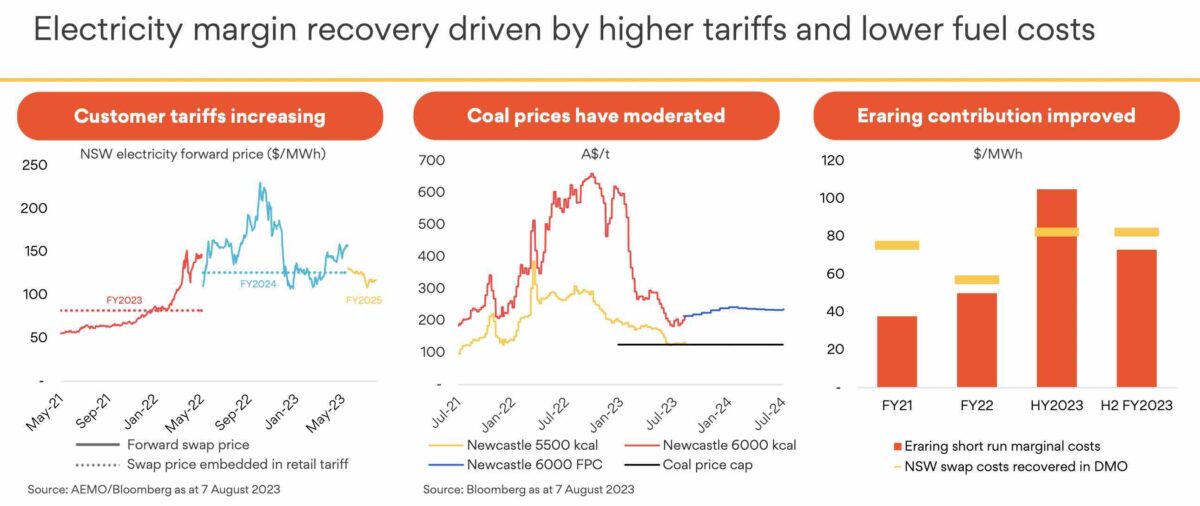
Origin Energy says it has made no change to its plans to close Australia’s biggest coal generator, the 2.88 gigawatt (GW) facility at Eraring, which returned to profit in the last six months thanks to the government imposed coal price cap.
Origin has said it plans to close Eraring as early as August, 2025, although it has consistently said the final decision will depend on market assessments.
“We are still doing that,” Origin CEO Frank Calabria told analysts after announcing a $1.03 billion net profit for the 2022/23 year on Thursday. “There’s no real change to what we’ve previously said.”
There has been growing speculation that Origin may decide, or be asked (or told) to keep at least a couple of the four 720MW units at Eraring open for at least another summer to ease supply and price pressures on the market.
Calabria was questioned by analysts about the company’s hedging strategy – critical for ensuring coal supplies beyond August, 2025 – but would not reveal details on the call. Increased output from Eraring pushed Origin’s greenhouse gas emissions up by 4% in the latest year.
The NSW government is scrambling to ensure anticipated capacity caps are filled with a series of auctions and tenders for large scale wind, solar, and long and short duration battery storage.
It has also received a “health check” for the grid from energy consultant Cameron O’Reilly, which it will release in the next fortnight, when it is likely to reveal whether it will seek an extension to the Eraring closure, or not.
NSW has already contracted the world’s most powerful battery, the 850MW/1680MWh Waratah Super Battery that will act as a kind of giant shock absorber, and Origin is also committed to building the first 460MW/920MWh stage of a giant battery at Eraring.
At least another 930MW of short term “firming capacity” – most likely battery storage – is being sought through a combined NSW/federal government tender which includes the first rollout of the new Capacity Investment Scheme. Another 600MW of long duration storage is being tendered.
Origin indicated that Eraring had been losing money in the first half of the year because of the high cost of coal, but the federal government coal price cap had helped the facility return to the black in the second half of the year. The price cap lasts for another year.
This is important because the cost of coal, and the level of wholesale electricity prices will influence Origin’s decision, and whether it will be holding its hand out for government support if it is under pressure to keep Eraring open for longer.
Origin has accepted an $18.7 billion bid from a consortium comprising Brookfield and Mid Ocean Energy. It is still subject to regulatory approval, and so the takeover will not likely to be completed before early 2024.
Brookfield has announced plans to spend $30 billion on more than 12GW of new wind, solar and storage assets by 2030 to accelerate the transition to green energy, and has struck MoUs with India’s Reliance and China’s Envision Group to possibly make wind turbines, solar panels, and batteries in Australia.
Origin, on the other hand, plans just 4GW of new capacity out to 2040 – reflecting the lack of ambition of Australia’s big three utilities under their current ownership, as pointed out by ITK principal David Leitch in this piece earlier this week.
One interesting aspect of Origin’s portfolio is the growth of its “virtual power plant” – which links rooftop solar panels and battery storage – and which now covers more than 270,000 installations and totals more than 815MW, a three fold increase over the last year. It is aiming for 2GW in the next three years.
That means its VPP is now bigger than any of its Eraring units (and bigger than any other single coal units in Australia), and reflects both the transition from centralised base-load power to distributed energy.
And it also speaks to the challenge of utilities like Eraring to engage with its customers who are now also individual generators. Origin has 4.5 million customers.
The Origin profit reflected a huge increase in earnings from its energy division – a six fold increase in profits to $803 million in the year – which reflects the higher bills being paid to consumers, allowed by regulator to offset the higher wholesale prices.
Origin’s underlying earnings from energy markets jumped to $1.04 billion, a rise of $637 million in the last year, and could jump to $1.7 billion in the current financial year. It also did well out of its investment in Octopus Energy, and its LNG division.
This is even after taking a $106 million charge over its decision to not surrender large scale certificates (LGCs) under the renewable energy target.
This follows a similar strategy by other utilities as the market turns the RET incentives into a massive trading opportunity.
Origin expects to make profits of more than $646 million from manipulating the shortfall charges. It pays a penalty for not buying LGCs one year on the assumption that it can buy LGCs at a lower price within the next three years.
Origin has pocketed a $221 million over the last three years from this strategy and expects another $425 million gain over the next three years. Those market plays – which have been encouraged by the regulator – have led to higher bills for consumers, at least over what they might have otherwise been.
A new take on a widely used mining technique called froth flotation can recover "virtually…
There has been a lot of news flow this week as the country's biggest energy…
Edify Energy reaches financial close on another pair of solar and battery hybrid projects, in…
When it comes to remote solar and battery storage solutions, the knowledge you leave behind…
It will take at least six years to make Australia's largest aluminium smelter 100 per…
"Twiggy" Forrest's renewables outfit has refinanced its portfolio in a deal backed by 15 banks,…