Yandin wind farm in WA. Photo credit: Alinta
The recent addition of two of the state’s biggest wind farms helped Western Australia set a new benchmark for wind output in late June, although overall wind generation had been badly impacted by the damage wrought by Cyclone Seroja on transmission lines in April and May.
The WA grid has recently added the biggest wind farm in the state, the 212MW Yandin wind farm and the 180MW Warradarge wind farm – both north of Perth – which helped set the highest 15 wind generation intervals on record in June, including a new benchmark of 945MW on June 27.
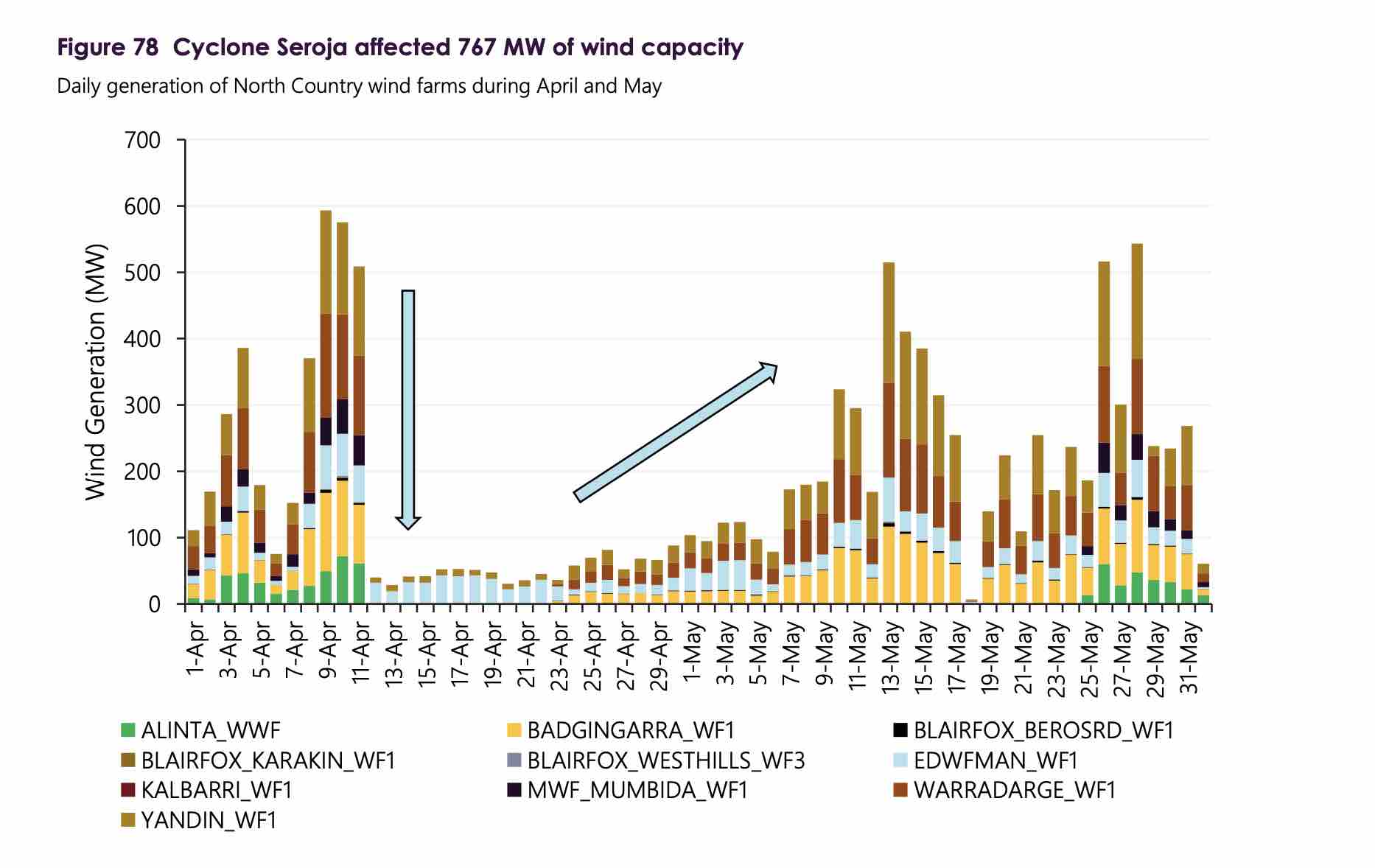
But most of the second quarter was badly affected by Cyclone Seroja, which made landfall near Kalbarri on April 11, resulting in the loss of several transmission lines and isolating, or “islanding”, the renewables-rich North Country region from the rest of the South West Interconnected System (SWIS).
The North Country region is home to the bulk of the state’s wind farms, and several solar farms too (some of them co-located with wind), although it is often affected by the lack of capacity on thin lines transporting power to the main demand centres around Perth.
The immediate impact of Seroja was to slash average wind output from the region from 500MW to 25MW, and even after the region was re-connected to the main grid a week later it averaged 276MW until full service was restored.
This won’t just be about supplementing the supply to the main grid, it will also be looking to unlocking the huge resources even further north that have been identified for potential renewable hydrogen facilities.
The WA government has acknowledged that its recent Whole of System Plan – a 20 year blueprint for the energy transition – did not go far enough and is now updating it with a view to taking into account the accelerating shift to solar, and the need to identify the lowest cost path to zero emissions.
Origin Energy has dropped plans to develop a major wind farm intended for 10 kms…
AGL names Bayswater, Loy Yang and Torrens Island as sites with all the attributes data…
CSIRO study finds households with solar and batteries are enjoying periods of "limitless" electricity, a…
State quietly launches its own version of the Solar Sharer offer, giving households the option…
Latest nuclear status report details the glum state of affairs for the far right's favourite…
The new 400 MW gas peaking plant will be the first for a decade in…