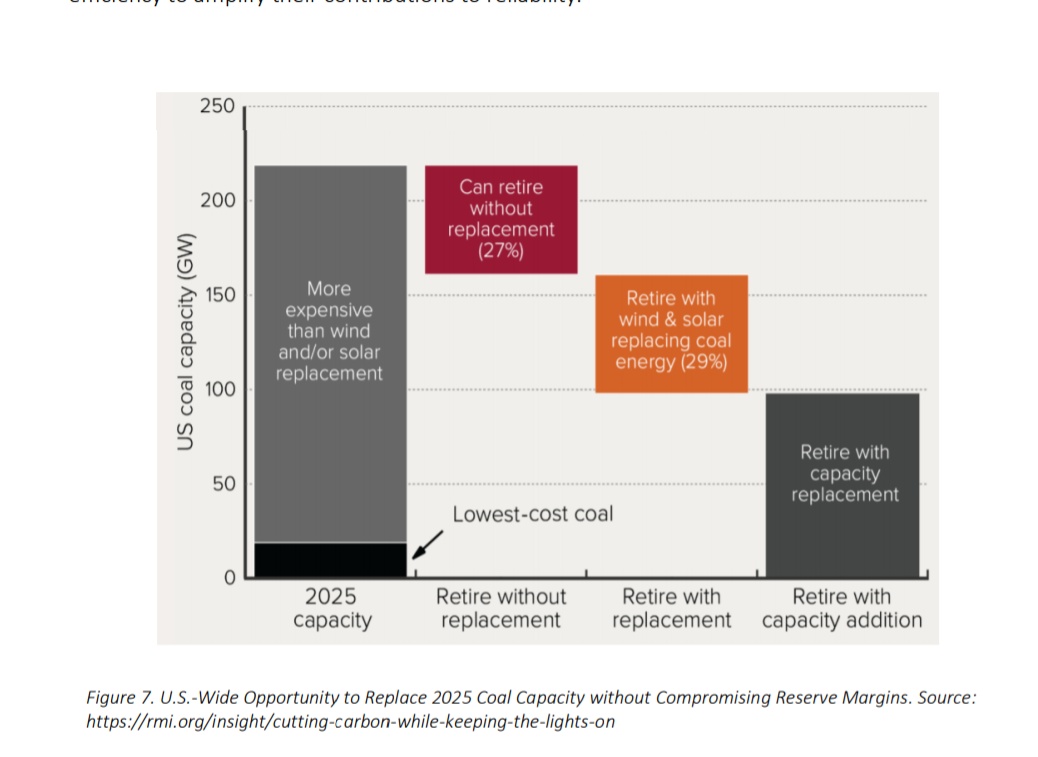
A new report from US think tank Energy Innovation shows that 72% of the country’s coal power fleet is now uneconomic compared to local wind and solar alternatives, or slated to retire within five years’ time. Of the 235 coal plants in the US, 182 are now generally uneconomic or have begun the process of retirement.
The authors describe this as a ‘cost crossover’ point. This marks when the costs of operating a coal plant are higher than the costs of building new wind and solar and operating those assets instead. They do not include other factors such as carbon pricing and subsidy schemes.
“In other words, the coal cost crossover trend continues to accelerate”. The 2018 report’s projections for the proportion of coal to uneconomic relative to wind and solar for the year 2025 have been almost reached in the year 2020.
The report highlights that around one third of US coal capacity can retire without requiring any replacement, one third should be replaced with wind and solar, and the final third would require additional dispatchable capacity.
“Because of significant coal plant retirements and reductions in coal power generation, coal power plants are causing fewer premature deaths in the U.S,” write the authors of the study. “However, coal power plants still cause about 3,000 premature deaths every year in the U.S. and are responsible for a host of negative health impacts including asthma and pre-term births. By switching from coal to clean, renewable power resources like wind and solar, we could continue to bring pollution-related deaths from the power sector down significantly”.
Middle of the day wholesale electricity prices are rising, and prices in the evening peak…
UNSW groups set new perovskite efficiency record but the real secret sauce is a new…
Envision Australia’s Peter Cowling talks their plans and the state of the energy transition.
Australia can now boast of record amounts of wind farm construction starts this year, but…
Andrew Forrest-owned Squadron wants to build a massive wind farm in western Victoria and connect…
A sunny Spring has delivered two new output records for rooftop solar in two Australian…