Chinese power technology giant Sungrow has unveiled a series of new storage and micro-grid technologies that it says will enable batteries and renewables to broaden their scope amid the rapid changes in energy markets and grid demand – and to scale up the speed of deployment.
The falling costs of battery storage and rising efficiencies means that battery providers can deliver double the storage in the same space, and at the same price, as what they were able to achieve just a few years ago.
AGL, for instance, has been able to build a new 2,000 MWh battery at Tomago, twice the size of its first big battery at Liddell, at around the same cost. And the costs are still falling and the efficiencies continue to improve.
At the recently held Global Renewable Energy Summit in Hefei, Sungrow unveiled the latest in its grid scale battery solutions, dubbed PowerTitan 3.0, which it says integrates more than 600 stacked battery cells, a round trip efficiency of up to 92 per cent, and grid-forming capabilities – crucial in a high renewable grid.
Sungrow says the AC block design supports factory pre-installation and pre-commissioning, which means that the system allows for “self-configuration and self-check within one hour” – enabling a 1 gigawatt hour project to be deployed in just 12 days.
To put that into context, Australia’s biggest operating battery is 2.5 GWh.
Also of particular interest to Australia, with its portfolio of isolated, remote and regional grids, was Sungrow’s release of a white-paper focused on renewable-powered mining micro-grids.
The paper was developed with TÜV Rheinland and the China Electrotechnical Society, and covers a range of systems ranging from 2.5 megawatts (MW) to “clusters” of more than 100 MW.
“Built on a fully self-developed, tightly integrated system architecture spanning PV, wind, storage, charging, and integrated energy management systems, the solution enables coordinated assets control and optimized system performance in complex and remote environments,” the company says.
In Australia, remote mines are achieving monthly renewable penetration levels of 95 per cent, supported by wind, solar and battery storage. The goal for the industry, and particularly the likes of Andrew Forrest’s Fortescue, is to eliminate fossil fuels altogether. Fortescue wants to to this, on its own 800 MW grid, by 2030.
As Fortescue has revealed in its early progress, the key lies in the role of smart management systems that can react to disruptions faster than a human.
“As mining operations face increasing demands for energy security and decarbonization, the focus is shifting from fragmented systems to fully integrated, full-stack microgrid solutions capable of ensuring continuous performance under complex conditions,” says Rui Sun, the head of Sungrow’s Grid Technology Center.
Sungrow has been enjoying some success with mines in Africa, which suffer from unreliable grids and often fuel shortfalls – some for up to 12 hours a day in countries like Zambia.
“With this white paper, we aim to provide a systematic approach to mining microgrid design and operation, helping the industry address growing system complexity while accelerating the transition to cleaner and more reliable energy.”
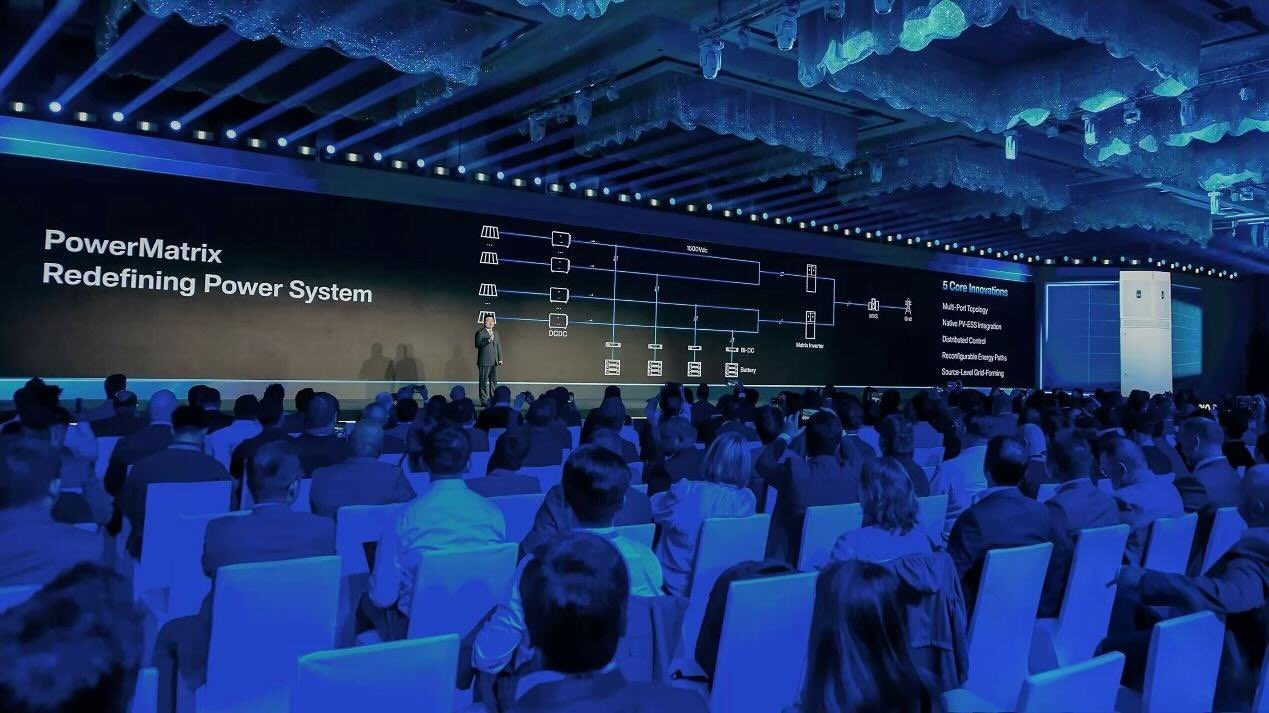
Sungrow, which achieved 143 GW of inverter shipments and 43 GWh of energy storage deliveries in 2025, also introduced its new “PowerMatrix” platform – a system engineered to combine solar PV, battery storage, the grid and electricity loads into a more integrated energy network.
Unveiling of PowerMatrix Platform, Hefei
According to Sungrow, the system refines “system stability, improves cost efficiency, and increases energy efficiency across the entire power chain.”
The company claims this design could reduce capital costs in large-scale projects by “enabling more flexible system expansion and cost optimisation throughout the project lifecycle.”
It gave an example of a 1 gigawatt project in China, where it said the PowerMatrix reduced total capital expenditure by about $120 million in comparison to a conventional AC-coupled architecture; with savings coming from substation and transmission cables, ESS equipment and other system components.
The company has also launched a C&I battery ecosystem it dubs “PowerKeeper” that is aimed at factories, large businesses and industrial sites, with a focus on reliable and flexible off-grid capability.
It also relies heavily on AI-based monitoring systems and energy management tools that support the deployment of peak shaving, demand management and back-up power.
Sungrow says the “PowerKeeper” successfully underwent seven “extreme” tests to ensure environmental resilience, structural integrity and safety.
These included flood exposure (24-hour immersion in 50 cm of water), extreme temperature exposure (-20°C to 40°C) and physical impact testing (endurance of a 250 kg pendulum impact and a drop from heights ranging from 1.6 m to 5 m).
Sungrow factory tour, Hefei
Note: The author travelled to China to attend the Global Renewable Energy Summit as a guest of Sungrow.
If you would like to join more than 29,000 others and get the latest clean energy news delivered straight to your inbox, for free, please click here to subscribe to our free daily newsletter.
Proposed cuts to staff in CSIRO's environment unit are likely to take in the team…
In the mad rush to home battery storage, this Australian company is doubling down its…
Chinese power company echoes findings of Tesla and Fluence, saying tests show grid forming inverters…
What happens when the wind don't blow and the sun don't shine? Australia got a…
Australia and Turkey have revealed the global oil crisis will prompt a major focus on…
Federal Labor commits new investment to fund state social housing upgrades like rooftop solar, electric…