Image Credit: Essential Energy
New South Wales electricity distribution networks says they have huge, untapped potential to integrate consumer energy resources, super-charge electric vehicle adoption, defer expensive grid upgrades and slash gas power consumption new modelling claims. But some key barriers need to be cleared, first.
In a report published on Monday by Ausgrid, Endeavour Energy, and Essential Energy, the three networks outlined how they can leverage the “missing middle” of the state’s energy market to support the transition to renewables and EVs and slash its cost and cut emissions.
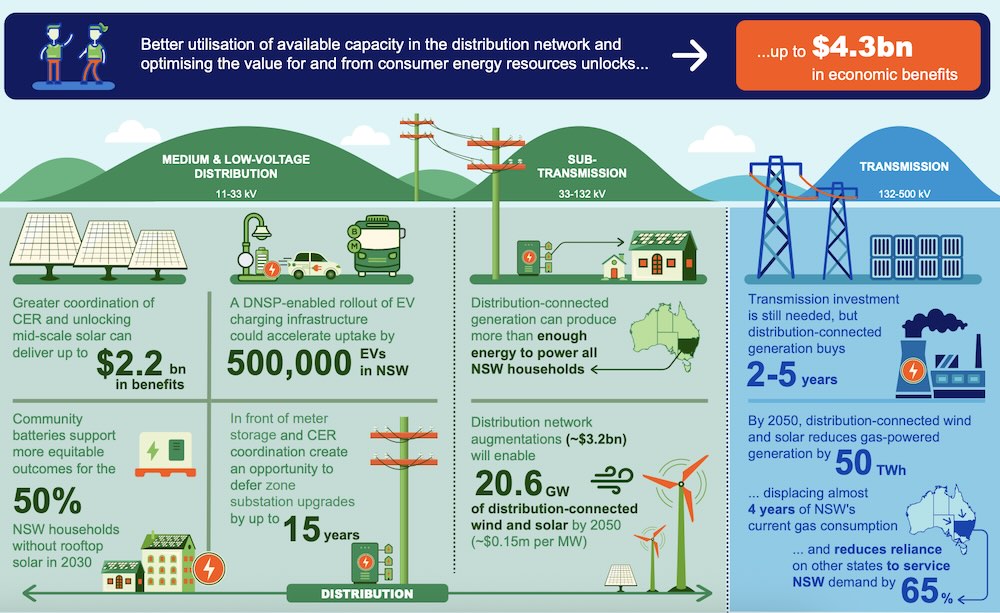
The report claims NSW can unlock between $2 billion to $4.3 billion in value by using distribution networks to integrate consumer energy resources, roll out EV charging networks and community batteries – and even to connect big solar, wind and storage.
The distribution network service providers (DNSPs) argue that they can do these things better, faster and more cost efficiently than most, while giving some much-needed “breathing room” to transmission network companies as they plan and build and try to finance a new backbone for Australia’s renewables dominated grid.
Among other things, the report claims distribution-connected wind and solar can buy up to five years of extra time for delivery of major NSW transmission projects and could cut gas-powered generation in the state by 50 terawatt-hours out to 2050, by displacing almost four years of current-level consumption of the fossil fuel.
“We’re not just waiting for major transmission to be built, we’re actively transforming today’s network into a dynamic, flexible platform that coordinates consumer energy resources in real time,” said Endeavour Energy general manager of future grid and asset management, Colin Crisafulli, on Monday.
“Our modelling shows that pushing storage deeper into the distribution network and finding customer centric ways of coordinating consumer energy resources can defer expensive network upgrades by as much as 15 years.
“A proactive, network-led approach could also fast-track EV adoption by half a million vehicles in NSW, a huge leap forward for faster transport decarbonisation.”
Distribution network companies have long argued – including in submissions to the National Electricity Market (NEM) Review earlier this year – that their role in the grid has been undervalued and overlooked in the transition so far, as well as in forward planning for a renewables dominated grid.
Currently, distribution networks have a fairly strictly regulated role as the owners and operators of the poles, wires and associated infrastructure that deliver electricity from the main grid – the transmission network – to consumers and from consumer resources, like rooftop solar, back to the grid.
But distribution networks say they could do much more, including to shoulder some of the load of transmission network companies, who are in the process of evolving from a hub-and-spoke model of electricity transportation to connecting huge amounts of new solar, wind and storage and multiple new Renewable Energy Zones (REZs).
Standing in the way of this, however, are current planning processes – including by the Australian Energy Market Operator – that the report says ignore opportunities “to rapidly unlock new utility-scale generation and BESS where it provides least-cost system outcomes.”
“The current approach overlooks the significant contribution made by distribution networks and distribution-connected assets to the electricity system, and risks missing further opportunities for how they can support the energy transition,” the NSW report says.
“Analysis completed through this project has identified over 16 GW of available capacity within the sub-transmission network. Leveraging this capacity with new generation and storage will de-risk the energy transition and accelerate progress towards emissions reduction targets.”
Ausgrid’s group executive of external affairs and strategy, Tim Jarratt, says unlocking this latent capacity in the distribution network capacity, while also using it to optimise consumer energy resources can provide a two- to five-year buffer to the energy transition timeline.
“The DSP is an Australia-first roadmap that finally shines a light on the ‘missing middle’ – our distribution networks,” Jarratt said on Monday.
“It proves that by using our existing assets smarter, we can deliver billions of dollars in value, significantly de-risk the transition, and buy up to five years of breathing room while critical transmission infrastructure is built,” he said.
The report also focuses on reforms that could take place at lower voltage parts of distribution network, to enable a more effective integration of consumer energy assets ranging from rooftop solar and battery storage to the management of electric loads and electric vehicles.
According to the modelling, a DNSP-enabled rollout of EV charging infrastructure in the state could accelerate uptake by 500,000 EVs by 2030, while greater coordination of CER and unlocking mid-scale solar could deliver up to $2.2 billion in benefits by that date.
The report says front of meter storage and CER coordination could defer zone substation upgrades by up to 15 years, while the roll-out of “community batteries” by NSW DNSPs could support “more equitable outcomes” for the 50 per cent of the state’s households that have yet to install rooftop solar by 2030.
But for distribution networks to have more of a hand in these things will require what the report describes as “active reform of market and regulatory frameworks,” including to long-standing ring-fencing rules designed to keep monopoly network companies in their lane and foster healthy market competition.
This is a contentious subject. On the one hand, network companies argue they are best-placed to fast-track much-needed innovation in areas like shared solar networks, on-street electric vehicle charging and dynamic operating envelopes.
On the other, consumer advocates and independent energy market contenders argue that it is virtually impossibly for the best interest of consumers and their distributed energy assets to be accommodated if legacy companies are leading the charge.
Recently, there has been a range of ring-fencing waivers extended to network companies by the regulator, including to Endeavour Energy for a smart meter trial and to CitiPower PowerCor and United Energy (CPU) to install, own and maintain 100 pole-mounted 22 kilowatt (kW) EV chargers across its Melbourne network over the next five years. In NSW, a proposed Ausgrid trial of commercial rooftop solar sharing is currently under consultation.
Nexa Advisory’s Stephanie Bashir argues that network ownership and operation of assets like community batteries and rooftop solar systems will likely stifle competition and innovation in what is a new and evolving market.
Bashir notes that Australian Energy Regulator, back in 2021, expressed concern that allowing DNSPs to actively engage in the community battery market risked pushing out other players. This would not be in the long-term interest of consumers, the AER said, and could mean the full range of benefits from batteries were not realised.
“The ring-fencing guideline protect consumers and ensure that the regulated electricity DNSPs do not exercise their monopoly powers in using revenue earned from electricity customers from regulated services to fund contestable services and increase their profits,” Bashir told Renew Economy in May.
But Essential Energy’s chief of customer and corporate affairs, Annie Pearson, says the report also highlights broader areas of reform that need to be addressed to ensure benefits and costs are shared fairly across NSW communities.
“It is vital that we put our communities first, supporting them in their choice around energy resources, while providing everyone with the opportunity to participate in and benefit from a cleaner, fairer energy system,” Pearson says.
“This means accelerating reforms regarding the cost allocation of the transition, the role of shared infrastructure, like community batteries, and how to co-ordinate new industries, like data centres.”
If you would like to join more than 28,000 others and get the latest clean energy news delivered straight to your inbox, for free, please click here to subscribe to our free daily newsletter.
Global ocean heat content increased by approximately 23 zetajoules (ZJ) in 2025, roughly 40 times…
AGL revises plans for a major gas peaking plant for the third time at a…
Trump's attacks on renewables sound as daft as ever, so why do Australia's conservative politicians…
UNSW Professor Matthew England, the world's leading expert on Southern Ocean modelling, discusses the catastrophic…
Solar delivered the fastest energy transition in history, but that is already being trumped by…
Fortescue reckons it has secured lowest prices for its big batteries, and says its first…