MacIntyre wind farm. Source: Acciona Energia
Queensland has slipped down the rankings of renewable energy investor potential, less than a year after the state LNP government came to power and started propping up coal and marching back progress on the state’s shift to wind, solar and storage.
The Clean Energy Investor Group’s (CEIG) latest member survey, covering investors with $38 billion in renewable assets across Australia, finds the Sunshine State has lost its spot at the top of the pops for potential, replaced by its southern neighbour, New South Wales.
The survey finds investors are already spooked by what is shaping up as a new era of planning uncertainty, policy instability, and government intervention in Queensland under the Crisafulli government, especially through changing regulations.
The findings come as news emerges that the Queensland LNP has ruled out $105 million in funding that had been earmarked for the development of an Australian Battery Industrialisation Centre in the state, to accelerate the commercialisation of battery technology.
The Crisafulli government has also locked in major changes to how renewable energy projects will be assessed for development in the state, raising concern that Queensland is reverting back to a Campbell Newman-style ideological war on renewables.
The most controversial of the suite of rule changes is the requirement for renewables developers to have Community Benefit Agreements signed off before a project can even lodge its development application with the state government.
The government has also outlined a new five-year energy plan for the state that will focus on propping up its coal plants, investing in new gas power and pushing ahead with select pumped hydro projects.
It is also expected to include the repeal of the former Labor government’s legislated renewable energy targets, which aimed for a 50 per cent share by 2030, and 80 per cent by 2035. It’s decision to abandon a key hydrogen project in central Queensland also led to the project’s collapse.
“The recent legislative changes and uncertainty in Queensland have weighed heavily on investor confidence, despite the Queensland government’s claims it remains open for business,” said CEIG CEO Richie Merzian on Tuesday.
Source: CEIG
Taking Queensland’s spot at number one, the survey shows that NSW currently ranks as the most attractive state for clean energy investment, following its updated NSW Renewable Energy Planning Framework.
And at the federal level, nearly 90% of respondents said they saw the re-election of the Albanese Labor government as a positive catalyst for clean energy investment, through policy continuity and ongoing support for renewables.
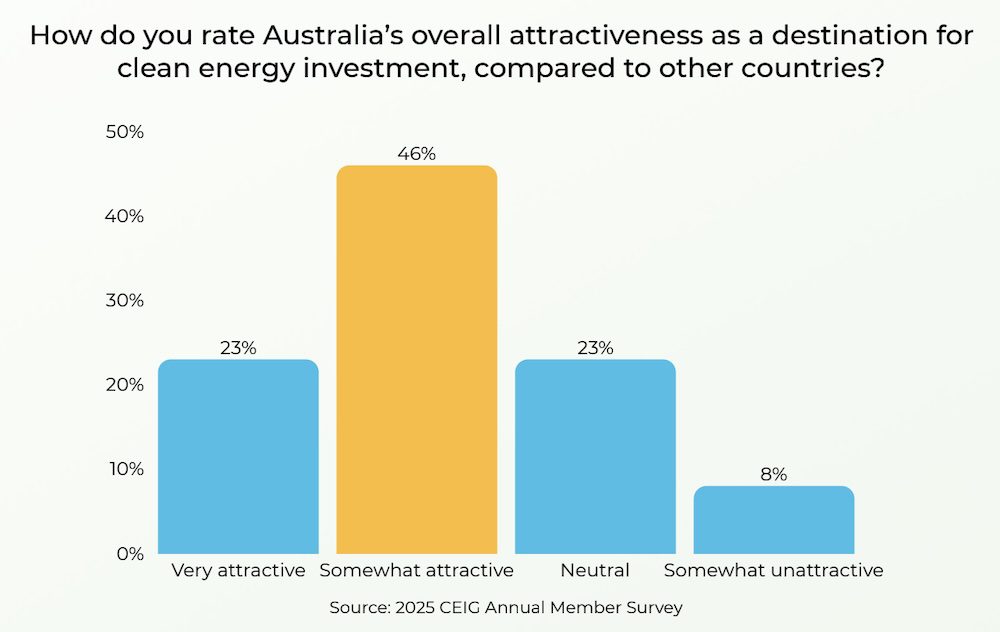
But despite ongoing progress, federally, and renewables-forward governments in most states and territories, the CEIG survey finds Australia is seen as just “somewhat attractive” for investment due to residual issues of regulatory complexity, delayed transmission upgrades and other commercial risks.
According to investors – the vast majority still coming from outside of Australia – transmission delays and slow planning processes are the biggest issues holding back capital, closely followed by costly and slow grid connections and lengthy environmental assessments.
“Australia remains highly reliant on foreign investment for renewables, with over 70% coming from overseas,” says Merzian.
“If the nation continues to be just somewhat attractive for investors we can expect that global capital to flow elsewhere, to other jurisdictions that are rolling out renewables and transmission with speed and scale.
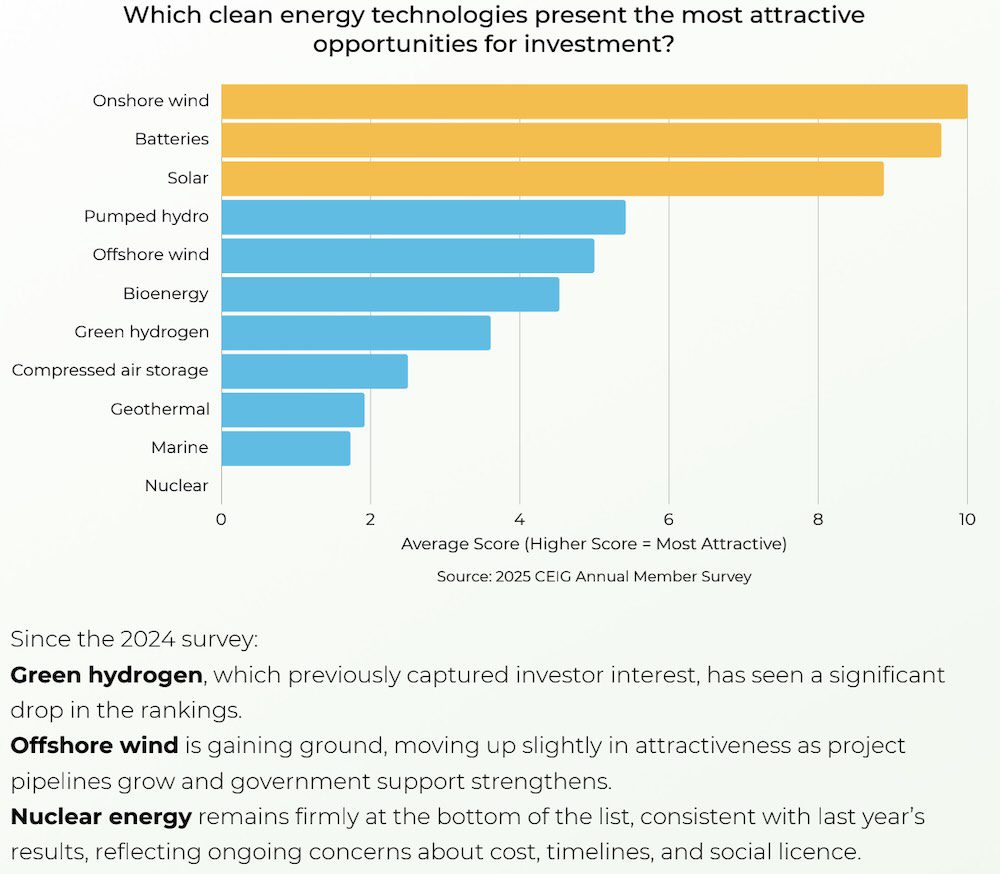
“Investors are focused on technologies like wind, batteries and solar that are proven, scalable, and ready to plug and play. Policy-makers should be focused on removing the barriers that are impacting their delivery.”
Source: CEIG
The CEIG survey also finds that onshore wind remains the top-ranked technology for investment, even despite the concerted efforts of some very loud and blustery politicians. Batteries follow closely after onshore wind, followed by solar.
Offshore wind, meanwhile, has moved up the ranks from sixth to fifth as government support strengthens and progress continues to be made on feasbility studies and preparations for the first tender in Victoria.
Nuclear remains at the bottom.
“As federal parliament returns next week, investors are sending a clear message: Australia cannot afford more delays to its renewables rollout,” says Merzian.
“The Albanese government has a clear mandate to deliver on its 2030 target for clean energy, that must include accelerating and coordinating the transmission buildout and reforming the Environment Protection and Biodiversity Conservation (EPBC) Act.”
Senior CSIRO scientists discussed how to have an "open conversation" about the rising threats from…
New 150 MW solar farm joins the NZ grid on the South Island, matching Aotearoa's…
Pacific leader turned activist says his island nation urgently needs to start "radical adaptation measures"…
A study tested two wind forecast models and found that more accurate one does not…
Australia's biggest wind projects have mostly locked in approvals and contracts, but are still shaking…
New analysis says Australia's dependence on imported diesel means some households are getting hit twice…