Image source: Vena Energy
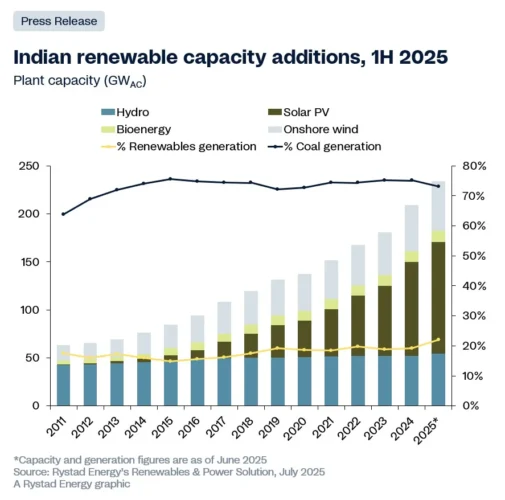
India added a record 22GW worth of renewable energy capacity through the first half of 2025, a 57 per cent increase from the 14.2GW installed during the same period in 2024.
According to a new analysis from research firm Rystad Energy, India’s new renewable energy capacity additions in the first half of 2025 included 18.4GW of new solar, 3.5GW of new wind, and 250MW of bioenergy, representing the country’s highest-ever six-month period of renewable energy additions.
Rystad pointed to the Indian government’s Interstate Transmission System (ISTS) charge waiver as the largest driver for developers, which begins at 25 per cent and increases each year until full implementation in June 2028, helping to significantly lower project costs and incentivise developers to act now.
In addition to renewable energy capacity, the award of contracts for battery energy storage additions also ticked up in the first half of 2025, with 5.4GW of co-located solar + battery storage systems and 2.2GW worth of standalone battery storage systems awarded to developers.
This record six-month start to 2025 highlights India’s progress towards its goal of sourcing 50 per cent of its installed power capacity from clean energy – though this includes nuclear as well as renewable energy sources.
In fact, India revealed a week ago that it had achieved its target of 50 per cent installed electrical capacity from non-fossil fuel sources five years ahead of its 2030 target under the Paris Agreement.
However, despite this, actual generation still favours fossil fuel sources, which accounts for over two-thirds of the increase in power generation in 2024, and a further 80GW worth of coal-fired capacity to be installed by 2032.
In the first half of 2025, according to Rystad Energy, fossil fuel sources accounted for around 75 per cent of actual electricity generated.
“India installed 22 GW of renewable energy capacity in the first half of 2025, a new record,” said Sushma Jaganath, vice president for renewables & power research, Rystad Energy.
“However, the country is still banking heavily on coal to meet growing power demand, with plans to install an additional 80 GW of new thermal projects.
“India is not yet undergoing a true energy transition; instead, it is focusing on building up installed capacity from both conventional and renewable energy sources to ensure energy security.
“Without urgent action to improve affordability and sustainability, particularly through grid upgrades and energy storage, coal will remain central to electrification efforts, jeopardizing progress toward India’s net-zero goals,” Jaganath concluded.
Origin Energy has dropped plans to develop a major wind farm intended for 10 kms…
AGL names Bayswater, Loy Yang and Torrens Island as sites with all the attributes data…
CSIRO study finds households with solar and batteries are enjoying periods of "limitless" electricity, a…
State quietly launches its own version of the Solar Sharer offer, giving households the option…
Latest nuclear status report details the glum state of affairs for the far right's favourite…
The new 400 MW gas peaking plant will be the first for a decade in…