Eraring Power Station. (AAP Image/Greenpeace)
Australia’s decision to launch a formal investigation into solar panel reuse and recycling deserves to be taken seriously.
Rooftop solar has moved from novelty to normal infrastructure, with more than four million systems installed and entire suburbs where panels are part of the built environment in the same way as hot water tanks or air conditioners.
When a technology reaches that level of penetration, questions about end of life management, reuse, and recycling are not signs of failure. They are signs of maturity. Planning for what happens after 25 or 30 years of service is exactly what competent governance looks like.
The investigation rests on an implicit principle that is both reasonable and widely shared. If an energy system produces waste, then society has a responsibility to manage that waste responsibly.
If that waste creates environmental harm, then regulation and oversight are appropriate. Solar panels contain glass, aluminium, copper, silicon, silver and trace metals. Wind turbines contain composites, steel, and concrete.
None of this disappears when systems are decommissioned, and where reusable elements can be recovered, they should be. Accepting that reality and designing systems to deal with it is sensible policy, not an indictment of the technology.
Accepting that principle also invites a second step. If waste is the lens through which energy systems are to be evaluated, then consistency matters. The correct unit of comparison is not piles of material photographed at a depot, but waste per megawatt-hour (MWh) of electricity delivered.
Electricity systems exist to produce energy, not to accumulate equipment. Comparing waste flows without normalising to output leads quickly to misleading conclusions.
When that comparison is done, the scale of solar and wind waste looks very different from how it is often portrayed. A typical rooftop solar panel weighs around 20 kg and produces roughly 10 to 15 MWh over a 30-year life in Australia. That equates to about 1.3 to 2.0 kg of panel mass per MWh, even before accounting for reuse or refurbishment.
Wind turbines show a similar, and in most cases lower, material intensity. Modern onshore turbines in the 4-6 MW range operating for 25 to 30 years at capacity factors around 35% to 40% typically result in roughly 0.15 to 0.30 kg of blade material per MWh, assuming worst-case landfill disposal.
In both cases, these are small, bounded, episodic waste streams that appear once, decades after installation, and remain in managed locations rather than being continuously dispersed into the environment.
Coal and gas systems operate on a different physical logic. They do not produce most of their waste at the end of life of the plant. They produce waste continuously, every hour they run. Coal generation emits roughly 900 to 1,000 kg of CO2 per MWh, along with nitrogen oxides, sulfur dioxide, and fine particulates.
Natural gas emits less CO2 from combustion, but when upstream methane leakage and methane slip from turbines are included, lifecycle emissions rise to roughly 380 to 690 kg CO2e per MWh, depending on plant type and leakage assumptions.
These waste streams are not contained. They are dispersed into the atmosphere, accumulate over time, and interact with biological and climatic systems.
In 2024, Australia’s coal and gas electricity generation produced on the order of 160–170 million tonnes of waste, dominated by carbon dioxide released directly into the atmosphere, along with an additional 9-13 million tonnes of coal ash managed as solid waste.
Embedded within those emissions were roughly 85,000–90,000 tons of nitrogen oxides and 130,000–140,000 tons of sulfur oxides from coal generation alone, released continuously during operation rather than appearing at end of life.
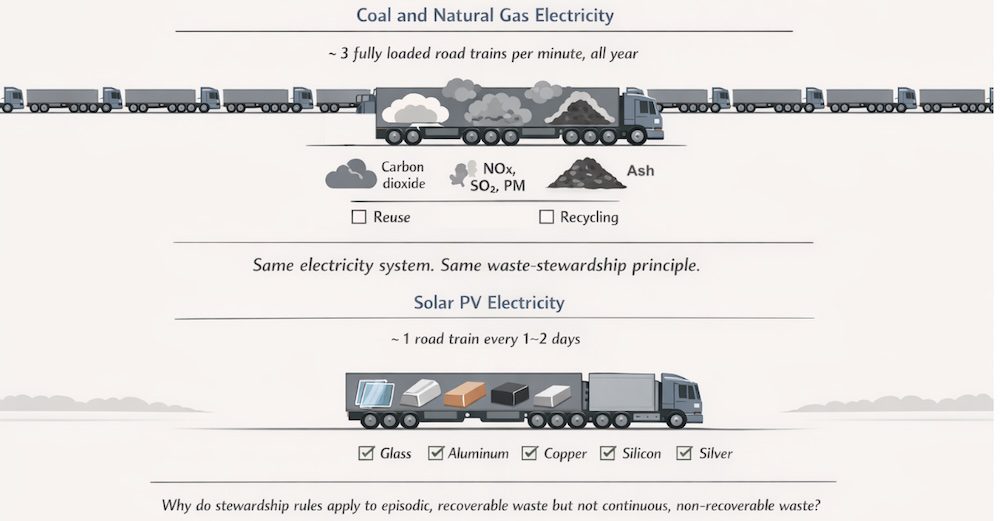
Expressed in physical terms Australians understand, the combined fossil fuel waste stream moves at the rate of about three fully loaded road trains every minute, continuously, all year.
Over the course of a day, that amounts to roughly 4,000 road trains, and across the full year it totals around 1.4–1.5 million fully loaded road trains, assuming a typical road train payload of about 113 tonnes.
Image: M Barnard
By contrast, total solar panel waste in the same year, reflecting early retirements, upgrades, storm damage, and the first wave of end-of-life systems, amounted to roughly 40,000–60,000 tonnes, about a quarter of the smog-causing nitrogen and sulfur oxides.
Using the same road-train framing, solar panel waste appears at the rate of around one road train every one to two days. Over the course of a year, that adds up to about 350–530 road trains in total.
Both streams are real and deserve competent management, but the difference in scale is not subtle. One operates at the cadence of minutes, the other at the cadence of days, which helps explain why treating them as comparable waste problems distorts policy priorities rather than clarifying them.
Mass alone, however, is not the only metric for environmental harm. Harm depends on dispersion, toxicity, persistence, and biological interaction. A kilogram of glass or composite material in a lined landfill remains contained and causes no particular problems. A kilogram of nitrogen oxides causes smog.
A kilogram of sulfur dioxide or fine particulate matter disperses across cities and ecosystems, contributing to respiratory and cardiovascular disease at concentrations measured in micrograms per cubic metre.
A kilogram of CO2 accumulates in the atmosphere for centuries, altering radiative balance and climate systems. A kilogram of methane lasts a much shorter amount of time in the atmosphere but causes a great deal more warming over 20 and 100 years than CO2.
One of the sharpest distinctions between solar waste and fossil fuel waste is what can be done with it after it appears. Solar panels are made primarily of glass, aluminium, copper, silicon, and small amounts of silver, materials that already sit inside well understood recycling and reuse pathways.
Many panels removed from roofs still operate at 70-90% of original output and can be refurbished and reused for years before recycling is required.
When panels do reach true end of life, aluminium frames are readily recovered, glass can be reused or downcycled, copper is valuable, and silicon can be reprocessed with improving yields as volumes increase. None of this is exotic. It is a question of logistics, scale, and product stewardship, not chemistry. Fossil fuel waste is fundamentally different.
Carbon dioxide, nitrogen oxides, sulfur oxides, and fine particulates have no reuse pathway once released. Coal ash can sometimes be incorporated into concrete, but only a fraction is used, and the rest remains a long-term containment problem, being much more environmentally harmful than solar waste.
Atmospheric emissions from coal and gas cannot be refurbished, reused, or economically recycled at scale. They disperse immediately, persist in the environment, and impose costs on health and climate systems without offering any recoverable value.
That asymmetry matters. Solar waste is a material management challenge with recoverable inputs. Fossil fuel waste is a one-way mass flow with no productive second life.
This is where displacement becomes central. Wind and solar do not exist in isolation. Every MWh they generate displaces a MWh from coal or gas somewhere on the grid margin. Ignoring displacement means ignoring how electricity systems work.
A solar panel that produces 10 MWh over its life avoids roughly 4 to 10 tonnes of CO2, depending on the marginal generator it displaces. That avoided pollution is continuous and cumulative. The panel waste is not, and it’s dwarfed by the avoided pollution it enables.
Taken seriously, the solar waste investigation raises an interesting question of consistency. If Australia is willing to investigate lifecycle waste for solar panels, then the same logic should apply to all energy systems.
On that basis, a second inquiry suggests itself, perhaps into mandatory 100% recycling of fossil fuel waste streams. Carbon dioxide, nitrogen oxides, sulfur dioxide, particulates, and methane leakage are all wastes produced by energy generation. If panels must not be landfilled, why should these wastes be freely vented into the atmosphere?
Framed in the language of policy, such an inquiry would ask how fossil fuel producers plan to capture, process, store, and guarantee the long term containment of their waste.
Carbon capture systems would need to operate at near perfect efficiency. Methane leakage across extraction and transport would need to fall to zero. Long term storage liabilities would need to be assigned and enforced. Monitoring and verification would need to continue for centuries. The scale of the challenge is not subtle. Fossil fuel waste streams are large because the underlying systems are inherently dirty.
This thought experiment is not intended to be taken literally. It is intended to expose an inconsistency in how waste is discussed. Solar and wind waste is visible, bounded, and manageable, which makes it easy to scrutinise. The newly announced solar waste investigation is drawing headlines as a result. Fossil fuel waste is invisible, dispersed, and continuous, which makes it easy to normalise. Serious energy policy requires resisting that bias.
Investigating solar waste is sensible. Improving reuse, refurbishment, and recycling is worthwhile. Product stewardship schemes can lower costs, recover valuable materials, and reduce landfill flows. None of that changes the system level comparison.
On a per MWh basis, the waste from wind and solar is miniscule, contained, and finite. The pollution they displace from coal and gas is large, dispersed, and ongoing and strongly detrimental to human health and the world’s climate. Keeping that distinction clear is essential if waste debates are to inform good decisions rather than distract from them.
Ground-breaking hybrid renewables system installed at an outback opal mining town in South Australia is claiming…
Amid fresh global conflict, the UK government is rolling out new measures to bolster national…
Queensland set two new instantaneous power generation records over the weekend, offering a useful snapshot…
Publicly-owned gentailer completes final concrete turbine foundation at what is the state's first new wind…
The real anathema in the modern Australian economy is not renewable energy, but the idea…
What will it take for regional communities to move from hosting renewable projects to sharing…