Murra Warra wind farm
A massive new wind farm of more than one gigawatt is being proposed for north-west Victoria, to be built alongside a big battery of 200 megawatts with up to four-hours of storage capacity.
The Cannie wind farm, being developed by renewables giant Res Australia, on Tuesday appeared in the queue of projects awaiting a decision on whether on not it needs to be assessed under the federal government’s Environment Protection and Biodiversity Conservation Act.
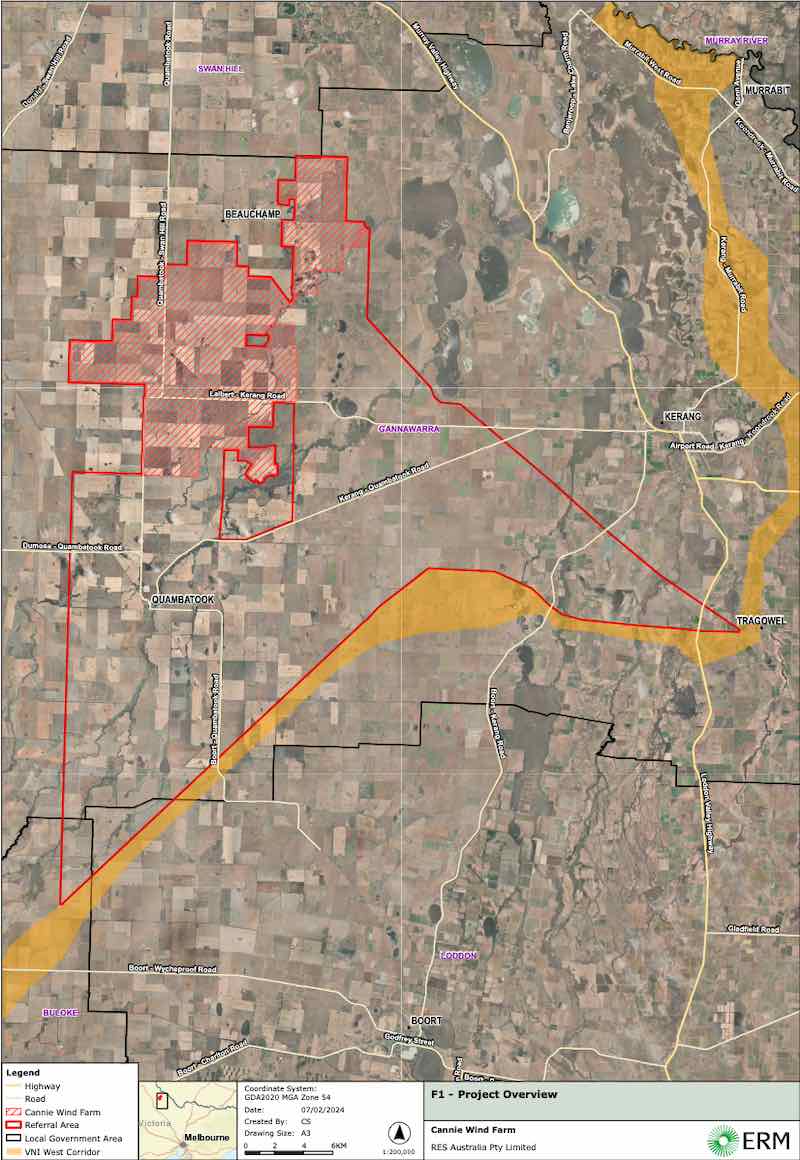
The huge project proposes to install up to 1.3 GW of wind generation capacity, comprising up to 174 turbines at around 7.4MW each, and will be located around 26km west of Kerang and 25km south of the Murray River and Victoria-New South Wales border.
A battery energy storage system is also proposed, with a capacity of up to 200 MW and 800 MWh, to be located adjacent to the wind farm’s main substation, the EPBC referral documents say.
It is just the latest in a series of gigawatt-scale renewable and storate projects that are being proposed along the routes of new transmission lines, with many focused on western Victoria, south west NSW and Queensland.
The federal government needs at least 40 gigawatt of new wind and solar capacity to reach its 82 per cent renewable energy target, but the Coalition wants to dump those renewable plans and go nuclear instead, with the Nationals promising to “tear up” contracts written by the Commonwealth through its Capacity Investment Scheme.
Although the design of the Cannie project is in its very early stages, documents suggest the wind farm would take in 112 different property parcels owned by 21 individual parties in the Gannawarra Shire, whose Traditional Owners include the Barapa Barapa, Wamba Wamba and Wiran peoples.
All up the wind farm and battery would span approximately 17,000 hectares of privately owned land, with the aim of co-existing with operational farming activities.
Notably, the proposed wind farm would also be in the vicinity of the controversial Victoria to New South Wales Interconnector West (VNI West) – a 500kV double-circuit overhead transmission line that proposes running from Bulgana in western Victoria to Dinawan in NSW via a new terminal station near Kerang.
The Victorian side of the project is now being led by the state government body VicGrid, but was originally worked up by the Australian Energy Market Operator as one of the transmission upgrades considered critical to the shift to renewables on the National Electricity Market (NEM).
It aims to solve a congestion problem in the north-west of Victoria that has caused significant grief to existing solar and wind energy asset owners, has delayed the development of new projects and earned the region the unfortunate nickname Rhombus of Regret.
But the proposed $3.3 billion transmission link has attracted criticism from landowners and local councils over visual and environmental impacts and the fate of endangered species and divided experts over whether it offers best value for money and the best support for renewables in the state.
The referral documents for the Cannie wind farm say three transmission corridor options are currently being investigated to connect the project to the new terminal station proposed to be located near Tragowel – south of Kerang – as part of VNI West, “or at an alternate location along the proposed VNI West transmission corridor.”
Res says the selection of the preferred transmission corridor for the wind farm will be informed through consultation with proposed landholders, and with consideration of engineering design and environmental investigations.
Res, which was established in Australia in 2004, has developed the Taralga Wind Farm in New South Wales, the Ararat and Murra Warra wind farms in Victoria, and the Dulacca wind farm in Queensland.
It hopes to get to work on the Cannie wind farm in 2027, “subject to change pending a planning permit and the construction of VNI (West).”
In the meantime, it is consulting with the local community and a wide range of stakeholders to provide information on the project and to seek input on community benefit sharing options.
The Cannie Wind Farm Environmental Effects Act referral is also now live on Victoria’s Department of Transport and Planning (DTP) website here.
Developer of small wind project in Victoria gets approval for five turbines from state government,…
The wind, solar and battery project secured state and EPA approvals in an astonishing four…
A solar installer has been fined for unsafe home battery installations, including one that sparked…
A 600MW wind project has the green light to start construction, but government wants turbine…
Another two major solar and battery projects have been referred to independent commission after objections…
In last week's heatwave, wind and solar generation were excellent, as they typically are on…