Australian households are already the biggest adopters of rooftop solar panels in the world, and the technology already provides all of local demand in some states at certain times, and more than 11 per cent of total grid demand over the past year.
But a new report says households could lift the output of their rooftop systems by more than 20 per cent if they chose to install dual-sided solar panels rather than the traditional one-sided systems – and if they had a light coloured roof.
Dual-sided, or bifacial, solar cells, are made with glass on both sides that allows for both the front and the back of the solar panel to generate power. They are commonly in large ground mounted solar systems, but rarely on rooftops, even though the potential is there for them to collect energy reflected those rooftops.
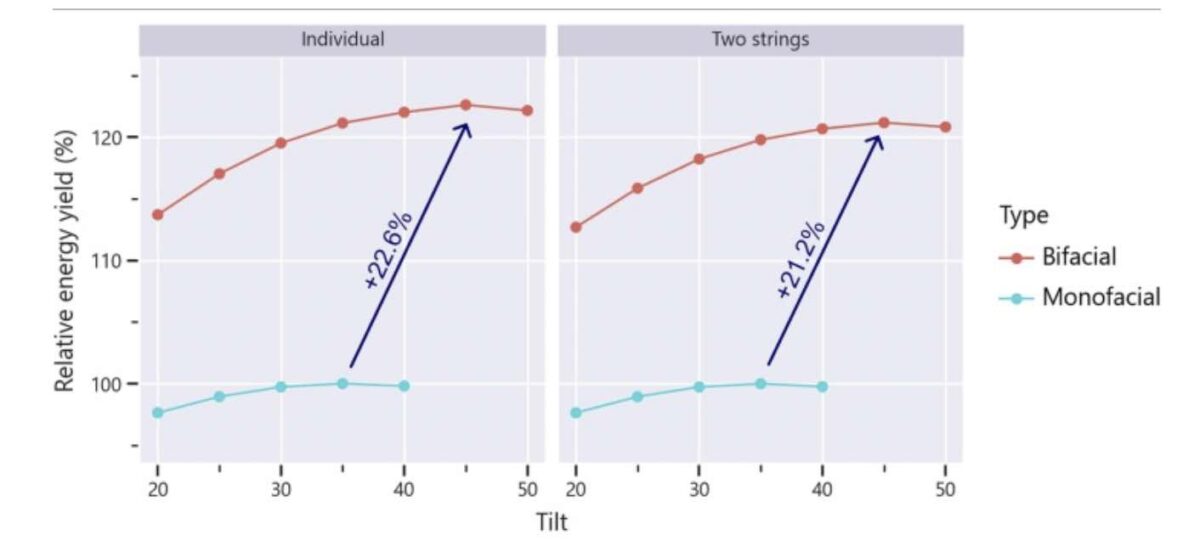
Lead author Dr Marco Ernst says the study showed that bifacial solar modules could lift output by 22.6 per cent compared to monofacial solar modules.
“It did surprise me a bit,” Ernst says of the results, which are significantly higher than for ground mounted systems. “That’s because the ground doesn’t reflect well, but rooftops with the right materials can reflect very well.”
The report notes that – depending on the latitude, and this study was based on Canberra installations – rooftop solar panels can produce most power with a 35° angle tilt, but bi-facial panels work best with a 45° angle tilt to allow more sunlight to be reflected on to the back panel.
The morning and evenings are particularly productive, and there are gains too on cloudy days. But there is a catch – the rooftops might need to be flat because flush mounted panels will not allow much reflection. Or the panels need to be rack mounted to gain the required tilt.
Ernst says rooftop colour is a key factor, because light coloured rooftops are better able to reflect sunlight on to the back of a solar module.
“Rooftop reflectivity is a critical factor in maximising the potential of bifacial solar panels, emphasising the importance of considering the specific characteristics of rooftop surfaces,” Ernst says.
Some cities around the world have responded to record heatwaves by ensuring that rooftops are painted white to help lower the soaring heat, but a ban on dark roofs in NSW in 2021 was scrapped a year later under protest from property developers, who favour dark rooftops.
“By using cool materials, such as light-coloured roofing, you can radiate heat rather than absorb it,” Ernst says.
“Mainstream adoption of light-coloured roofs would reduce heat in our urban areas and energy consumption and costs, and help Australia achieve its goal of net zero emissions by 2050.
“It would be in Australia’s best interest to act quickly and incentivise the use of light roofs to fight climate change and to futureproof the industry for what’s coming.
Policy review will investigate settings for Australia's 2030 and 2035 emissions reduction targets.
Kane Thornton has moved from the peak renewables body to data centres, now the presumed…
Australia's government-run "carbon neutral" certification scheme is being wound up. It is good news for…
Victoria's newly appointed energy minister says the state will go ahead as planned with Australia's…
A promise of banning gas while waving through “gas firming” and “gas peaking” with unlimited offsets leaves…
Plans for a potentially massive new wind farm start federal environmental assessment, proposing up to…