AAP Image/Dan Himbrechts
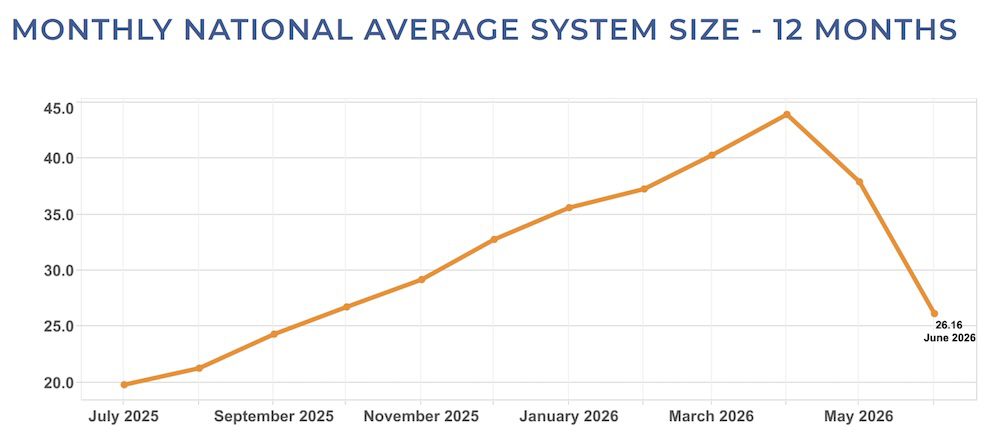
Australia’s home battery market is undergoing a “healthy reset,” new data shows, with monthly installations falling by nearly 30 per cent and the systems being installed “right-sizing” to between 20-30 kilowatt-hours, down from an outsized average up around 50 kWh.
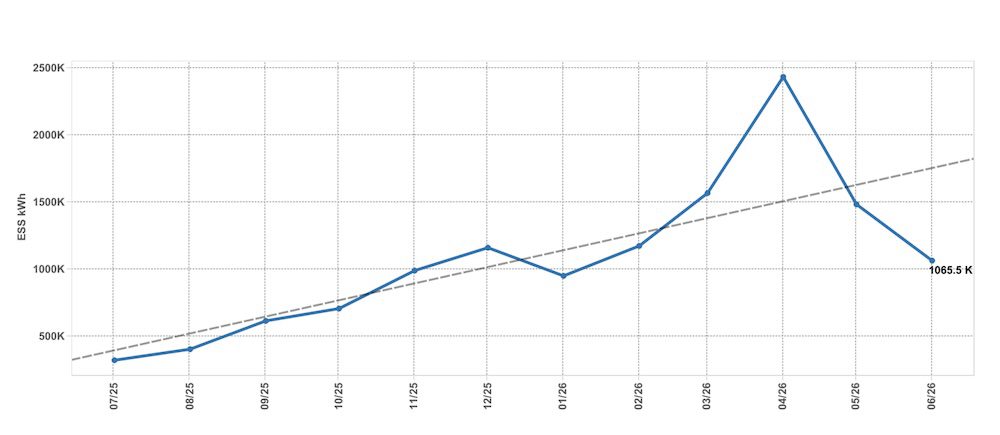
Solar industry analyst SunWiz says a total of 1.07 gigawatt-hours (GWh) of home batteries were registered in June, a decrease of 28.3 per cent on the total installed in May.
SunWiz managing director Warwick Johnston says that while the June slowdown takes market growth below the 12-month trendline, numbers are still above where they were at the start of 2026 – and roughly triple the levels of one year ago, when the federal rebate was just one month old.
Source: SunWiz
“[This is] a healthy reset after the rebate-driven surge,” Johnston says in the report. “[It’s] a controlled reset, rather than a structural decline, with late registrations likely to firm the final figure.”
The “reset” follows the May 01 adjustment to the settings of federal Labor’s Cheaper Home Batteries rebate, which restricts access to the full discount to the first 14 kWh of usable capacity of a battery system.
It offers a 60 per cent discount on capacity from 14 kWh up to 28 kWh, and just 15 per cent from 28 kWh to 50 kWh.
The main aim of the changes was to cool the red hot market and to prevent the government-funded subsidy from being eaten up by systems sized at 50 kilowatt-hours (kWh) and above.
“Beneath the headline, the market is right-sizing, rotating out of oversized systems into mid-scale 20-30 kWh storage,” Johnston says.
Source: SunWiz
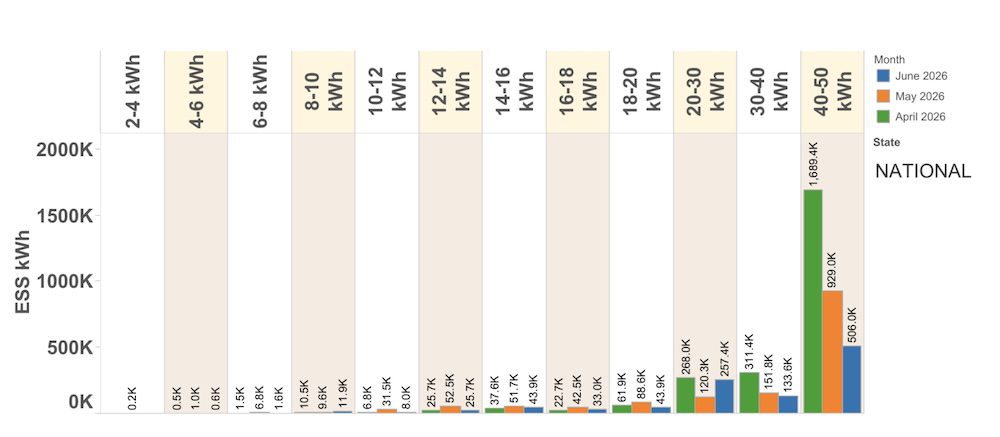
“The oversized 40-50 kWh band nearly halved (−46% MoM) and the 10-20 kWh band eased (−42%), while the 20-30 kWh band surged 114% – the only segment to grow – cementing its role as the market’s new centre of gravity, even as 40–50 kWh systems still lead on absolute volume.
“Though our charts depict growth in the 20-30 kWh range, uncertainties in installation date make converting [small-scale technology certificates] to kWh difficult – these are likely 40 kWh systems installed pre 1st May but registered last month.
Source: SunWiz
“The key message is the market has cooled considerably since its peak and looks likely to fall further,” Johnston says.
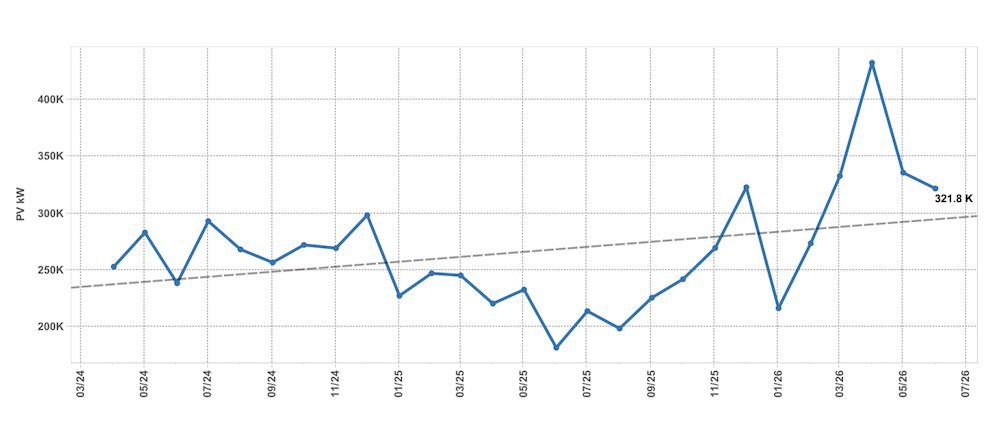
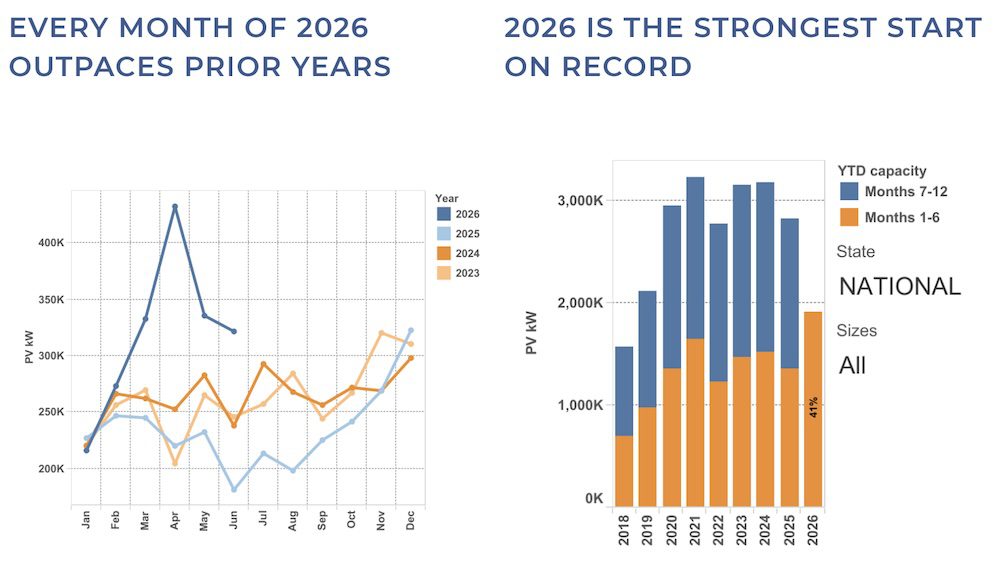
Rooftop solar, meanwhile, continues to enjoy its highest ever tally for the first six months of the year, and at the end of June is running around 41 per cent ahead of the same point in 2025.
After riding the battery rebate wave to record-setting heights in April, a total of 322 megawatts (MW) of new rooftop solar capacity was registered in June, according to SunWiz, down 4 per cent month-on-month and 26 per cent off April’s 435 MW.
Source: SunWiz
As the chart above shows, such has been the battery boost to rooftop solar that “June 2026 sits clearly above the same month in 2023–2025, comfortably the strongest June on record despite cooling off from April’s spike,” says Johnston.
“Smaller systems – the 0-15 kW residential core – edged up (+2% MoM) while every larger band fell, led by 20-30 kW (−31%) and 15-20 kW (−16%). The 10-15 kW band remains the backbone at ~118 MW (~37% of the market).”
Source: SunWiz
Johnston says the bulk of the national decline came from the 15-100 kW segment that powered April’s spike, while the national average system size also slipped to a 12-month low of 10.01 kW, down from May’s 10.47 kW and April’s peak of 11.32 kW.
If you would like to join more than 29,000 others and get the latest clean energy news delivered straight to your inbox, for free, please click here to subscribe to our free daily newsletter.
Amandine Denis-Ryan from IEEFA on what can be done about Australia's unique and unhealthy dependence…
For maximum readings, September came in as Australia's third warmest. For minimums, last month narrowly…
Diesel fuel tax credits earned over 10 years nearly equate the price of a huge…
Updated: The biggest wind farm to reach financial close in Australia in the last two…
Australian battery maker whose customers include the federal energy minister has gone into voluntary administration,…
A major new transmission line that the state opposition has vowed to scrap is seeking…