Image: Ausgrid
Plans to develop a 200 megawatt, two-hour battery in New South Wales have been cleared by the state’s independent regulator, less than a month after being sent for reassessment by dozens of interstate and long-distance objections.
The NSW Independent Planning Commission (IPC) said on Monday that it has approved the 400 megawatt-hour (MWh) Steel River East Battery Energy Storage System (BESS), proposed by network company Ausgrid for development next to an existing substation in an industrial estate in Newcastle.
In its statement of reasons, the IPC said the $208 million project, which sits in the Hunter and Central Coast Renewable Energy Zone (REZ) would “contribute positively” to the NSW energy transition, by storing energy during periods of low demand and releasing it during peak demand.
The State Significant BESS landed with the IPC after receiving 61 public objections. Under NSW rules, any project that receives more than 50 objections must be referred to the IPC, regardless of where those objections come from.
This sometimes works as intended. In January, a gigawatt-scale battery project near Tamworth in the New England region was sent to the IPC on the weight of objections more than half of which came from people living within 5 kms of the planned project.
But increasingly, the process is being hijacked by anti-renewables groups and serial objectors.
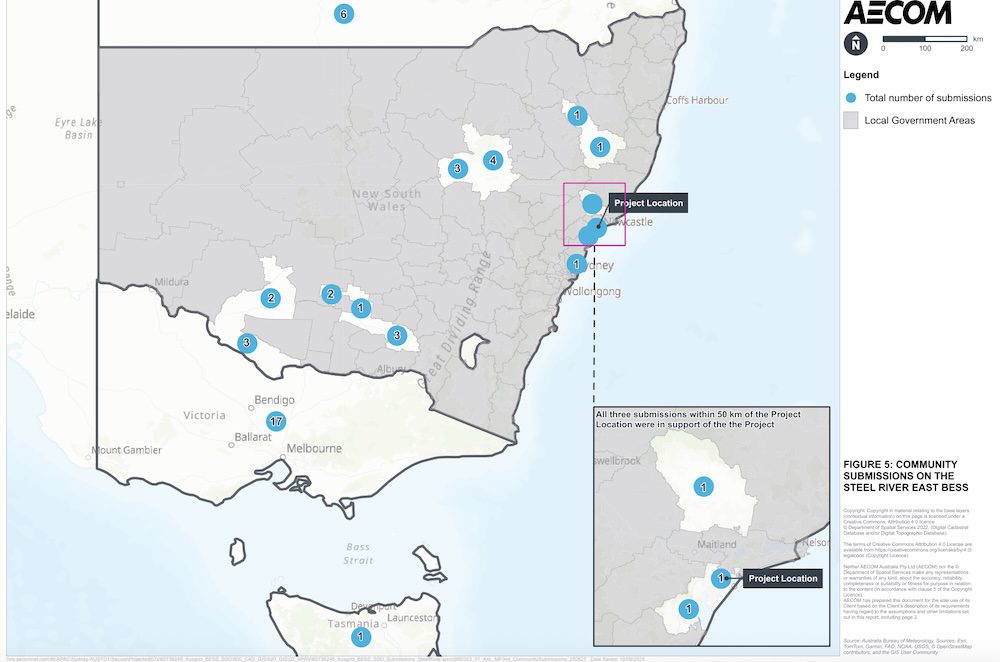
In the case of the Steel River East BESS, of the 64 public submissions made during public exhibition of the development application, three were in support – all within 50 km of the project – while 61 objected to the project, all from further than 50 km away.
As the map below illustrates, nearly all of the objectors to the battery lived more than 200 km away from the proposed development site, with 11 of the NSW submissions coming from between 400 km and 600 km away, down near the state’s southern border.
Another 24 submissions objecting to the battery came from interstate, including 17 from Victoria, six from Queensland – including serial objector to all projects solar, wind or storage Rainforest Reserves – and one from Tasmania.
According to the EIS submissions report, objections to the project covered concerns ranging from modern slavery to the perceived inefficiency of BESS technology; economic, environmental and social impacts, fire risks and chemical waste and agricultural impacts.
One submission, in this case from the NSW New England region, says “I want you All to Go To China and Never Come Back. Never. Never. Go away.”
The IPC received a total of nine written submissions during its own public consultation process. Two of these were from parties located within less than 25 km from the proposed battery and supported its development. The remaining seven submissions objected to the BESS, six of which came from more than 100 km away.
“The Commission finds that impacts on the local community would be minimal and limited to impacts associated with typical construction activities,” the statement of reasons says.
On fire risk, the commission says it is “satisfied that, subject to conditions of development consent requiring the completion and implementation of a Fire Safety Study and Emergency Plan, the project would not pose a material risk to the community or the environment.”
All told, the Commission concludes that the Steel River East BESS proposal is “consistent with key state policies that collectively seek to accelerate renewable energy deployment and improve grid reliability.”
Alongside the Steel River East BESS in Newcastle, Ausgrid is proposing another 200 MW, 400 MWh project for the western Sydney suburb of Homebush, at a site zoned for electricity supply.
Ausgrid says the two BESS installations will provide storage and firming capacity, and frequency control ancillary services (FCAS) for the grid, and while it’s pushing the concepts through the planning process, it ultimately wants both to be built and operated by someone else.
If you would like to join more than 29,000 others and get the latest clean energy news delivered straight to your inbox, for free, please click here to subscribe to our free daily newsletter.
The Energy Efficiency Council wants state and federal governments to take energy productivity seriously.
The task of repowering the mining giant's Australian aluminium assets now lies with an executive…
One of Australia's pioneering community renewables projects is complete and will soon start generating power…
Environmental services provider ordered to rectify non-compliant water heater installations at its own cost as…
Government pledges $2 million towards local industrial outfits bid to establish state's first domestic manufacturing…
The downfall of the Liberals in South Australia problem affecting the party across the nation:…