Iberdrola's Lake Bonney wind farm.
South Australia has set a new wind output record, as new capacity comes on line and as previous limits on wind out put are relaxed after the installation of four synchronous condensers that provide grid security.
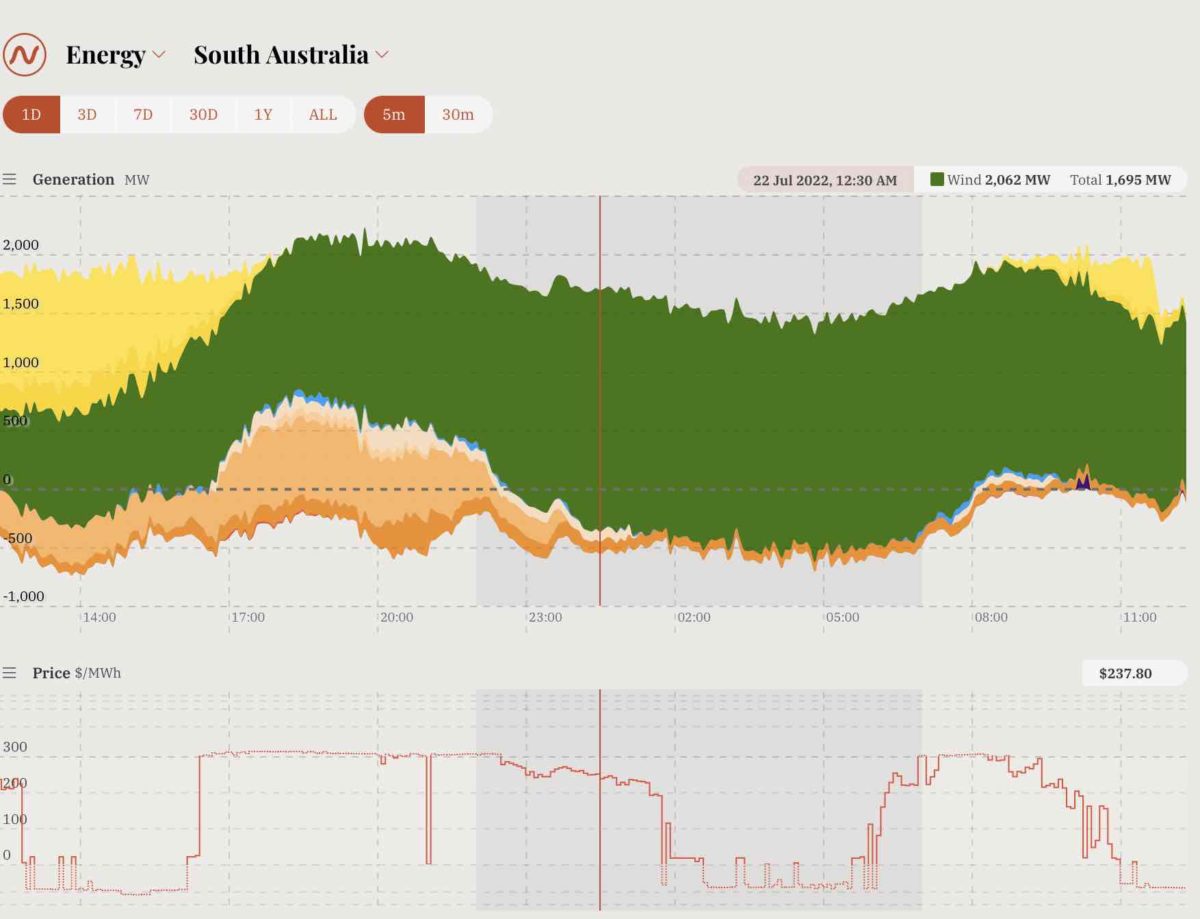
According to NEMLog, the new wind output record of 2,062MW in South Australia was set at just after midnight on Friday morning, beating the previous record of 2,051MW set just six days earlier.
At the time, wind was providing 120 per cent of the state’s local electricity demand, although the few gas generators that were operating at the time succeeded in keeping the wholesale electricity price at around $220/MWh.
The price later went negative around 2am after the last of the reciprocating gas engines were switched off, and went negative again during the daytime when the combined impact of wind and solar pushed more gas out of the system.
The constraints on wind and solar output in the state have been relaxed significantly since the installation of the four syncons, which provide “system strength” and allow the market operator to retain only a minimum amount of gas generation when there is plenty of wind and solar.
Syncons are spinning machines that do not burn fuel, but many in the industry believe that battery storage with “advanced” or “grid forming” inverters will be able provide a similar service.
Several big batteries have installed such inverters, including Hornsdale Power Reserve in South Australia, but trials to date have been limited.
South Australia’s wind output has been highly variable over the past week, falling to a minimum share of 3 per cent on Tuesday, but the state’s share of wind and solar remains at a world leading 67.4 per cent over the past week, and 65 per cent over the last 12 months.
The Port Augusta Renewable Energy Park, which had been shut down for several weeks after as yet unexplained “oscillations” caused lights to flicker, has also resumed output and is producing at up to its current hold point level of 140MW as it works its way through the commissioning process.
PAREP will ultimately have 210MW of wind capacity and 107MW of solar capacity, making it the biggest wind and solar hybrid facility in the country once complete.
The flurry of new wind financing deals continues, this time with the banking of Australian…
Earthworks begins on key substation for the Copperstring transmission line that will unlock some of…
Technology used to build world's tallest wind turbine, to tap into high altitude winds, similar…
State-owned utility cuts full-year loss after lifting generation and collecting a one-off insurance payment for…
New report shows Germany generated as much solar energy by end of September as in…
Plans by the owner of Australia's biggest wind farm to build a new stand-alone battery,…