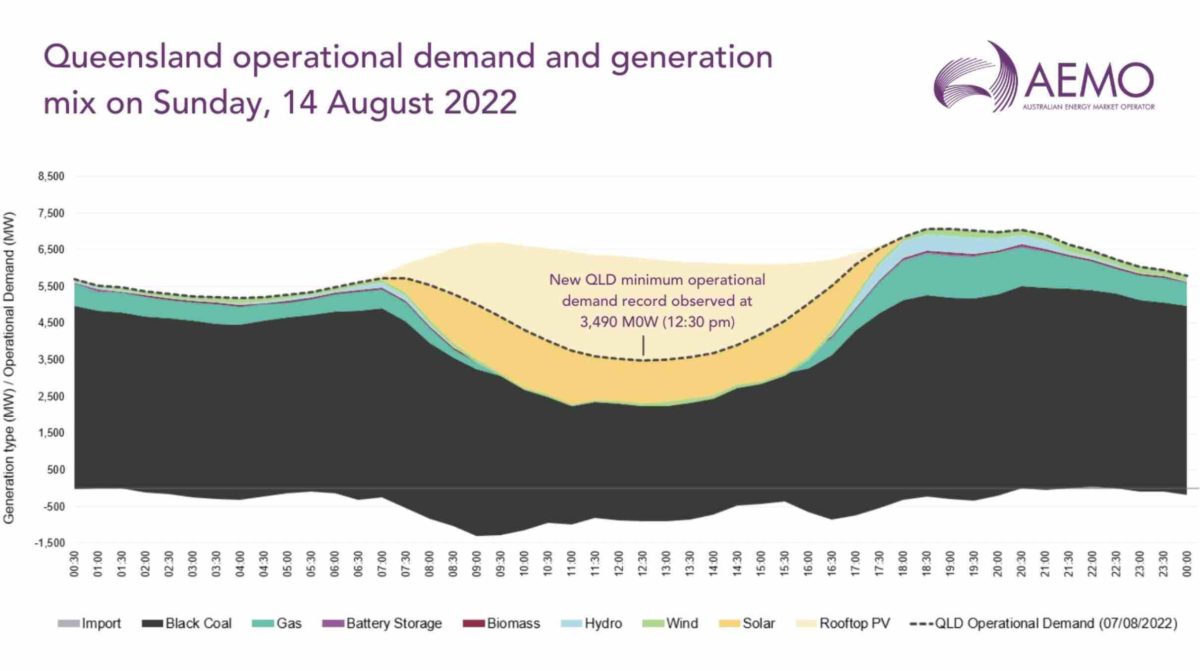
The continuing roll out of rooftop solar in Queensland, the Sunshine State, has helped set a new record low for minimum “operational demand” and crunched the production plans of the state’s coal generation fleet.
The new low was observed by the Australian Energy Market Operator and occurred around 1230pm on Sunday, in the middle of a sunny winter’s day, with relatively low demand because of the weekend and relatively mild weather.
It was just a few years ago that the biggest concern for grid managers and operators was peak demand, and whether there was enough supply to meet the needs of customers, particularly as they turned to air conditioners in the summer heat.
Now, just as problematic, is the prospect of minimum demand falling to levels where it makes it difficult for the market operator to maintain grid security.
The significance of this occurring in Queensland is that it is the country’s most coal dependent grid, with 73 per cent of its supply coming from coal in the last 12 months.
The falling operational demand already a problem for coal generators, who have to dial down their output, but AEMO is also working on ways to ensure that there is enough synchronous generation, or alternatives, to maintain grid security.
Options include soaking up the excess rooftop solar with battery storage, or other forms of storage, load management – encouraging more loads to be switched on during the day, rather than at night when they were used to keep coal plants busy, or more “dynamic” controls on rooftop solar itself.
AEMO noted that the new minimum came just seven days after the previous record (3,672MW on August 7, also a Sunday).
It said that at the time of the new minimum operational demand, the sunny conditions allowed rooftop solar to contribute 44 per cent (2,777MW) of underlying demand.
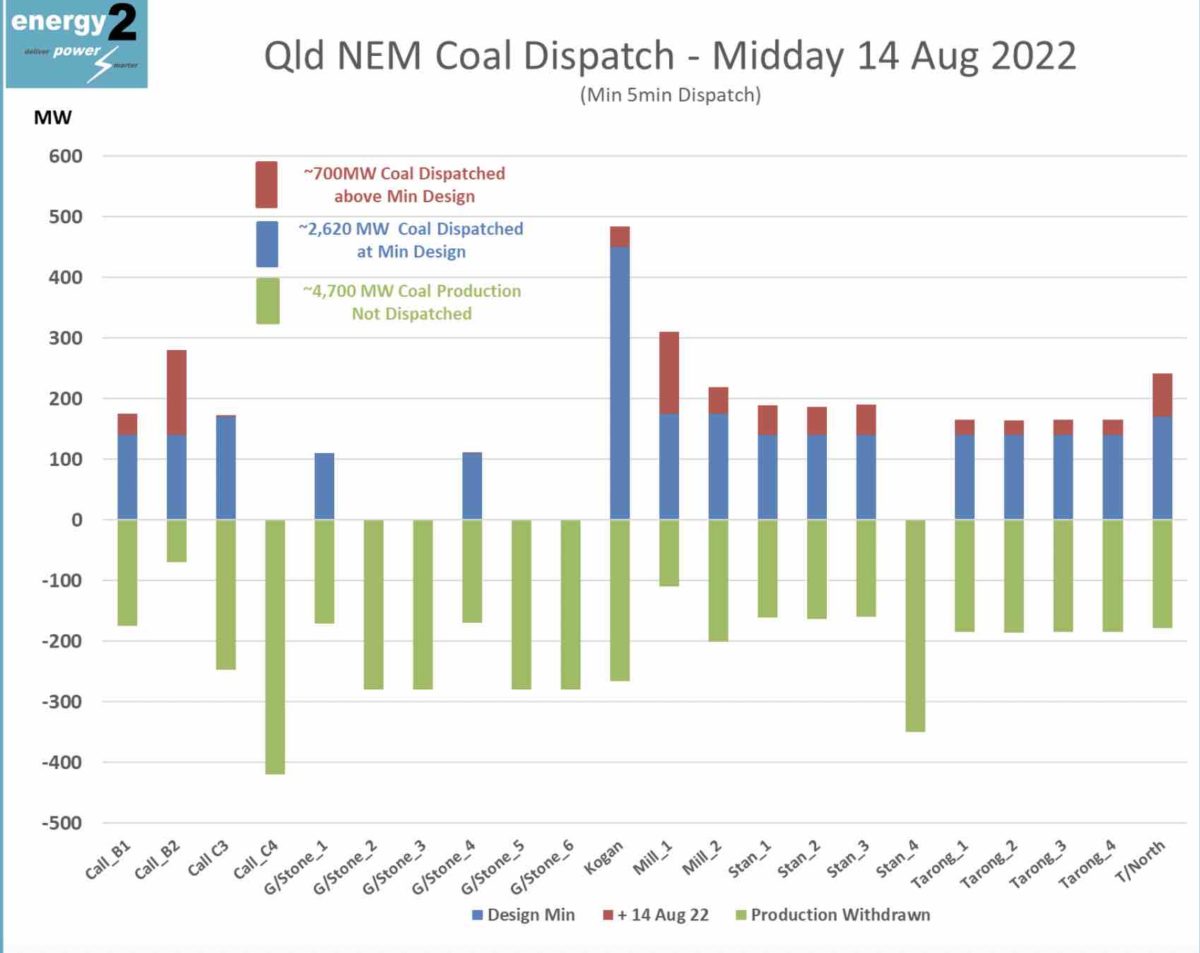
It had an immediate impact on coal generators, as this graph (Avon) posted on Twitter from Scott Armstrong at Energy2Power reveals, with some coal generators already forced down to their minimum operational levels, others barely above it, and all forced to withdraw significant amounts of capacity.
Large scale solar also had a good day, contributing to a record share of around 20 per cent at the time, beaten by a new record share of 22.7 per cent on Monday, August 15, according to GPE2 NemLog.
Tougher rules to protect Australia's environment have been welcomed by developers, but conservation groups say…
Karl Braganza, head of research at the BoM, explains El Niño and what it means…
Freshly minted NEM data shows solar-charged batteries discharging at record levels, helping lower wholesale prices…
It is now well established that the combination of new renewables and the huge growth…
Remote First Nations renewable energy projects are a complicated sell to investors, but a new…
Sod turned at first major solar and battery project to connect to new REZ, at…