Humber Gateway offshore wind farm. Image: Power Technology
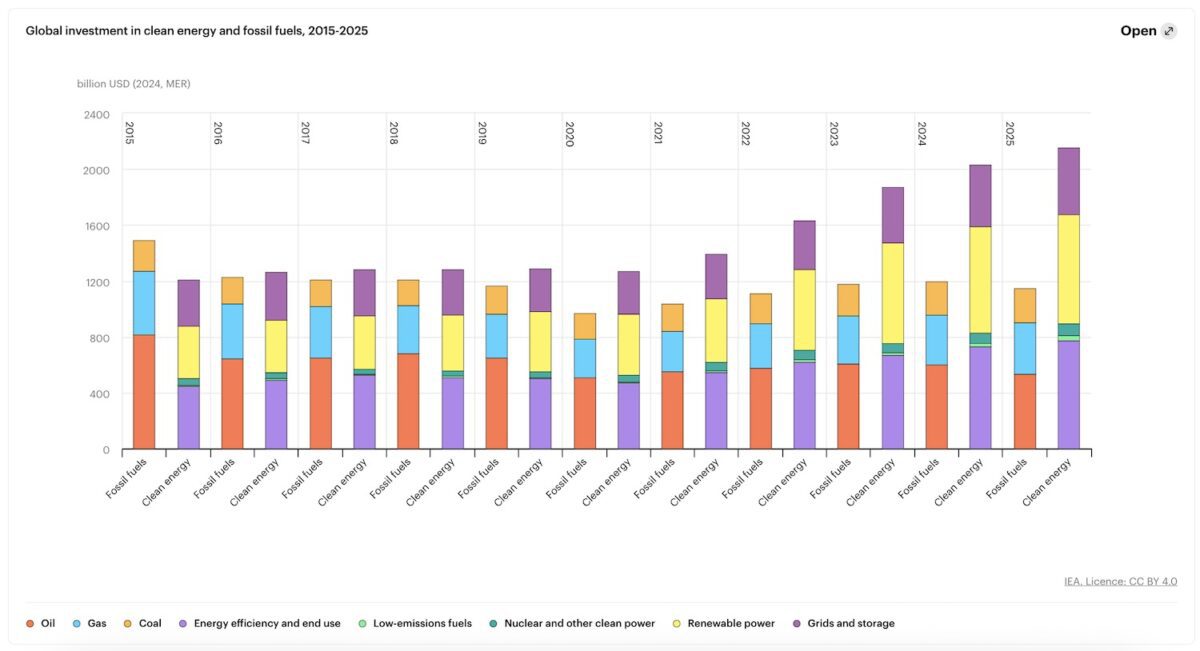
Global investment in clean energy technology will continue to grow this year to a whopping $US2.2 trillion, according to a recent benchmark analysis from the International Energy Agency (IEA).
The huge number represents a 2% increase on the figure from last year, which covers investments into a range of technologies including renewables, nuclear, energy storage, low-emissions fuels and electrification.
In additional positive news for the planet, the report says notes 2025 will be the first since 2020 to see a year-on-year fall in fossil fuel investment – dropping from US$1.195 trillion last year to US$1.148 trillion in 2025.
This is in spite of a handful influential political leaders, including US President Donald Trump, pushing for more oil and gas production.
“The fast-evolving economic and trade picture means that some investors are adopting a wait-and-see approach to new energy project approvals, but in most areas we have yet to see significant implications for existing projects,” said IEA Executive Director Fatih Birol.
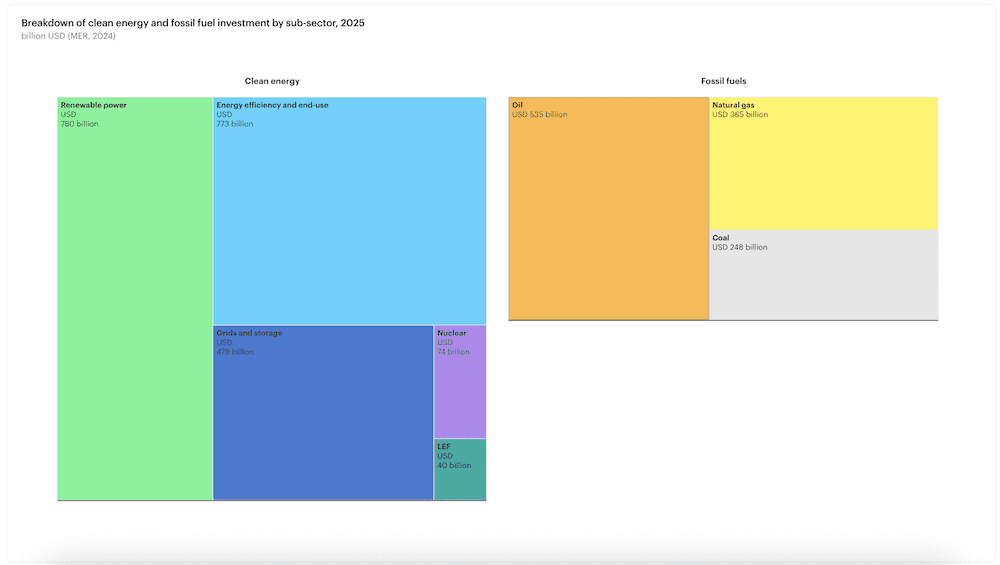
Solar technology is set to receive the single largest investment this year at US$450 billion, which the IEA attributes to “fierce competition among suppliers and ultra-low costs.”
As noted by the IEA, this huge figure can also be attributed to many emerging and developing countries using solar, often paired with energy storage, as a way to advance local power grids. Global spending on batteries is set to reach US$66 billion this year.
In terms of individual countries and territory investments in clean energy, China is expected to lead the way with US$627 billion, followed by the US (US$400 billion) and then the European Union (US$386 billion).
Unfortunately, China and the US are also expected to lead the way in fossil fuels this year, with investments up to US$257 billion and US$187 billion, respectively.
According to a recent report from Greenpeace, China gave the green light to around 11GW of new coal-fire generation during the first quarter of this year, after approving a further 100GW during 2024.
Global Investment into nuclear technology also continues to rise and is expected to exceed $US70 billion this year.
EVs outsell petrol cars again as we unpack September's sales figures, Hyundai scraps its Australian…
New study demonstrates that solar farms can have a material impact on reducing dust pollution…
Macquarie's renewables offshoot is seeking to add a big battery to a fully operational 330…
As solar module makers use fewer valuable materials to get prices down, questions arise about…
Amandine Denis-Ryan from IEEFA on what can be done about Australia's unique and unhealthy dependence…
A Melbourne project to assess apartment buildings' electrification potential suggests that technically it's doable but…