Rooftop PV in Frankfurt. Source: BSW Solar
Well before Russia started to wage war on Ukraine , Germany’s government begun to decide on a wide-ranging renewables reform that should make the country’s power supply almost 100 percent renewable by 2035.
In a draft paper seen by Clean Energy Wire, the economy and climate ministry proposes higher renewable capacity targets for 2030, aligning the German clean energy path with the 1.5 degree warming limit.
In a more immediate reaction to the possible reduction or stop of Russian gas deliveries to Germany, minister Robert Habeck said that Germany’s gas reserves will last for this winter and summer – but securing supply for next winter would demand new procurement sources and weaning the German economy from its appetite for gas, he added.
While insisting there would be no taboos when looking into supply security, he said that using imported coal for longer or letting existing nuclear plants remain online would likely not be feasible solutions.
Amid Vladimir Putin’s war against Ukraine and the energy supply repercussions it has for Germany and the rest of Europe, the country’s climate and energy ministry will propose a faster expansion of renewable energy capacity, in order to reach a near 100 percent renewable power supply by 2035.
According to the Süddeutsche Zeitung the plans – seen by Clean Energy Wire – will be voted on by ministries as of today.
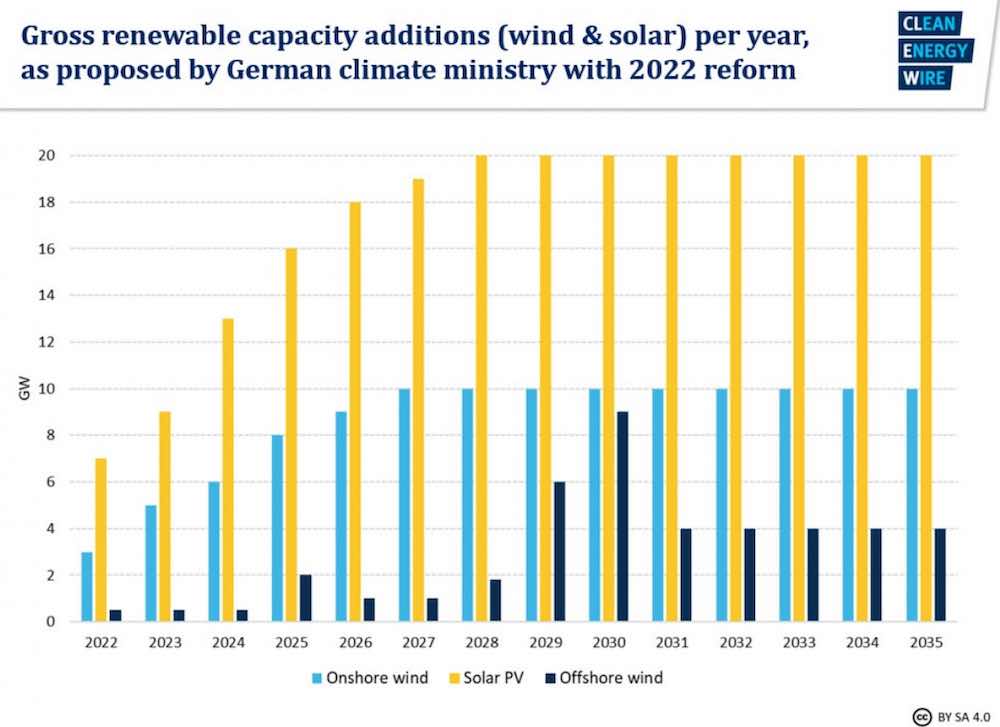
The Renewable Energy Act (EEG), which was so far aiming for full renewable supply “before 2050,” will be amended to reach up to 110 gigawatts (GW) of onshore wind capacity by 2030 (more than double the amount running at present), 30GW of offshore wind (almost four times more than today) and 200GW of solar PV capacity, also almost four times more than currently exists. Tender volumes under the EEG will have to be adjusted to reflect the higher target capacities.
With these changes, “Germany is thus consistently aligning the expansion of renewable energies with the 1.5-degree climate protection path,” says the ministry paper.
Government auctions that reward the lowest bid by giving them a guaranteed feed in payment will remain in place. But for ground mounted solar PV installations, the ministry proposes to gradually enter into a “contracts for difference” (CfD) scheme, whereby a minimum payment is guaranteed per kilowatt-hour to an installation – but if the operator can sell their electricity at higher prices, they must refund their income above the minimum revenue.
Other changes include exceptions from the tendering process for citizen-run renewable projects and increased payments to small solar rooftop installations. A controversial provision that used to reduce solar subsidies the more capacity additions boomed will be abolished.
Economy and climate minister Robert Habeck told public broadcaster ARD on Sunday (28.2.) that his department would look into all options in response to the likely decrease or stop in Russian fossil fuel deliveries to Germany – in particular of natural gas.
These include a longer run-time of nuclear and coal power stations. He said that there should be “no taboos” on this in order to secure Germany’s energy supply.
Germany has a legal phase-out date for coal power in place for 2038 which the government has pledged to bring forward to 2030 if possible. The last remaining nuclear power stations are to be taken offline by the end of this year.
Habeck said that letting coal plants run longer “means a longer dependence on hard coal from Russia”, while buying coal elsewhere would create a dependency on other countries.
Regarding nuclear, the Green Party minister – whose party is in staunch opposition to nuclear energy – said that he wouldn’t “ideologically reject” letting existing plants run longer but that his ministry’s initial examination had shown that “for the winter of 2022/23 nuclear power would not help us”.
Preparations for the upcoming shutdowns are so far advanced, he said, that the nuclear power plants can only continue to operate “under the highest safety concerns and possibly with fuel supplies that have not yet been secured”.
Habeck said that Germany’s gas supply was secure for this winter and throughout the summer without Russian gas. But for the coming winter, the procurement strategy had to be extended considerably.
“The most important step would be to curb our gas-hunger. We will very soon present a gas-reduction plan, in order to reduce our vulnerability,” he said.
This article was originally published by Clean Energy Wire. Reproduced here with permission
Australian households have installed a record number of rooftop solar systems and home batteries so…
Trump administration appears to have bet on the wrong horse, with renewables surging and coal…
Few home battery owners have signed up to join virtual power plants, with concerns about…
Zenith Energy’s Michael Buzzard on the remarkable energy transitions achieved in off-grid mines, and plans…
It is 10 years since South Australia's state-wide blackout: Far from being the end of…
First urban renewable energy zone to host pilot program to demonstrate how social housing tenants…