The Kwinana battery stage 2. Photo: WA Government.
Western Australia has some remarkable features that make it a particular focus for energy observers watching the state and pace of the transition from fossil fuels to renewables and storage.
W.A. is host to the South West Interconnected System (SWIS), its main grid, and which is the biggest isolated grid in the world, with peak demand of more than 4.4 gigawatts and no links to other states.
It is also the next state due to quit coal (by 2029), and currently has the biggest dependence on gas power of any state in the country. It is also rapidly rolling out a suite of big batteries and currently has the two biggest operating batteries in the country, both located in the coal centre of Collie.
Which makes the latest forecasts coming from the Australian Energy Market Operator all the more interesting. W.A., as noted, intends to shutter its last remaining state owned coal generators at Muja and Collie in 2029, and the last privately owned coal generator at Bluewaters is also expected to be gone by then.
Coal has contributed around 29 per cent of the SWIS supply in both 2024 and 2025, and gas around 31 per cent in 2024 and about the same in 2025.
The expectation might be that gas power generation will grow significantly after 2029 when the last of the coal generators close. But this is where the AEMO forecast gets interesting.
Yes, there is a brief spike in 2030, but then a rapid decline as wind and solar fill the gap in bulk energy, and battery storage takes an increasingly dominant role for “dispatchable’ supplies.
Gas won’t disappear altogether – W.A.’s lack of interconnections and pumped hydro options – which means some gas capacity will be needed to fill in for any longer term wind and solar droughts, but its day to day operations will be vastly reduced, at least compared to the dominant role it plays now.
The AEMO forecasts are included in its latest Gas Statement of Opportunities, an annual forecast of gas demand and supply opportunities that usually focuses on the next 10 years, but which now looks out 20 years to 2045. It was published on Friday.
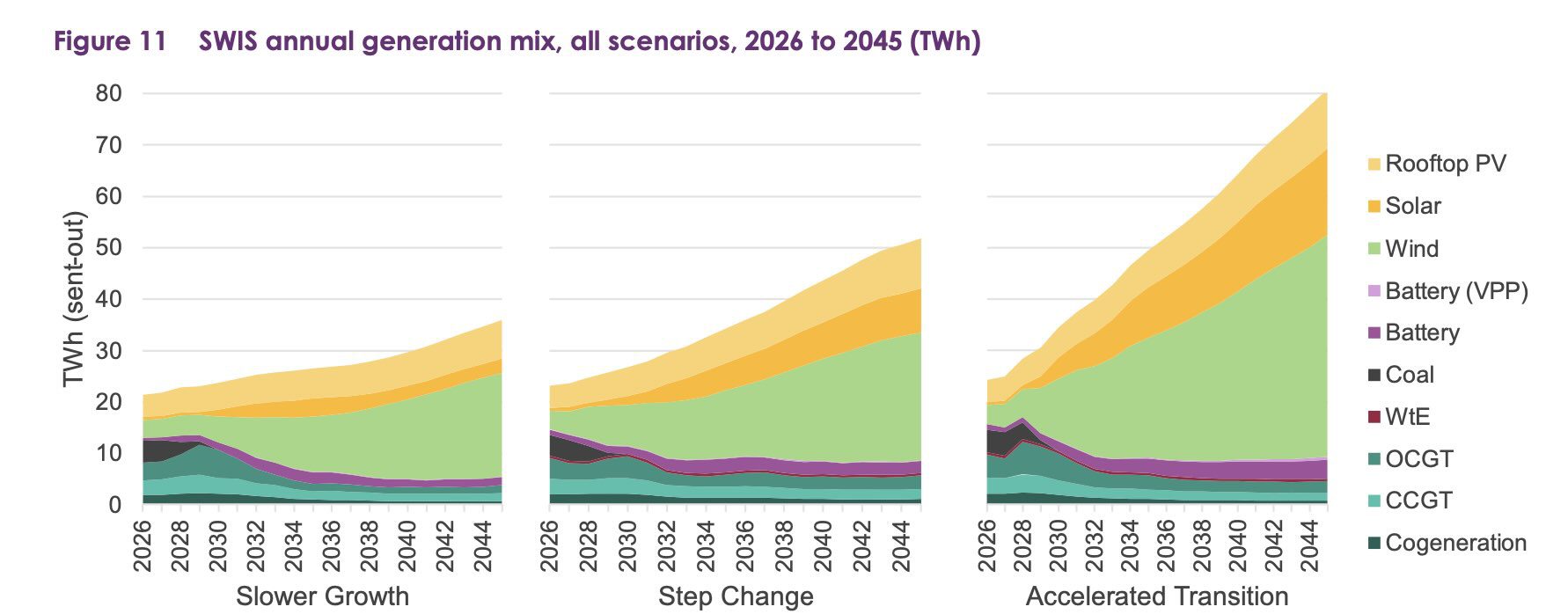
In that time, the W.A. grid will change dramatically, as these graph below illustrate, with an anticipated surge in solar and wind to provide up to 90 per cent of supply in a grid whose demand levels will have at least doubled and maybe quadrupled over that time.
Coal is represented in black in the graphs above, but its future is doomed and it is gone by 2030. Gas has a burst of increased activity in 2030, but its role and the amount of gas needed for power generation rapidly contracts after that, depending on the scenario.
AEMO says that gas’ share of the main grid will fall from 31 per cent in 2026 to just 9 per cent in 2045, with annual gas consumption for power generation to fall from 227 terra joules a day in 2026 to 136 TJ/day in 2035.
This is because annual contributions from large-scale wind and solar generation are forecast to increase from 4.2 terawatt hours (TWh) in 2026 to 33.4 TWh in 2045.
In a way it is similar to South Australia, another grid heavily dependent on both coal and gas, which shuttered its last coal generators in 2016. That led to a brief increase in gas dependency – more than 50 per cent in 2017 – but that has fallen to less than 20 per cent now with the growth of wind, solar and battery storage.
South Australia has an official target of 100 per cent “net renewables” by 2027, although it will still require some gas to manage some day to day volatility, and seasonal droughts. But on occasions it won’t be needed at all.
Western Australia appears to be headed towards 90 per cent renewable (yearly average) by 2045, which would be remarkable for an isolated grid of that size.
AEMO says gas will still be needed to manage day to day volatility, and provide synchronous services,
“Gradually retiring coal generation is forecast to be replaced by committed capacity and forecast new capacity investment from 1 October 2028, which includes VRE (variable renewable energy – wind and solar), battery storage and GPG (gas power generation),” the AEMO document says.
AEMO’s modelling says that over the next 10 years, around 700 megawatts of new gas capacity will be installed, and another 900 MW out to 2045. This compares to the tens of gigawatts of wind, solar and storage over the same period, particularly in the step change and fast transition scenarios.
And most of the new capacity is assumed to replace anticipated retirements, such as the Pinjar power station, and will mostly be focused on peaking plant, which is used rarely and deployed only to help reliability during periods of high volatility or low levels of renewable output.
If you would like to join more than 28,000 others and get the latest clean energy news delivered straight to your inbox, for free, please click here to subscribe to our free daily newsletter.
Claims and promises of carbon offset schemes are falling deep into the category of being…
Australia has just experienced its worst heatwave in six years but it's set to become…
There will be daily cap on the federal government's Shared Solar free power offer, to…
Developer of what was once hailed as the biggest solar hybrid project cuts PV component…
Fortescue wind technology company says its turbines will be the "tallest, mightiest and the widest,"…
Rooftop solar reaches remarkable 117 pct of state demand in Australia's most advanced renewable state,…