Image Credit: APA Group
A new “large” solar, wind and battery proposal for the Pilbara is APA Group’s latest move to carve out a piece of a $33 billion regional energy decarbonisation opportunity.
The company unveiled what it’s calling the Newman Renewable Energy Hub (NREH) this week, located 25km south-east of its namesake town deep in the Pilbara iron ore mining region.
The revelation came after APA signed an Indigenous land use agreement with the Karlka Nyiyaparli Aboriginal Corporation (KNAC), following talks that started in 2021.
But the project is still so early in development it won’t reveal just how much energy and storage capacity it’s considering for the site.
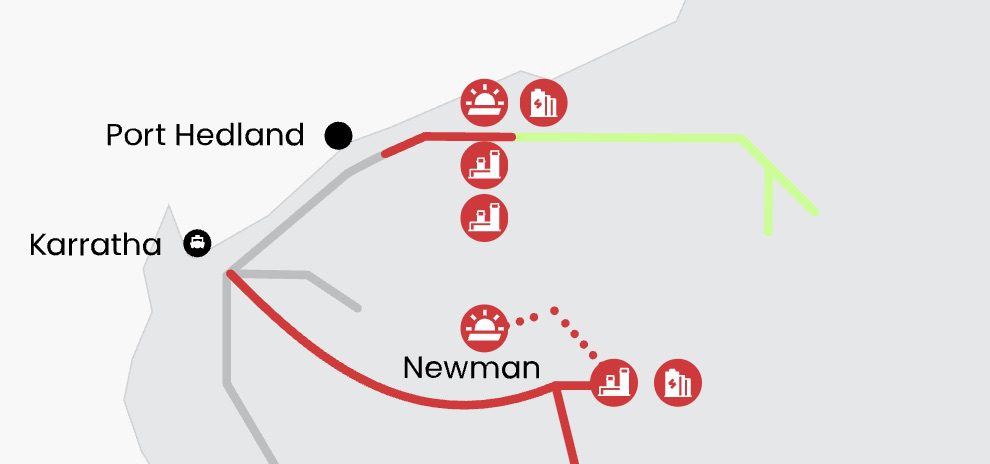
However, already to the south-east of Newman lies the eponymous 300 megawatt (MW) energy hub, a wind project that APA acquired when it bought Alinta’s Pilbara assets in 2023.
Also in the area are APA’s 35 MW, 11 megawatt hour (MWh) Newman battery and the 60 MW Chichester solar farm, which has long been pencilled in for a 30 MW capacity bump.
APA’s Pilbara assets include gas, solar, storage and transmission lines. Image: APA
Although APA has pulled back on its plans for energy infrastructure elsewhere in Australia this year, CEO Adam Watson still sees a big opportunity in the Pilbara.
It was he who put the $33 billion figure on the size of the market for decarbonising mining activities in that region, during the company’s annual results presentation in August.
The company is still committed to building its East Pilbara Network Project (EPN), a “pit to port” common-use electricity transmission line connecting APA’s Port Hedland and Newman gas power stations, and the Burrup (Murujuga) corridor.
APA already has a 4 gigawatt (GW) pipeline of projects in the Pilbara, including the cyclone-proof Port Hedland facility which combines a 45 MW solar farm and a 36.5 MWh battery, partly thanks to its acquisition of a more than 1 GW portfolio of operating and development assets from Alinta.
The Pilbara is in need of not only a coordinated backbone of transmission, but significant new energy resources if companies and governments want to turn dreams of emissions-free shipping and green iron ore into a reality.
And there are no shortage of proposals to do this.
Fortescue has its 2.1 GW East Pilbara and 2.1 GW Bonney Downs wind projects, while Philippines company Acen is backing the 3 GW Yindjibarndi project which takes in an area of 13,000 square kilometres.
And this week the Ngarluma Aboriginal Corporation (NAC) published a proposal for a 5 GW energy park on land in its native title determination, stretching across much of the coastal areas in the western Pilbara region and includes the coastal towns Karratha, Roebourne, Wickham, Cape Lambert, and out to Whim Creek.
Then there’s the 6 GW Wallareenya solar and wind energy hub, which is being pitched by a company called SP Energy and is yet to submit any planning paperwork.
But the Pilbara is also proving to be something of a graveyard for mega-project ambitions as well.
Last year Macquarie, and then BP in July, pulled out of the gargantuan Australian Renewable Energy Hub (AREH).
The backers proposed to build 26 GW of solar and wind by 2029.
The Asian Renewable Energy Hub, as it was first known, was roundly rejected by then-environment minister Sussan Ley as being “clearly unacceptable” under the EPBC.
Fortescue dumped its plans to build the 5.4 GW Uaroo wind and solar project in 2023, as it became clear that an ammonia export business was unlikely to pan out in the medium future.
And the 12 GW HyEnergy project near Carnarvon was killed in 2024, with the backer Province Resources blaming the government for the loss.
However, given the company had no assets and was not close to having the kind of financial heft of an Intercontinental Energy, a CWP Global, or an Acen Renewables, it was something of a hail Mary project anyway.
Electricity retailers with their own version of Solar Sharer consistently offer bigger power bill savings…
Sea surface temperatures are now way ahead of previous levels at this time of the…
When Greens elder Bob Brown addressed a throng of forest campaigners on Saturday, he did…
One of Australia's landmark renewable energy "gen-tailers" is reportedly up for sale, with its major…
Large-scale solar curtailment was "reduced significantly" in August as batteries help prevent electrons from going…
Seven home battery models from one of the up and coming new budget brands on…